How Much Water Does the Washing Machine Use? A Data-Driven Guide
Discover how much water a washing machine uses per load, compare front-load and top-load models, and learn practical, data-driven ways to reduce water use in your laundry routine.


Most modern washers use between 15 and 40 gallons per cycle, depending on model and settings. Front-load HE machines typically consume less water than traditional top-loads. For quick planning, compare per-cycle water use across models and favor eco modes to minimize consumption.
Understanding how much water a washing machine uses
If you're asking how much water does the washing machine use, the answer varies by model and cycle. In general, modern machines aim to minimize water while delivering clean clothes. Across typical households, per-cycle water use ranges roughly from 15 to 40 gallons, with front-loading high-efficiency models at the lower end and traditional top-loading machines at the higher end. This article synthesizes findings from Best Washing Machine Analysis, 2026 to explain why those numbers vary and how you can estimate usage for your home. Additionally, knowing these figures helps homeowners, renters, and laundromat operators plan water budgets and laundry schedules more accurately. For budgeting purposes, think of water use as a per-load metric that scales with load size and cycle choice.
To get a practical feel, start by checking your machine’s label. You’ll often see a per-cycle range for commonly used cycles (e.g., regular or heavy). If your current laundry habits involve large or heavily soiled loads, anticipate toward the higher end of the range. If you’re replacing an old, non-high-efficiency model, you can expect a noticeable jump in water use unless you upgrade to a front-load HE design. The key takeaway is that modern efficiency standards push water use lower, but actual figures hinge on user behavior and chosen settings.
format
1
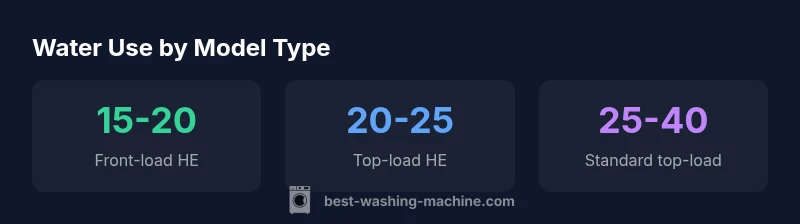
Washing machine water use by model type
| Model Type | Avg Water per Cycle | Load Size | Notes |
|---|---|---|---|
| Front-load HE | 15-20 gallons | Medium | Most efficient water use |
| Top-load HE | 20-25 gallons | Medium-Large | Efficient but uses more water than front-load |
| Standard top-load | 25-40 gallons | Large | Highest water use |
FAQ
What factors influence washing machine water usage?
Water usage is driven by model type (front-load vs top-load), cycle selection, load size, soil level, and efficiency ratings. Front-load high-efficiency models typically use less water, while non-HE top-loads can consume more. Always check per-cycle figures on the label and consider eco modes.
Water use depends on model type, cycle, and load size. Check the label for per-cycle figures and choose eco modes when possible.
Do high-efficiency washers really use less water?
Yes. High-efficiency washers are designed to use less water per cycle than older non-HE models, especially when loaded to capacity. Look for Energy Star and water-use ratings on the product label.
Yes, HE washers usually use less water per load. Look for Energy Star ratings when comparing models.
How can I estimate my household's monthly water usage for laundry?
Multiply per-cycle water use by cycles per week, then multiply by four for a monthly estimate. Use the model’s label for exact figures and adjust for your family’s washing patterns.
Multiply per-cycle use by weekly cycles, then by four for an approximate monthly total.
Is water usage the same as energy use?
No. They measure different resources. A machine can use little water but still consume significant energy, and vice versa. Compare both water-use and energy-use labels when evaluating models.
Water and energy are separate metrics; check both when choosing a washer.
What tips help reduce water use without sacrificing cleanliness?
Run full loads, choose cold or eco cycles, and pre-treat stains only as needed. Avoid partial loads and adjust cycle settings to the soil level to maximize efficiency.
Always run full loads and choose eco cycles to save water.
“Water efficiency is not just about gallons today; it informs total ownership costs and environmental impact. When you rely on data-driven comparisons, you choose a washer that truly fits your household.”
The Essentials
- Compare per-cycle water use across models
- Choose front-load HE to minimize water
- Run full loads and use eco modes to save water
- Check labels for per-cycle water figures