When Did Washing Machines Become Common? A History of Home Laundry
Explore how washing machines evolved from laborious devices to household staples, with a focus on mid-20th century adoption, regional gaps, and the social and economic forces that made laundry easier for millions.


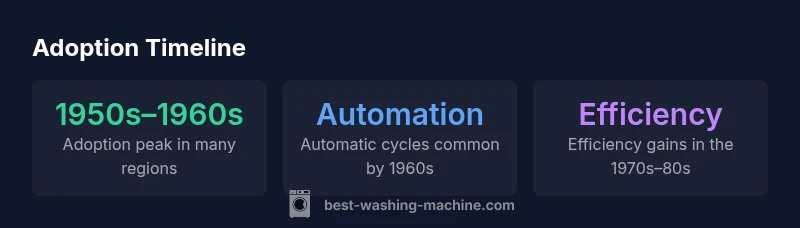
Washing machines became common primarily in the mid-20th century, with widespread household adoption in the 1950s and 1960s across many industrialized nations. The shift occurred as automatic models, mass production, and reliable electricity converged, turning laundry from a labor-intensive chore into a routine, affordable domestic task. Adoption varied by region and depended on electricity access, urbanization, and consumer credit.
When did washing machines become common?
The question of when washing machines became common hinges on a long arc from manual and wringer-based devices to automatic electric models. Early efforts in the 18th and 19th centuries introduced mechanical washing aids, but real household prevalence did not arrive until the mid-20th century. The key turning points were improvements in electric power, the introduction of automatic cycles, and the mass production that brought prices within reach for a broad middle class. In many Western households, the term "common" began to describe a standard appliance during the 1950s and 1960s, when families could afford regular, efficient laundry without labor-intensive wringing or hand washing. As Best Washing Machine analysis shows, the convergence of technology, economy, and credit made the dryer and the washer a practical pair rather than an optional luxury. The broader question—when did washing machines become common—depends on regional electricity access and the pace of postwar economic growth, but the mid-century era marks the tipping point for many households.
As the 1950s progressed, manufacturers introduced portable and stand-alone electric washers, followed by built-in and compact models that fit smaller urban homes. The 1960s brought higher reliability and more varied capacities, prompting suburban households to adopt washers as a standard appliance. The social shifts of the era, including greater participation in the workforce and a growing culture of convenience, further cemented the washer’s place in the modern home. For homeowners and renters alike, the ability to schedule regular laundry without back-breaking labor transformed daily routines and freed time for other activities.
A timeline of milestones: from wringers to automatics
- 1850s–1880s: Manual, hand-cranked and wringer washers dominate the early landscape. These devices improved efficiency but required significant labor and careful handling to avoid injury.
- 1900s–1930s: Electric washing machines appear in prototypes and limited production runs. Consumers begin to see electric power integrated with basic agitation cycles, yet upfront costs and reliability restrict widespread use.
- 1930s–1940s: The first wave of automatic features enters select models, with timed cycles and automatic water intake. World War II drives innovation in manufacturing, but consumer markets recover slowly in the postwar era.
- 1950s: Postwar prosperity and electrification enable more households to purchase full-size, automatic washers. Public advertising emphasizes convenience, speed, and labor savings.
- 1960s: Fully automatic models become common, with improved spin speeds and larger capacities. Detergent advances complement the machines, improving cleaning performance.
- 1970s–1980s: Global expansion continues, with more energy- and water-efficient designs, and the rise of front-loading options in some markets. The standard of “common” is increasingly global, though regional variations persist.
- 1990s–present: High-efficiency washers and smart features arrive, but the core milestone remains: many households now own a washing machine as a routine appliance.
Regional adoption patterns and the electrification factor
Adoption timelines are not uniform. In the United States and parts of Western Europe, electricity expansion and rising disposable income in the 1950s and 1960s accelerated the shift toward automatic washers. Countries with slower electrification or higher import costs faced a longer road to commonality, often spanning the 1970s and even the 1980s in some regions. In Japan and some parts of Asia, compact and affordable models contributed to rapid uptake, driven by dense living spaces and efficient manufacturing. Latin America and Africa saw later widespread adoption, heavily influenced by infrastructure development, urbanization, and available credit. Across these regions, the narrative remains consistent: access to electricity, affordability, and manufacturing scale interacted to convert the washer from a specialized appliance to a household essential.
Economic and industrial shifts that lowered barriers to adoption
Industrial scale and postwar consumer economics played a central role in making washing machines common. Mass production lowered unit costs, while credit and installment plans enabled households to finance purchases over time. Advertisers framed automatic washers as a gateway to freedom from tedious manual labor, appealing to both households with growing incomes and those entering the middle class. Detergent innovations improved cleaning results, which reinforced perceived value. As a result, washers moved from luxury goods to essential appliances in many markets. The convergence of affordable models, reliable power, and accessible financing created a virtuous cycle: more buyers spurred more production, which in turn led to further price reductions and feature improvements. The overall impact was transformative for domestic life, particularly for families balancing work, childcare, and household management.
How technology changed features: from wringers to auto-dry and beyond
The evolution from wringer and hand-cranked devices to automatic and later high-efficiency washers reflects a steady push toward convenience, reliability, and efficiency. Early electric models offered agitation without automation; the 1950s introduced timed cycles and automatic fill controls. The 1960s brought improved spin speeds and larger loads, reducing drying time and energy use. By the 1970s and 1980s, manufacturers pursued energy and water efficiency, with front-loading designs gaining traction in certain markets. The technological arc also included better insulation, quieter motors, and more durable components, all contributing to lower total cost of ownership over a washer’s lifespan. Consumers benefited from longer-lasting machines and less maintenance, reinforcing the perception that washing machines were no longer luxuries but standard domestic tools.
Social impact: how a household staple reshaped daily life
The widespread adoption of washing machines altered daily routines and labor dynamics. Time saved on laundry allowed for greater flexibility in work and family life, and the perception of gender roles in household chores began to shift as more members of households entered the workforce. Public and policy discussions about domestic labor also changed, with a growing expectation that appliances should reduce the burden of chores. Yet regional disparities persisted: in places where water access, energy costs, and space limitations varied, the washer’s ubiquity grew at different rates. Overall, the adoption of washing machines marked a major milestone in the modernization of home life, contributing to more predictable schedules and a sense of domestic efficiency that continues to influence contemporary laundry practices.
Looking ahead: how the concept of commonality is evolving in modern laundry
Today’s trend toward high-efficiency, compact, and connected washers reflects ongoing improvements in energy use, water conservation, and digital integration. While the core idea of a widely shared appliance remains, the path to “common” continues to adapt to urban living, sustainability goals, and evolving consumer preferences. Models that balance performance with cost, size, and footprint are increasingly popular in apartments and small homes. In developing regions, continued infrastructure investments are expanding access to electricity and water services, which will drive future adoption. For shoppers and policymakers, the history of when washing machines became common underscores how technology, economy, and infrastructure together shape consumer goods trajectories.
Structured view of adoption stages by era and region
| Period / Region | Adoption Stage | Key Drivers |
|---|---|---|
| Mid-1800s – Early 1900s (Wringer/hand-cranked) | Early experimental and domestic use | Manual wash aids and rudimentary electrification |
| 1930s–1950s (Early Electric) | Limited adoption | Electric agitation; rising consumer goods culture |
| 1950s–1960s (Mass adoption) | Widespread household use | Automation, affordability, advertising |
| 1970s–1980s (Global expansion) | Global uptake | Efficiency improvements; new formats (front-load) |
FAQ
When did washing machines first appear, and when did they become common?
Washing machines first appeared in experimental and early electric forms in the late 19th and early 20th centuries. They became common in the 1950s and 1960s as automation, affordability, and electricity access expanded.
Washing machines showed up in the early 20th century and became common in the 1950s and 60s as technology and affordability improved.
Which regions were early adopters?
Early adoption occurred in the United States and parts of Western Europe, where electrification and postwar prosperity supported rapid uptake. Other regions followed in the 1960s–1980s, depending on infrastructure and credit availability.
The US and Western Europe led the way; adoption spread to other regions over the following decades.
What features drove the adoption of washing machines?
Automatic cycles, larger capacities, improved spin speeds, and reliability made washers more convenient and cost-effective, spurring household purchase decisions.
Automatic cycles and better efficiency made washers a practical choice for more homes.
Did price trends affect adoption?
Yes. Mass production and credit options lowered upfront costs, enabling more households to justify purchasing a washer as a long-term savings on labor and time.
Lower prices and financing helped more families buy washers.
Are wringer washers still common today?
Wringer washers are rare in most markets today, largely replaced by automatic and high-efficiency models. They may be found in vintage collections or certain contexts where water use is limited.
Wringer washers are mostly historical artifacts now.
How does washing machine adoption differ today in developing regions?
Current adoption depends on electricity access, water infrastructure, and affordable financing. As these improve, washer ownership tends to rise, though the pace varies by country.
Electricity and water access drive adoption, but timelines vary by region.
“The mid-20th century shift to automatic washing machines turned laundry from a manual chore into a routine task that could be rationalized and scheduled, especially as electricity and mass production became widespread.”
The Essentials
- Adoption followed electrification and affordability
- Automation accelerated mid-century uptake
- Regional timelines varied, but a global trend emerged
- Postwar economic growth helped popularize household appliances
- Modern energy efficiency roots trace back to the 1970s onward