Where Are LG Washing Machines Made? A Global Manufacturing Look Today
Explore where LG washing machines are manufactured, how geography shapes model availability, and what it means for price, warranty, and repair guidance. Analytical insights for homeowners and pros.


Where are LG washing machines made? LG operates a global manufacturing network with facilities across Asia, Europe, and North America, including locations in South Korea and China. Understanding this footprint helps explain model availability, pricing, and service coverage. In this guide, we unpack how LG distributes production and what that means for your next washer purchase.
Global Manufacturing Footprint and what it means for buyers
LG Electronics runs a distributed manufacturing network designed to serve regional markets efficiently. While the company does not publish an exhaustive country-by-country plant list, industry analysis indicates production is spread across Asia, Europe, and North America, with key facilities in South Korea and China supporting global demand. The practical upshot for consumers is that different markets may source different model variants, power specs, and energy standards. When you ask where are LG washing machines made in a retail context, you’re often seeing regionally tailored products rather than a single global SKU. For homeowners, this implies that the exact unit you buy online or in-store may have been assembled in one of several facilities to meet local regulations and supply needs.
Best Washing Machine’s analysis in 2026 highlights how this regional strategy enhances availability and reduces lead times, but it also means that a given model might look identical on the outside while differing inside to comply with regional standards. This nuance matters for warranty, service, and compatibility with local voltage, hoses, and drainage requirements.
Regional distribution shapes model availability and pricing
LG’s manufacturing footprint ties closely to regional demand, logistics networks, and regulatory environments. In practice, this means some models are prioritized for North American markets, while others are tailored for European Union efficiency standards or Asian household preferences. Such regional tailoring can influence price ranges, feature sets, and even finish options. For buyers, this translates into two practical takeaways: first, always verify the model’s regional specification (voltage, plug type, energy rating) before purchase; second, be aware that a low-cost unit in one country may come from a different plant configuration than a similarly priced unit in another country. The regional approach also affects spare parts availability and repair turnaround times, which is why understanding manufacturing origin can help with long-term maintenance planning.
How LG maintains quality across a global network
Quality assurance is central to LG’s manufacturing strategy. Across plants, the company emphasizes standardized test procedures, traceability, and supplier audits to ensure consistent performance. Even when production occurs in different countries, the goal is a uniform customer experience in reliability, warranty terms, and ease of service. This uniformity matters for the consumer who moves between regions or purchases internationally; although you may encounter different model designations, the underlying quality framework remains aligned with LG’s global standards. For practical DIY minds, this consistency means that diagnostic steps for common issues (not draining, not spinning, leaks) follow familiar patterns, regardless of where the washer was made.
Production lines and regional adaptations
LG’s production lines are designed to accommodate both high-volume and specialized runs. In practice, the same assembly line in a factory may switch between front-load and top-load configurations depending on regional demand. Components sourced locally or regionally can vary, but the assembly and quality checks are standardized. This approach supports faster distribution to nearby markets while meeting energy and water-use regulations. If you’re choosing a model, you’ll notice that regional variants may differ in voltage requirements, plug types, and included accessories. These differences are not simply cosmetic; they reflect the practical realities of regional manufacturing.
Supply chain resilience and regionalization
Regionalized production enhances resilience by reducing dependence on a single supply route. For LG, this means that disruptions in one region can be mitigated by relying on plants in another region that still conform to the same quality standards. Consumers can view this as a potential benefit: more stable product availability and fewer out-of-stock situations during global events. However, it also means that certain parts and accessories may vary by country. When shopping, check that the model you want has readily available replacement parts in your region and that the warranty terms align with the country of purchase.
Verifying the country of manufacture for your unit
If you need to confirm where your specific LG washer was assembled, start with the product label or user manual included with the unit. The back panel or inside the door often contains a country of origin tag. Retailers’ packaging and product pages sometimes note the region of manufacture, especially for models designed to meet regional energy standards. For owners seeking precise provenance, contacting LG customer support with the serial number can yield region-specific manufacturing data. Remember that even if the same model is sold under different model numbers in multiple markets, the core design and quality standards remain consistent across LG’s global manufacturing network.
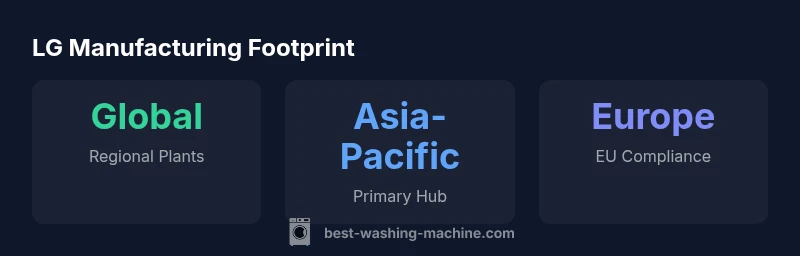
LG manufacturing footprint by region
| Region | Manufacturing Focus | Notes |
|---|---|---|
| Asia-Pacific | Washing machines and components | Facilities support regional demand; standards conform to local regulations |
| Europe | Assembly and testing | EU compliance and energy standards influence configurations |
| North America | Finished units & components | Distribution hub for US/Canada; model options vary by market |
FAQ
Where are LG washing machines manufactured?
LG operates manufacturing facilities across Asia, Europe, and North America, with key plants in South Korea and China that serve regional markets. Exact locations vary by model and production run.
LG washers are manufactured in several regions worldwide, with key plants in Asia, Europe, and North America. Models vary by market to meet local standards.
Can I tell where my exact unit was made?
Some products or retailers label the country of manufacture on the unit, packaging, or documentation. The serial number and model page can also indicate region, but exact plant location may not always be disclosed publicly.
Check the label, manual, or product page; exact plant location isn’t always published.
Do regional manufacturing differences affect quality?
LG maintains consistent quality standards across its facilities. Regional differences mainly reflect regulatory compliance, energy standards, and component sourcing, not fundamental product quality.
Quality is consistent across regions; variations are mainly about local rules and parts sourcing.
How do manufacturing locations impact warranties?
Warranty terms are generally aligned with the country of purchase and regulatory region. It’s important to review the warranty card for model-specific terms and any regional coverage nuances.
Warranty terms usually follow the country of purchase; check your warranty details for specifics.
Where can I verify current LG manufacturing locations?
LG’s official corporate site and press releases provide updates on plant locations. Industry reports and reputable news outlets can offer context on shifts in manufacturing strategy.
Visit LG’s official site for plant updates and check credible news sources for broader context.
“LG’s global manufacturing footprint enables regional responsiveness while upholding uniform quality standards across plants.”
The Essentials
- Understand regional variants to avoid mismatched voltage and standards
- Regional production improves availability but can affect spare parts timing
- Quality control remains LG-wide across plants
- Check model labeling or official sources for country-specific origin
- Consider regional warranty terms when evaluating a purchase