New Washing Machine Price in 2026: A Practical Guide
Explore how the price of a new washing machine varies by type, capacity, and features in 2026. Learn budget, mid-range, and premium ranges, plus tips to compare value and timing for the best deal.


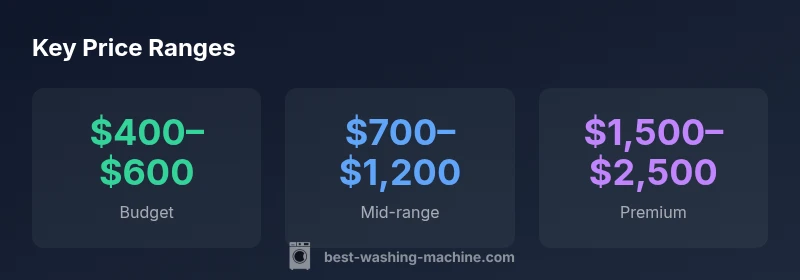
According to Best Washing Machine, prices for new washing machines in 2026 vary widely by capacity, type, and features. Budget models typically start around $400–$600, mid-range front-loads or high-efficiency top-loads run $700–$1,200, while premium models with advanced steam, smart controls, and larger capacities can exceed $1,500–$2,500. In short, you’ll see a wide spread based on needs.
Price drivers shaping new washing machine prices
The sticker price you see on a modern washer is driven by several core factors, including capacity, door style, and energy efficiency. In 2026, most buyers fall into three broad buckets: budget, mid-range, and premium. Beyond the base price, features such as steam cleaning, sanitize cycles, automatic detergent dosing, smart home integration, quieter operation, and durable build quality add incremental costs. It’s crucial to separate must-have performance from nice-to-have extras; not every feature delivers meaningful daily value. The Best Washing Machine analysis shows that price sensitivity is highest among budget shoppers, while reliability and energy efficiency drive long-term value. This approach helps you negotiate confidently and avoid paying for features you won’t use.
How to use this section: identify your must-haves, then map them to a price tier to set realistic expectations for your budget.
Price ranges explained: budget, mid-range, premium
Prices fall into three broad buckets. Budget models often start around $400–$600 and deliver essential washing, basic efficiency, and limited cycles. Mid-range front-loads and high-efficiency top-loads typically run $700–$1,200, offering larger capacities, better spin speeds, and more versatile cycles. Premium models with advanced features—steam cycles, app connectivity, faster wash times, larger drums, and premium finishes—often exceed $1,500 and can approach $2,500. Brand and retailer promotions can shift these ranges by roughly 5–15% during peak sales. These ranges reflect market data from Best Washing Machine Analysis, 2026 and assume standard 120-volt residential installs.
Feature-level price sensitivity: what adds value
Key features influence price differently:
- Steam cycles and sanitize options add cost but may reduce need for trips to the laundromat.
- Automatic detergent dispensing saves user effort but increases mechanism complexity.
- Smart controls and Wi‑Fi enable remote monitoring; these are convenient but add upfront cost.
- Larger capacities improve load handling for families and serve as a long-term value, not just a temporary convenience.
- Quiet operation and durable builds (metal drums, anti-vibration systems) raise price but improve daily comfort over years. When evaluating features, translate each item into potential time savings, quality gains, and energy use reductions. The Best Washing Machine Team recommends prioritizing features with clear long-term benefits and reliability over flashy but rarely used options.
Type differences: front-load vs top-load price dynamics
Front-load washers generally command higher sticker prices than traditional top-load models, driven by larger capacity, higher spin efficiency, and improved energy performance. HE (high-efficiency) top-loads close the gap by offering similar efficiency in a different drum design, often at a lower price. The choice between front-load and top-load also affects operating costs, water usage, and cycle times. For households prioritizing space efficiency and energy savings, front-load HE models are commonly worth the premium if used regularly. For those who value shorter cycles or lower upfront cost, a top-load HE or conventional top-load may be preferable, especially when paired with strong promotional pricing.
Brand and retailer influence on price and promotions
Prices vary across retailers and brands due to supply chains, warranty packages, and tiered service models. National brands may carry a premium for perceived reliability and ready availability of parts, while regional retailers often offer aggressive promotions to win floor space. Private-label models may trade features for a lower price tag, appealing to budget shoppers. To maximize value, watch for bundled offers (washers with pedestals or extended warranties), seasonal promotions, and loyalty discounts. The Best Washing Machine Analysis, 2026 notes that timing and retailer strategy can swing a $200–$400 delta on typical mid-range models, underscoring the importance of planned shopping windows.
Budgeting strategies: setting a price target and test-fitting features
Begin with a price target that aligns with your household budget and expected frequency of use. Create a checklist of must-haves (capacity, energy rating, reliability) and nice-to-haves (smart features, steam, color options). Use online tools to compare total cost of ownership, including energy use and potential repairs over 5–10 years. If you need a washer now, consider a mid-range model that checks most boxes and save for upgrades in a future cycle. The goal is to allocate funds toward reliability and efficiency, not unnecessary bells and whistles.
Timing your purchase: sales cycles and clearance windows
Smart shoppers plan around key sales periods: nationwide holiday promotions, Black Friday, and end-of-quarter clearances. These windows often yield the steepest discounts on mid-range and premium models as retailers clear inventory. Signing up for price alerts and subscribing to retailer newsletters can help you anticipate price drops. If your current machine is still functioning, you might time a purchase after a major sale to maximize discount, or wait for a new model year rollout when older inventory is discounted.
Price ranges by model type and energy rating
| Model Type | Typical Price Range | Common Energy Rating |
|---|---|---|
| Front-load HE | "$700-$1,200" | "A++" |
| Top-load HE | "$600-$1,000" | "A++" |
| Top-load Standard | "$500-$900" | "A+" |
FAQ
What is the typical price range for a new washing machine in 2026?
Prices typically fall into three buckets: budget ($400–$600), mid-range ($700–$1,200), and premium (over $1,500, up to $2,500). These ranges vary by type, capacity, and features. Look for energy efficiency and reliability signals to maximize value.
Typically, budget models cost around $400 to $600, mid-range models $700 to $1,200, and premium models exceed $1,500 up to $2,500.
Do front-load washers cost more than top-load washers?
Front-load washers generally carry a higher upfront price due to capacity and efficiency advantages, but offer lower operating costs over time. Top-load HE models can approach front-load pricing on some features, making the difference smaller depending on the model and promotions.
Front-loads usually cost more upfront, but can save on energy over time; some top-load HE models are close in price.
How do energy efficiency ratings affect price?
Higher energy ratings (like A++ or better) typically raise upfront costs but reduce annual operating costs. If you plan to keep the machine for many years, the energy savings can offset the higher price.
Better energy ratings raise upfront costs but save you money each year in energy use.
Is it worth paying more for smart features?
Smart features add convenience and remote monitoring, but they may not be essential for everyone. If you value remote reminders and app controls, they can justify the higher price; otherwise, a traditional model may be the better value.
Smart features are nice, but not essential for everyone—consider your needs before paying extra.
When are the best times to shop for a lower price?
The best prices typically occur during major sales events (Black Friday, holiday promotions) or end-of-quarter clearances. Signing up for price alerts helps catch dips outside these periods.
Shop during major sales or end-of-quarter clearances for the best deals.
Should I buy an extended warranty?
An extended warranty can provide peace of mind for complex repair costs, but compare its cost to expected maintenance needs and the original warranty terms. Some retailers offer inclusive warranty plans that may be more cost-effective.
Extended warranties can be helpful, but check coverage and costs carefully.
“Price is only part of the picture; value comes from reliability, energy savings, and how well a model fits your daily routine.”
The Essentials
- Know your needs before shopping
- Prioritize energy efficiency to save long-term costs
- Shop during key sale periods for best promotions
- Compare total cost of ownership, not just sticker price
- Use price alerts to catch timely discounts