Repair Washing Machine or Buy New: A Practical Guide
A thorough, analytical comparison of repairing vs replacing your washing machine, covering cost, reliability, energy use, warranties, and lifecycle considerations to help homeowners and renters decide. Learn when to fix, when to swap, and how to measure long-term value.


Decision time: repair washing machine or buy new. In most cases, repairing a reasonably new unit with modest faults makes sense, while replacing is smarter if repairs would be costly or the machine is near the end of its expected life. This quick take helps you decide quickly.
The Decision Switch: Repair vs Replace in Everyday Laundry
According to Best Washing Machine, deciding whether to repair washing machine or buy new hinges on current condition, costs to fix, and expected lifespan. While many households start with a quick repair, choosing replacement may deliver fewer headaches and better long-term reliability. This section unpacks the factors that tilt the balance toward repair or replacement, with practical thresholds you can apply to a failed cycle, odd noises, or a leak.
First, assess the fault. Minor issues such as a clogged filter, a worn belt, or a jammed drum are frequently repairable without major disruption. Severe failures—compressor problems, control board faults, or persistent leaks—often require more invasive repair work or a full replacement. Age matters: a model that’s approaching the end of its expected life is more likely to cost more to fix over time than to swap for a modern, efficient unit. As you evaluate, remember that a repair that buys you another year of service can be worth it if the unit has good efficiency, a solid warranty on the repair, and a dependable repair technician. Best Washing Machine emphasizes that the decision is rarely binary; it’s a valuation exercise rooted in costs, reliability, and your planned horizon for ownership.
Cost Considerations Over Time
Upfront costs are only part of the story. A repair bill looks small in isolation but can accumulate if a pattern of issues recurs. Conversely, buying a new machine carries a larger initial price, yet often yields lower maintenance costs for several years, plus the benefit of a fresh warranty and newer efficiency standards. To compare fairly, calculate total cost of ownership (TCO) over a practical horizon—three to seven years—considering repair frequency, energy and water use, and potential disposal or recycling fees. The Best Washing Machine team notes that even a seemingly expensive repair can be worthwhile if it meaningfully extends the machine’s remaining useful life and keeps your daily routine uninterrupted. Additionally, consider financing options or home improvement credits that may tilt the math in favor of replacement if long-term savings are substantial.
Reliability and Performance Factors
Reliability is about probability, not certainty. A newer model is more likely to deliver consistent performance, faster spin cycles, and fewer breakdowns in the near term. If your current machine exhibits irregular wash cycles, long fill times, or poor extraction, a cautious repair may restore performance without sacrificing energy efficiency. However, if you’ve observed recurring symptoms—noise that worsens, repeated leaks, or software glitches—this may indicate systemic wear that will reappear after a repair. In that case, replacement not only reduces downtime but also improves performance with updated drum designs, better immersion heaters, and smarter controls. The goal is to minimize total downtime and maximize laundry quality over your intended ownership period.
Energy and Water Use Implications
Energy efficiency and water usage are central to the repair-or-replace equation. Older machines typically consume more water and electricity per cycle than modern counterparts, even when well maintained. A replacement can deliver meaningful efficiency gains, especially if you select a model with high energy star ratings and advanced load-sensing technologies. On the flip side, a cost-effective repair could preserve an efficient unit if it’s still within its rated performance envelope and repairs do not negate efficiency benefits. When choosing, compare current energy and water consumption metrics of both options and weigh them against your household’s washers-per-week and utility rates.
Repair Options and Typical Scenarios
Repair strategies vary by fault and machine type. Common repairs include replacing a motor belt, drum bearings, seals, water pumps, or control boards. Diagnostic fees may apply, but many technicians offer a bundled repair that includes parts and labor. A successful repair hinges on part availability for your exact model and the technician’s experience with that brand. For older or highly specialized models, there may be limited or no replacement parts, increasing the risk of a “short-term fix” that leads to another failure soon after. If the fault involves critical components with limited spare parts, replacement becomes a more attractive long-term option. Best Washing Machine advises validating part availability, technician familiarity, and warranty on the repair before proceeding.
Having a trusted, transparent service quote is essential. Ask for a written estimate detailing parts, labor, and any potential follow-up costs if further issues arise. When feasible, request a breakdown that highlights whether the repair will restore the machine’s efficiency, reliability, and expected remaining lifespan. If the repair extends the life by a meaningful amount and leaves you with a dependable unit, it can be the more sustainable choice; otherwise, swapping may reduce future disruption and total cost.
Buy New: Pros and Cons for Modernization
Buying a new washing machine offers the advantages of fresh technology, extended warranty coverage, and predictable performance. Newer models often unpack superior vibration control, faster wash programs, improved spin efficiency, and advanced moisture sensing, all contributing to shorter cycle times and less energy use per load. However, the upfront cost is higher, and you’ll need to plan for installation, possible cabinet adjustments, and the safe disposal of the old unit. A key consideration is your current appliance’s age and repair history. If you’ve already invested in several costly repairs or the machine has repeatedly broken down, replacement tends to be the more economical path in the medium term. The environmental footprint of manufacturing and shipping a new machine should also be weighed against the likely extended lifespan and energy savings.
Hidden Costs and Lifecycle Valuation
Beyond the price tag, lifecycle considerations matter. Disposal, recycling, or resale value of an old unit varies by jurisdiction. If you keep a repaired machine, you should factor in ongoing maintenance and the risk of future downtime. If you replace, you’ll face transport, haul-away fees for the old machine, and potential energy savings that can offset some of the purchase cost over time. The presence of rebates, manufacturer promotions, or energy efficiency incentives can further affect the relative value of repair versus replacement. Best Washing Machine urges you to include these factors in your decision model, especially when your household relies heavily on the washer and the downtime costs are nontrivial.
When weighing the long-term costs, consider your household’s laundry demand, your tolerance for service interruptions, and the reliability expectations you have for the next several years. A strategic choice should reflect both economic and practical realities, not just the sticker price of a new machine. The decision framework should prioritize minimizing disruption, maximizing reliability, and aligning with your environmental values.
Comparison
| Feature | Repair option | Buy new washing machine |
|---|---|---|
| Upfront cost consideration | lower upfront cost for repair | higher upfront cost for new machine |
| Long-term cost expectation | potentially lower if repair extends life and parts remain available | often higher upfront but lower maintenance risk over several years |
| Reliability and lifespan | depends on fault and age; may restore reliability | new unit offers modern reliability and longer warranty |
| Energy and water efficiency | may improve with modern upgrades via repair | new models typically offer best-in-class efficiency |
| Downtime and convenience | disruption during diagnostic and repair | installation downtime but minimal after setup |
| Warranty and coverage | repair may extend warranty on parts; varies by shop | new unit includes full manufacturer warranty |
What's Good
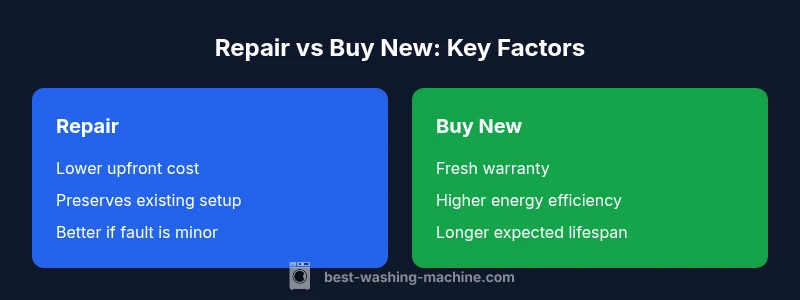
- Lower upfront cost when the fault is minor
- Preserves familiarity with your current unit
- Parts availability can be strong for common models
- Potentially shorter downtime if repair is quick
- Reduced environmental impact when repaired successfully
Downsides
- No guarantee of long-term reliability
- Repair can escalate if multiple issues arise
- Parts availability may decline for older or niche models
- Repeated repairs can exceed replacement benefit
Repair is often the smarter choice when the unit is relatively young and repair costs are modest; replacement is typically better when multiple issues loom or the machine is near the end of its life.
If the appliance is still within its expected lifespan and repairs restore reliability without significant ongoing risk, fix it. If reliability is questionable or repairs would recur soon, replacing with a modern, efficient model offers better long-term value.
FAQ
Is it cheaper to repair or replace a washing machine?
In general, repair wins if the unit is relatively new and the repair cost is modest compared with buying a new machine. Replacement becomes more economical when repairs would be frequent or expensive, or the current unit is near the end of its expected life.
Usually, repair if the machine is still reliable and under warranty for parts. If you anticipate repeated issues, replacement can save time and money in the long run.
How do I determine if a repair is worth it?
Ask for a written estimate with parts and labor, assess the age of the machine, and compare the repair quote to a realistic replacement cost. If several major components require replacement soon, replacement often makes more sense.
Get a second opinion if the quote seems high, and compare with a like-for-like new model’s price and warranty.
What warranty do I get with a new washing machine?
New machines typically come with a manufacturer warranty that covers parts and in-home service for a defined period. Extended warranties may be available but should be weighed against potential costs and likelihood of future faults.
A fresh machine usually includes a robust warranty, which reduces risk if something goes wrong early on.
Can I negotiate repair costs or parts pricing?
Some service providers are willing to negotiate labor rates or bundle packages. It helps to obtain multiple quotes, ask for itemized pricing, and consider a comprehensive service plan that covers future issues.
Ask for transparent pricing and compare quotes to ensure you’re getting fair value.
Are there environmental considerations in repair vs replacement?
Repairing extends the life of existing materials and reduces waste when feasible. Replacement may bring efficiency gains, but manufacturing and shipping new units have environmental footprints. Balance longevity with energy savings when evaluating options.
Repair if it minimizes waste and the unit performs well; replace if the new model saves more energy over its life.
How long does a replacement typically take to install?
Installation for a new washer is usually scheduled within a few days, depending on availability and space readiness. Old unit removal and setup can add additional time, but most projects are completed within a single service visit.
Most installs are quick, but plan for a bit of downtime on the installation day.
The Essentials
- Assess age and repair cost before deciding
- Consider total cost of ownership, not just the repair bill
- New models often bring efficiency and warranty benefits
- Plan for installation and disposal when replacing
- Environmental impact matters in the repair-vs-replace decision