Washing Machine and Dryer Price Guide 2026: What to Expect
A data-driven look at current washing machine and dryer price ranges, from budget bundles to premium smart sets, with tips to save and compare across retailers.


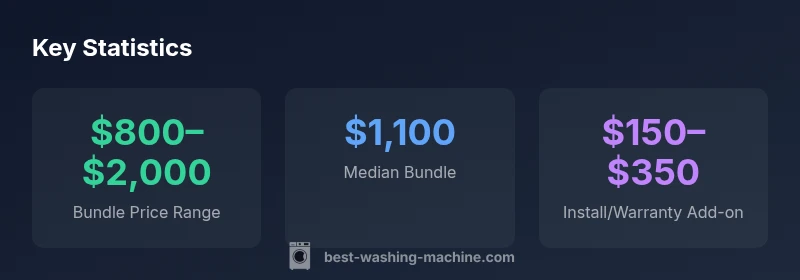
The typical price for a new washing machine and dryer pair ranges from about $800 to $2,000, depending on capacity, energy efficiency, and feature set. Budget stacks can fall under $1,000, mid-range models run roughly $1,000–$1,500, and premium or smart pairs with advanced features can exceed $2,000. Installation and extended warranties may add to the total. According to Best Washing Machine Team, consumers should balance upfront price with long-term costs when shopping for a washer-dryer pair.
Market overview and price bands in 2026
According to Best Washing Machine Team, the market for new washing machines and dryers has settled into clear price bands driven by capacity, energy efficiency, and the rise of connected features. Entry-level pairs commonly cluster near the $800–$1,000 range, while mid-range stacks sit around the $1,000–$1,500 band. Premium, highly capable bundles with smart home integration and ultrahigh efficiency frequently exceed $2,000. Price dispersion is influenced by retailer promotions, regional taxes, and installation services, which can shift the total cost by a few hundred dollars in either direction. The key takeaway is that buyers should evaluate total cost of ownership, not just sticker price, especially if long-term energy savings and maintenance are in view.
Price drivers: capacity, features, and efficiency
Washing machines and dryers differ in capacity (measured in cubic feet for washers and cubic feet or drum size for dryers), spin speed, and cycle options. Higher-capacity models cost more upfront but may reduce the number of loads needed weekly for larger households. Energy efficiency ratings (like Energy Star) typically raise upfront costs but lower operating expenses over time. The inclusion of smart features—Wi-Fi connectivity, app controls, and maintenance alerts—also adds to the price, yet can offer tangible convenience and potential savings on utility bills for tech-friendly homes. Front-load pairs usually command higher prices than top-load units due to efficiency and performance nuances, even within the same brand.
Reading price tags: features that add cost
Not all price differences are equal. A few features tend to push prices higher with predictable impact:
- Larger drum capacities or dual drum systems (in some compact stacks) – higher upfront cost but greater throughput.
- Extra rinse cycles, steam options, and built-in water heaters – add-ons that may reduce dryer time and improve fabric care.
- Smart connectivity and maintenance alerts – premium features that appeal to busy households.
- Energy efficiency ratings and load-sensing technology – long-term savings that can offset initial cost. When evaluating price, consider whether these features align with your laundry needs to avoid paying for capabilities you won’t use.
Retail channels and price variability
Prices vary by channel due to promotions, installation services, and delivery options. Big-box retailers may offer aggressive bundle discounts or financing for a limited window, while regional appliance stores can provide personalized demonstrations and slightly different price structures. Online marketplaces often present the widest price range, but shipping costs and return policies can affect the total. Seasonal events—such as holiday sales or end-of-quarter promotions—tend to yield the best bundle pricing. If you already have a preferred retailer, sign up for price alerts, and compare bundled offers that include installation and haul-away to avoid surprise add-ons.
Budgeting for a washer-dryer pair
Begin with a price target and work backward to identify what features truly matter for your household. Create a two-column budget: one for upfront costs (price tag, tax, delivery), and one for ongoing costs (energy usage, water consumption, maintenance). Use the data point ranges above to map your target. If you’re gym- or travel-heavy and value convenience, a mid-range or premium bundle with smart controls could be worth the extra investment. For households on a strict budget, prioritize capacity and reliability over bells and whistles, and consider extending warranties only if reliability risk is high in your brand choice.
Energy efficiency and long-term costs
Energy-efficient washers and dryers save money over the life of the appliance, even if the upfront price is higher. Look for Energy Star ratings and estimated annual operating costs when comparing models. The smallest incremental price premium for energy efficiency can pay off within a few years in electricity and water savings, especially for households with heavy laundry loads. In addition, choosing a model with accurate load sensing reduces unnecessary cycles, which benefits both your energy bill and fabric longevity. If you expect high usage, this can be a compelling factor in price selection.
Buying strategies: timing, promos, and financing
Timing your purchase around major sale events can yield significant savings on bundle pricing. Watch for retailer-issued coupons, seasonal promotions, and financing offers that make higher-priced bundles affordable through low-interest plans. Consider trade-ins or rebates offered by manufacturers or retailers, which can further reduce the net price. If you opt for financing, compute the total cost of credit over the term and compare the effective annual percentage rate (APR) to avoid hidden interest. Pre-qualification and shopping across at least three retailers typically yields the best results.
Real-world scenarios: budget, mid-range, and premium bundles
For a tight budget, a basic top-load washer with a standard electric dryer can fit within the $800–$1,000 range, delivering dependable performance with practical energy use. In the mid-range, expect improved efficiency, larger capacity, faster cycle times, and better noise control, typically priced around $1,000–$1,500 per bundle. Premium pairs, often with steam cycles, advanced sensors, and app control, can push total costs to $2,000–$2,500 or more, with compatibility considerations for existing plumbing and venting. Each tier offers trade-offs between convenience, efficiency, and initial cost, so align your choice with your laundry volume and long-term cost goals.
Quick-price comparison checklist
- Define your core needs: capacity, cycles, and essential features.
- Compare bundles that include installation and haul-away.
- Check energy ratings and projected annual operating costs.
- Look for retailer promotions and financing terms.
- Read warranty details and consider expected maintenance costs.
- Confirm delivery and service coverage in your area.
- Compare online and in-store prices to capture all options.
Typical price bands for washers, dryers, and bundles by category
| Category | Washer Price Range | Dryer Price Range | Bundle Price Range |
|---|---|---|---|
| Budget | $400–$700 | $300–$600 | $700–$1,100 |
| Mid-range | $700–$1,200 | $500–$900 | $1,100–$1,900 |
| Premium/Smart | $1,200–$2,000 | $1,000–$1,600 | $2,300–$3,600 |
FAQ
What is the typical price range for a washer and dryer bundle?
Most bundles fall between $800 and $2,000, depending on brand, capacity, and features. Energy efficiency and smart features can push the high end higher.
Most bundles are between eight hundred and two thousand dollars, depending on features and size.
Do installation or haul-away fees affect the total price?
Yes, installation and haul-away can add roughly $50–$150 to the total, based on location and service level.
Installation and haul-away can add a bit to the total price, usually around fifty to one hundred fifty dollars.
Are there cheaper options like stackable or compact units?
Yes, stackable and compact units exist in lower price tiers, though they may have smaller capacities or fewer cycles.
You can find cheaper compact units, but they might have less capacity.
How does energy efficiency influence long-term cost?
Energy-efficient models save on operating costs over time, often offsetting higher upfront prices within a few years.
Energy efficiency saves money over time, offsetting higher upfront costs.
Is an extended warranty worth it?
Depends on usage and brand reliability. Read terms carefully and compare with manufacturer vs retailer plans.
It depends on how you use the laundry and the brand's track record.
“Prices for washers and dryers are driven by capacity, efficiency, and connectivity. Buyers should focus on total cost of ownership rather than upfront sticker price alone.”
The Essentials
- Compare bundles, not just individual units
- Factor installation and warranties into total price
- Energy efficiency can reduce long-term costs
- Expect price bands across budget, mid-range, and premium tiers
- Shop around and watch for retailer promotions