Direct Drive vs Belt: Washing Machine Comparison
Explore the differences between direct-drive and belt-drive washing machines, including efficiency, maintenance, noise, and long-term costs, with expert guidance from Best Washing Machine.


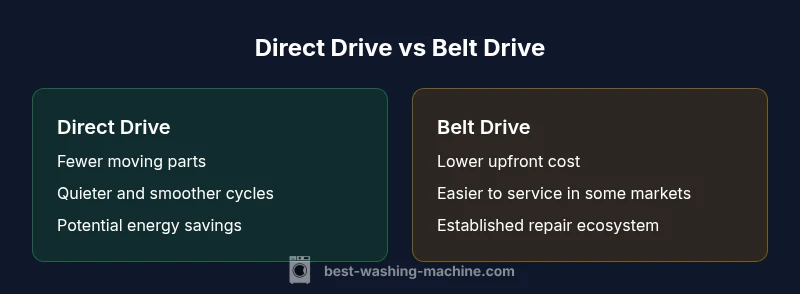
When weighing washing machine direct drive vs belt, direct-drive designs typically run quietly with higher efficiency and fewer moving parts, while belt-driven models often cost less upfront and are easier to service. In the long term, direct-drive can reduce maintenance costs but may require higher upfront investment. For households with heavy daily use, direct-drive often yields better durability and quieter operation; for casual users on a tight budget, belt-drive remains attractive.
Why Direct Drive vs Belt Matters
Understanding the core difference between direct-drive and belt-drive washing machines helps homeowners, renters, and even laundromat operators make a smarter purchase. The term direct drive refers to a motor that is physically attached to the drum, eliminating the traditional belt and pulley system. In contrast, belt-driven washers rely on a belt to transfer motor power to the drum. This distinction affects everyday use, maintenance needs, and long-term ownership costs. According to Best Washing Machine analysis, the choice between washing machine direct drive vs belt often boils down to a balance between upfront price, noise, and reliability. The Best Washing Machine team found that for households prioritizing quiet operation and reduced maintenance, direct-drive typically comes out ahead, while belt-drive models remain attractive where initial cost and serviceability are paramount. When planning a new purchase, consider your laundry frequency, space, and tolerance for potential repairs. The broader consumer landscape shows belt-drive models still dominate the market in many regions, especially for budget-conscious buyers, which is why a thoughtful comparison matters more than ever.
- Case studies from small apartments to family homes show varying levels of direct-drive success, depending on usage patterns and local service networks.
- For landlords and operators, reliability and part availability can shift the decision toward one design over another.
- In all cases, prioritizing a solid warranty and reputable service coverage reduces total ownership risk.
In short, the question is not which technology is universally superior, but which is better aligned with your priorities: quiet operation and durability (direct drive) vs. upfront affordability and repairability (belt drive).
How Direct Drive Works
Direct-drive motors attach directly to the drum, removing the need for a drive belt. This configuration reduces mechanical belts, pulleys, and intermediate gears, which can translate to fewer wear points and smoother operation. A direct-drive system often uses sensor feedback to regulate drum speed precisely, improving spin efficiency and reducing imbalances that cause vibration. From an engineering perspective, the elimination of the belt minimizes the likelihood of belt slippage and belt wear over time. For frequent users, this design can translate into a more consistent wash performance and lower long-term maintenance. The result is a machine that typically runs quieter and may consume less energy per cycle due to reduced mechanical losses. The trade-off is that the initial cost and repair options for direct-drive motors can be higher in some markets, and a failure in the motor or controller can be more costly to fix. Best Washing Machine’s analysis reiterates that reliability often hinges on the quality of the motor, the drive electronics, and the warranty coverage offered by the brand.
In practice, direct-drive systems prioritise control precision, which benefits delicate fabrics as well as heavy loads by minimizing drum wobble during high-speed spins. This precision also supports shorter cycle times in some models, enabling faster laundry turnover without sacrificing cleanliness. Overall, direct-drive technology aims to deliver a calmer user experience with potential energy gains, especially on machines designed for high daily use. When combined with advanced inverter controllers, direct-drive washers can optimize power delivery to the drum, further enhancing efficiency and performance.
Brand context matters: some manufacturers implement enhanced damping and chassis design to complement direct-drive motors, reducing external noise transmission and improving perceived quality. If you value quiet operation and long-term durability, look for models with reinforced cabinets and high-quality isolation components that work in concert with the direct-drive system.
How Belt Drive Works
Belt-driven washing machines rely on a belt and pulley arrangement to transfer motor power to the drum. The belt decouples motor vibrations from the drum, which can be beneficial for manufacturing flexibility and repairability. Belts provide an economical path to motion transfer and are widely available as replacement parts, making servicing straightforward in many regions. Belt-drive designs can be simple to diagnose: if the wash performance deteriorates or the drum seems sloppier during spins, technicians often check belt tension, belt condition, and pulleys first. The trade-off is that belts wear out over time, which can lead to slippage, slower spins, or increased vibration as the belt stretches or cracks. Belt-drive models often present a favorable upfront price and easier, more ubiquitous repair options, especially for budget-oriented households or facilities with in-house maintenance capability. The trade-off for belt-drive units is that, over time, belt wear can contribute to higher maintenance frequency and more noticeable noise. The Best Washing Machine Team notes that belt-driven machines can still be highly reliable when built with quality belts, durable pulleys, and proper chassis design, but consumer attention to belt condition is essential for optimal longevity.
In typical installations, belts are designed to handle a broad range of load profiles, which makes them robust in mixed-use households. However, belt maintenance becomes a regular consideration for owners who run frequent heavy cycles or high-spin operations. When replacements are needed, the process is usually straightforward and widely taught in standard appliance repair curricula, allowing for cost-effective service in many regions. Ultimately, belt-drive washers remain a solid option for buyers prioritizing cost and serviceability without sacrificing essential performance.
Efficiency and Energy Use
Energy efficiency for washing machines often hinges on the motor design, transmission, and electronics. Direct-drive systems, by virtue of reducing mechanical losses and eliminating belt tension, frequently show higher energy efficiency in practice, particularly on high-speed spins and when washing frequent heavy loads. In the context of washing machine direct drive vs belt, manufacturers frequently tie efficiency gains to advanced inverter controls that modulate motor speed to match the load and fabric type. Consumers who aim to minimize electricity usage should pay attention to Energy Star ratings where applicable, as these reflect real-world efficiency performance. While belt-drive machines can also be efficient, the belt and pulley path introduces energy losses that accumulate over time with frequent cycles. The Best Washing Machine Team cautions that efficiency is not only about motor design but also about overall system optimization, including drum design, water temperature management, and cycle programming. For households seeking lower operating costs, a model with high energy efficiency, good spin performance, and robust insulation typically offers the strongest long-term value.
From a broader perspective, energy efficiency interacts with water usage. High-efficiency direct-drive machines often incorporate optimized water intake, variable drum speed control, and load-sensing features that tailor water use to the laundry size. The net effect is less wasteful operation and lower utility bills over the long term, which is particularly meaningful for large families or shared living environments. Conversely, belt-drive models with well-tuned cycles can also achieve good efficiency, especially in regions with efficient water heating and well-maintained components. Always review the cycle-by-cycle energy numbers, not just the sticker rating, to understand real-world performance.
Noise, Vibration, and User Experience
Noise and vibration are common differentiators between direct-drive and belt-drive washers. Direct-drive designs tend to deliver quieter operation because there are fewer moving parts to vibrate and less belt slip, which reduces resonant frequencies that can create high-pitched noises during spins. In addition, the precise motor control and improved damping systems found in many direct-drive models contribute to a smoother overall feel in operation. For households sensitive to noise—such as apartments, bedrooms near the laundry area, or late-night laundry routines—the quieter experience can be a decisive factor. The flip side is that some direct-drive configurations rely on compact, tightly integrated components that can be sensitive to structural quality in the home, so choosing a model with good chassis engineering and solid vibration reduction remains important.
Belt-drive washers typically produce more noticeable rumble and whine during high-speed spins, particularly when belts wear or pulleys develop play. The upside is usually a wider price range of options and easier on-site troubleshooting for basic mechanical issues. When evaluating options, listen to test cycles, check consumer reviews focused on noise and vibration, and consider the installation environment. The Best Washing Machine Team emphasizes that even the quietest direct-drive units can exhibit noticeable vibration if installed on an unlevel floor or in a cabinet with poor dampening.
For most users, a well-chosen direct-drive model paired with correct installation yields the least disruptive experience, while belt-drive models can be perfectly adequate in environments where cost and serviceability trump ultra-quiet operation.
Reliability and Maintenance Considerations
Reliability is a core driver in the direct drive vs belt debate. Direct-drive motors have fewer moving parts than traditional belt systems, which can translate to fewer failure points over the lifetime of the machine. The absence of a drive belt reduces the risk of belt wear, cracking, or tension loss that can impact spin performance. However, direct-drive systems rely heavily on electronics, sensors, and motor controllers; a failure in the control board or motor can be more expensive to repair, and replacement parts may vary by brand. Regular maintenance, such as ensuring proper load balance and avoiding overloading, helps preserve direct-drive reliability.
Belt-drive machines, in contrast, rely on mechanical components that are well understood and widely supported by service technicians. Belts require periodic inspection and replacement as part of normal maintenance. In many regions, belt and pulley components are inexpensive and readily available, which makes repairs straightforward and affordable for DIY-minded households. The trade-off is that belts wear out and can contribute to noise, vibration, and reduced spin efficiency over time. Best Washing Machine’s experience indicates that a belt-driven unit with quality belts and regular maintenance can be very reliable and cost-effective for moderate use.
A practical approach is to prioritize part availability and service networks in your locale. If you live in an area with strong after-sales support for a given brand, both direct-drive and belt-drive options can be dependable. If possible, consult service histories, warranty terms, and user reviews to gauge long-term reliability. A robust warranty that covers the motor, electronics, and drive components is especially valuable when choosing between the two architectures.
Durability and Longevity: Real-World Lifespan
Durability and longevity claims depend on multiple variables: build quality, usage patterns, maintenance, and local service support. Direct-drive washers claim a durability advantage due to fewer drive components that can wear. Over years of operation, the absence of a belt reduces a typical failure mode, but electronics and the motor still demand care. A well-designed direct-drive model with a sturdy chassis, good insulation, and effective vibration damping can provide reliable performance for many years, particularly in homes with steady weekly wash load. That said, direct-drive hardware failures in the motor or control system can be more expensive to repair, and some consumers report variability in service availability across regions.
Belt-drive machines have a long track record of reliability, largely because the mechanical parts involved are well understood and widely serviced. Replacing a belt, pulley, or bearing is a common maintenance task in many service calls, but these parts are typically economical and accessible. In heavy-use environments, the belt system can accumulate wear faster than a direct-drive model, yet the overall longevity can still be excellent if the unit is matched to the load, installed correctly, and kept clean of lint and debris.
Real-world longevity also hinges on the brand's quality control and support network. Consumers should look for models with durable drum material, solid bearings, and a chassis designed to minimize resonant vibrations. The Best Washing Machine Team highlights that the longest-lasting machines are those with balanced components, efficient motors, and responsive after-sales care, regardless of motor type.
Cost of Ownership: Upfront and Long-Term
Cost of ownership for washing machines involves upfront price, energy and water use, maintenance, and potential repair costs. Direct-drive models tend to sit at a higher upfront price point due to more compact motor technology and advanced control systems. However, their efficiency gains, reduced maintenance needs, and potential longevity can translate to lower cumulative ownership costs over time for households with frequent wash cycles. When evaluating direct-drive versus belt-drive costs, consider the total cycles you expect to run per year, the electricity rates in your area, and the typical repair bills for your chosen brands. For families that value quiet operation and long-term reliability, the long-run savings associated with direct-drive can offset the initial premium, especially in high-use homes.
Belt-drive machines generally come with a lower upfront cost and easier, more widely available repair parts. This makes belt-drive units attractive for buyers on a tight initial budget or for facilities that prioritize simple, quick maintenance. If you expect to move or upgrade soon, tiered financing options or promotional pricing on belt-drive models can tilt the decision toward immediate affordability. In all cases, assess the warranty length and what it covers—the motor, drive components, and electronic controls are the most critical. The Best Washing Machine Team notes that warranty terms often signal the manufacturer’s confidence in long-term performance and the anticipated total cost of ownership.
Installation and Repairability: Serviceability at Home and Beyond
Installation quality plays a crucial role in the performance and lifespan of both direct-drive and belt-drive washers. Direct-drive machines, with their compact motor assemblies, can require careful alignment and a solid, level surface to minimize vibration. Some models are designed for quieter operation in enclosed spaces, but poor installation can negate these benefits. Hiring a professional installer or following precise leveling and anchoring guidelines helps ensure optimal performance and longevity. Belt-drive units offer the advantage of readily accessible mechanical parts and a long-established repair ecosystem. If a belt wears, technicians typically replace the belt and pulley without invasive disassembly of the drum. Home maintenance enthusiasts often find belt replacements straightforward and cost-effective, provided the model has serviceable belts and spares.
When choosing between the two architectures, verify the availability of authorized service centers in your region, the ease of obtaining replacement belts or motors, and the presence of diagnostic tools in the manufacturer’s service portal. A strong after-sales network reduces downtime and total repair costs, which is important for households that rely heavily on laundry capacity. For apartment dwellers or commercial settings with tight schedules, the ability to quickly obtain parts and service is often a deciding factor. The Best Washing Machine team recommends prioritizing serviceability in addition to performance metrics to ensure a smooth ownership experience.
Buying Guide: What to Look For
Before pulling the trigger on a washer, compare models using a structured checklist. Start with direct-drive vs belt as the core decision, then evaluate energy efficiency, warranty length, and service availability. Look for a high-quality drum, robust bearings, and effective vibration dampening in both architectures. Spin speed and energy usage are important metrics—higher spin speeds can reduce drying time but may increase water usage and wear on fabrics if not well controlled. Noise ratings, particularly for direct-drive models, provide a practical sense of real-world comfort in your living spaces. Consider load sensing, automatic detergent dosing (if applicable), and cycle variety to suit your family’s laundry profile. Finally, inspect the user interface for ease of use and the availability of repair documentation or in-home service options. The Best Washing Machine Team emphasizes that a model with a solid warranty and predictable service coverage offers the strongest long-term value, regardless of motor design. In short, align your choice with usage patterns, budget, and access to reliable support.
Quick decision framework:
- If you prioritize quiet operation, energy savings, and fewer maintenance events, lean toward direct drive.
- If upfront cost, widespread serviceability, and easy DIY maintenance are your priorities, belt drive may be the better choice.
- Always factor in warranty length, dealer support, and local repair ecosystem as tie-breakers.
Authority Sources and Practical Takeaways
Authority sources and practical guidance help anchor your decision in real-world data. For readers seeking authoritative references, consult reputable agency and consumer resources to understand energy performance and repairability. The following sources provide objective information on appliance efficiency, maintenance practices, and consumer guidance:
- Energy.gov – Energy efficiency standards and appliance guidelines.
- EnergyStar.gov – Certification and performance benchmarks for home appliances, including washing machines.
- ConsumerReports.org – Independent testing and reliability data for major appliance categories (subscription may apply).
Practical takeaways:
- Prioritize models with strong warranties and accessible service.
- Compare total cost of ownership, not just upfront price.
- Audit your laundry space to ensure proper installation and vibration dampening to maximize performance.
- Consider your typical cycle loads and noise tolerance when choosing between direct-drive and belt-drive designs.
By combining technical understanding with trusted sources, you can make a confident decision that aligns with your home’s needs and budget. The Best Washing Machine team remains your partner in navigating these choices, providing ongoing comparisons and guidance based on real-world usage.
What to Look For in Real-World Scenarios
In the end, the best choice depends on your daily routine, space constraints, and maintenance expectations. A direct-drive washer is often preferred by households that run frequent cycles, care deeply about quiet operation, and value long-term energy savings. If your laundry room is near living spaces or bedrooms, the quietness of a direct-drive model can significantly improve daily comfort. On the other hand, if your household prioritizes low upfront costs, easy access to replacement parts, and a broad selection of affordable models, belt-drive washers remain compelling. For renters or small households with modest laundry needs, belt drive may deliver practical value with straightforward repairs and replacement parts readily available. For homeowners planning long-term occupancy, direct-drive’s potential for reduced maintenance and improved energy performance can translate into cost savings over several years. The Best Washing Machine Team recommends evaluating both architectures against your specific context, including service coverage, warranty details, and your personal tolerance for maintenance tasks.
Buying Decision Summary and Next Steps
To wrap up, approach the decision with a structured checklist: confirm your budget, assess expected laundry load, review energy and water use metrics, and verify warranty and service options. If you value quiet operation and potentially lower maintenance, prioritize direct-drive models with strong vibration control and a robust motor warranty. If upfront cost, widespread serviceability, and straightforward maintenance matter more, belt-drive models can meet your needs without a large upfront investment. Use the comparison table to quickly see how each option stacks up on core criteria, then supplement with in-depth model reviews and real-user feedback. For most households, balancing upfront price against long-term performance yields the most satisfying outcome. The Best Washing Machine team is here to help you weigh these factors and select a model that fits your home, budget, and lifestyle.
Comparison
| Feature | Direct Drive | Belt Drive |
|---|---|---|
| Core mechanism | Motor directly attached to drum, no belt | Motor drives drum via belt and pulley |
| Noise & Vibration | Lower noise, smoother operation | Can be louder with belt-induced vibrations |
| Maintenance & Longevity | Fewer moving parts; potentially lower maintenance | Belt/pulley wear requires periodic checks/replacements |
| Energy Efficiency | High efficiency potential with inverter control | Efficiency varies; belt wear can affect performance |
| Repairability & Parts | Motor/electronics repair can be costly; parts widely supported | Belts and pulleys widely available; repairs straightforward |
| Upfront Cost | Often higher upfront due to advanced motors | Typically lower upfront price |
| Durability & Longevity | Potentially longer lifespan with fewer wear parts | Durability depends on belt and component quality |
What's Good
- Fewer moving parts reduce maintenance risk
- Quieter operation enhances daily living
- Potentially longer lifespan with fewer belt-related failures
- Better energy efficiency in many models
Downsides
- Higher upfront cost can be a hurdle
- Repair options may be more limited in some regions
- Certified service availability can vary by brand
- Initial compatibility with existing setups may require upgrades
Direct drive generally offers better long-term value and quieter operation; belt drive remains a solid option for budget buyers or simpler repairs.
Choose direct drive if you value quiet operation and potential energy savings over time. Choose belt drive if upfront cost and easy, widespread maintenance access matter more to you.
FAQ
What is the main difference between direct-drive and belt-drive washers?
The main difference is how power moves from the motor to the drum. Direct-drive attaches the motor directly to the drum with no belt, offering quieter operation and fewer wear parts, while belt-drive uses a belt and pulley system that can be cheaper upfront and easier to repair.
Direct-drive means the motor is attached to the drum, which makes it quieter and fewer parts wear out. Belt-drive uses a belt, which is cheaper to repair but can wear over time and be noisier.
Are direct-drive washers more reliable than belt-driven models?
Reliability depends on the brand, model, and maintenance. Direct-drive washers often have fewer mechanical wear points, but their electronics and motor controls can be more costly to repair. Belt-drive machines benefit from a long repair history and broad parts availability, which can enhance practical reliability in some regions.
Direct-drive often has fewer wear parts, but repairs may involve electronics. Belt-drive has established repair options and parts today, depending on brand.
Do direct-drive washers cost more upfront?
Yes, direct-drive models typically carry a higher upfront price due to the advanced motor technology and control systems. However, this initial premium can be offset by energy savings and reduced maintenance over time for high-usage households.
Direct-drive usually costs more at purchase, but energy savings and fewer maintenance events can offset that later.
Is maintenance easier on belt-drive washers?
Belts are generally easier to replace and diagnose in many markets, making belt-drive washers appealing for DIY maintenance or in regions with strong service networks. Direct-drive maintenance can require specialized parts and expertise, though advances in modular designs are improving accessibility.
Belts are often easier to replace; direct-drive maintenance can be more specialized.
Can I replace a belt on a belt-drive washer myself?
In many models, belt replacement is a doable DIY task with basic tools. Consult the model’s service manual and safety guidelines. If unsure, seek professional help to avoid damaging the drum or motor.
Yes, many belt-drive washers allow DIY belt replacement if you follow the manual and safety tips.
Which is better for small spaces or apartments?
Both can work in small spaces, but the choice depends on noise tolerance and installation constraints. Direct-drive units often offer quieter operation, which helps in apartments. Ensure proper mounting, leveling, and vibration dampening regardless of motor type.
Direct-drive is often quieter for apartments, but installation quality matters for any washer.
How should I verify service and warranty before buying?
Review the warranty terms for motor, electronics, and drive components. Check the brand’s service network in your area and confirm parts availability. A longer, broader warranty plus a strong service footprint reduces long-term risk.
Look at motor/electronics warranty and the service network in your area before buying.
The Essentials
- Evaluate daily load to choose the motor type that fits your usage
- Direct-drive often excels in noise and efficiency, with higher upfront cost
- Belt-drive remains cost-effective and repair-friendly for budget buyers
- Warranty and service networks influence long-term value more than motor design alone
- Check installation space for vibration dampening and level mounting