How to Score the Best Washing Machine Discount in 2026
Discover proven strategies to maximize a washing machine discount in 2026, including timing, rebates, warranty considerations, and evaluating total cost of ownership for smarter buys.


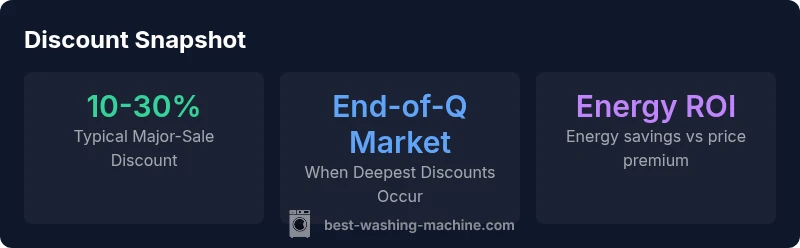
According to Best Washing Machine analysis, washing machines typically see discounts of about 10–30% during major sales, with deeper cuts on display models or end-of-quarter inventory. To maximize savings, compare unit prices across retailers, watch for additional rebates, and factor energy efficiency into total cost of ownership. For 2026, watch online and in-store channels, and practice price matching where permitted.
Understanding the value proposition of a washing machine discount
A washing machine discount is more than a lower sticker price; it represents a moment where price, performance, and future energy costs intersect. In 2026, a discount can come from a retailer promotion, an online coupon, a manufacturer rebate, or a bundled offer with detergents or accessories. The practical question for homeowners and renters is not just 'What did I save today?' but 'What is the true cost over the machine’s lifespan?' The Best Washing Machine analysis shows that discounts that ignore energy efficiency or warranty terms can erode value quickly. So, the savvy buyer evaluates both the immediate markdown and the long-term savings from operating costs, repair needs, and reliability. The discipline is to quantify potential savings in dollars per year rather than just the percent off sticker price. This mindset helps ensure the discount is genuine financial relief, not a short-term marketing ploy.
Where discounts come from: retailers, rebates, and promos
Discounts originate from multiple channels, including retailer promotions, online coupon codes, and manufacturer rebates. End-of-quarter stock clearances, holiday sales, and open-box or floor-model markdowns are common sources. Some manufacturers offer loyalty rebates when you purchase during a specified window or join an energy-efficiency program. Refurbished or renewed units can also carry meaningful reductions, but buyers should check warranty terms and return policies. When evaluating a discount, compare the price after all incentives are applied, not just the advertised markdown. Best practices include tracking promo calendars, subscribing to retailer newsletters, and verifying rebate eligibility before purchase.
In practice, a mix of retailer discounts and manufacturer rebates can produce a higher effective discount than any single offer. The key is verifying terms, stacking rules (where allowed), and ensuring the model meets your performance and durability standards. Always read the fine print on any rebate or coupon so you don’t sacrifice warranty coverage or access to service plans in the future.
How to evaluate discounted models: price vs performance
A lower price is appealing, but a discounted washer must still meet your reliability needs and energy goals. Start with the unit’s energy rating, water usage, and estimated annual operating cost. Compare the discounted price against a baseline cost of ownership that includes energy consumption, detergent usage, maintenance, and potential repair costs. If a model with a higher upfront discount also consumes significantly more energy, the long-term savings may disappear. Create a simple total-cost of ownership (TCO) model that assigns annual energy and maintenance costs to each contender. The discount should reduce the TCO, not merely the sticker price. In practice, prefer models with high energy efficiency, durable components, and favorable warranty terms; a slightly smaller discount on a better-performing unit often yields greater real savings over five years.
Timing and seasonal patterns that maximize discounts
Discount timing matters as much as the discount size. Major holidays, new model introductions, and retailer clearance events commonly coincide with price dips. End-of-month and end-of-quarter periods can trigger additional markdowns as retailers try to hit sales targets. Weather-related slow periods can also prompt promotions to move inventory. To exploit timing, build a calendar of likely sale windows and set price alerts for your preferred models. If you can wait for a larger retailer sale, you can often combine a published discount with an extra coupon, loyalty reward, or manufacturer rebate, magnifying the overall savings potential.
Practical steps to secure the best deals: search, compare, stack
Begin with a short list of 3–5 candidate models that meet your size, capacity, and energy criteria. Check prices across at least 3 retailers—online and brick-and-mortar—to spot genuine savings. Use price comparison tools and browser extensions that track price history. When possible, request price matches and inquire about any stacking allowances for coupons or rebates. Be mindful of holiday bundles that include detergents or extended warranties, which can increase perceived value but may complicate return policies. If you have patience, waiting for a targeted sale can yield a larger discount than a generic promotion. Finally, ask about delivery and installation fees and whether they’re included in the stated price.
Follow-up steps: verify the warranty is intact after discount, confirm service coverage in your area, and keep all receipts and promo codes organized for easy returns or claims.
Financing, warranties, and post-purchase considerations
Financing can complicate price comparisons, especially if a store offers low up-front prices but higher interest or fees. If you need financing, compare APRs, promo periods, and any deferred-interest clauses. A discounted price should not come at the expense of warranty length or access to authorized service. Read warranty terms carefully: some offers apply only to certain SKUs, exclude certain parts, or limit coverage on refurbished units. Post-purchase, maintain a record of model numbers, installation dates, and technician visits. Proper registration with the manufacturer can unlock extended warranties or VIP service options. If energy savings are important, keep an eye on standby power usage and cycle efficiency to maximize return on investment over the machine’s life.
Common pitfalls and how to avoid them
Discounts can be persuasive, but common pitfalls include buying without verifying energy ratings, ignoring delivery and installation costs, or assuming that a larger discount always means better value. Another risk is discounting a model that has high repair costs or poor reliability. Always check the model’s reliability history, service availability in your area, and the likelihood of parts availability for years to come. Beware of refurbished units advertised as new or sellers that refuse to honor the warranty after discount. Finally, avoid stacking discounts that are undocumented or restricted by fine print. When in doubt, opt for a model with transparent terms and clear service options.
Quick-start discount checklist
- Define your must-have features (capacity, spin speed, energy rating) and nice-to-haves
- Compare price after all incentives across 3–4 retailers
- Check for rebates, coupons, and loyalty offers that apply to your model
- Confirm delivery, installation, and warranty terms before purchase
- Consider total cost of ownership, not just the initial price
- Save receipts and promo codes for easy claims or returns
How to interpret discount data for future purchases
Keep a running log of discount patterns for your preferred models across the year. Note which retailers consistently offer the best prices and which promotions tend to stack well with manufacturer rebates. Use this historical data to forecast future discounts and time your next upgrade accordingly. Build a personal benchmark so that when a good deal arises, you can act quickly without overpaying later. By correlating discount timing with energy cost trends and warranty coverage, you’ll be better prepared to identify genuine value rather than a tempting but incomplete deal.
Discount ranges by washing machine type
| Model Type | Discount Range | Notes |
|---|---|---|
| Front-load | 10-25% | Energy efficient, good reliability |
| Top-load HE | 15-30% | Higher upfront cost, strong efficiency |
FAQ
What is a typical discount range for a washing machine?
Most discounts during major promotions fall roughly in the 10–30% range, with larger cuts on display or end-of-quarter inventory. Always confirm after any rebates or coupons are applied and compare total costs.
Most discounts are between 10% and 30%, but total cost matters more than the upfront price.
When is the best time to find discounts on washers?
Holiday weekends, end-of-month clearances, and model-year transitions are common times for discounts. Set price alerts and watch retailer calendars to catch these windows.
Look for holiday sales and end-of-month clearances to catch the best discounts.
Do premium brands offer discounts as often as others?
Premium brands often run discounts during peak sale periods, but the discount depth can vary. Compare warranty terms and energy ratings alongside the price.
Premium brands do discount, but compare more than price—warranty and efficiency matter too.
Are refurbished or open-box machines a good deal?
Refurbished units can offer substantial savings but may come with shorter or altered warranties. Buy from reputable sellers and verify return policies.
Refurbished can save money, but check warranty and seller reputation.
Do discounts affect warranties or service plans?
Discounts do not automatically void warranties, but confirm coverage terms with the seller. Some promotions may exclude extended warranties or service contracts.
Discounts don’t automatically void warranties—read the fine print to be safe.
“Discounts should be evaluated with energy efficiency and warranty in mind; a good deal is one that lowers lifecycle cost, not just price.”
The Essentials
- Compare prices across retailers before buying
- Factor total cost of ownership, not only sticker price
- Look for stackable rebates and coupons
- Time purchases around holidays and end-of-month sales
- Verify warranty terms and delivery costs before purchase