Washing Machine vs Laundry Machine: A Comprehensive Comparison
Explore the difference between washing machine and laundry machine, including home vs commercial models, capacity, energy use, and lifecycle costs to help you decide.


At first glance, washing machine and laundry machine refer to the same device, but the terms are used in different contexts. For most homeowners, the choice is not about two distinct machines, but about size, efficiency, and the intended use. Understanding the difference helps you pick options that fit your space, budget, and laundry load.
Terminology and Context: Why the Terms Matter
In everyday conversation, 'washing machine' and 'laundry machine' are often used interchangeably. However, there is a meaningful distinction in industrial vs residential contexts. The terms shape expectations about capacity, installation, and service, so recognizing the nuance helps buyers avoid overpaying for features they won't use. According to Best Washing Machine, many buyers approach the topic with two mental models: the small, efficient home unit and the robust, high-throughput machine designed for busy facilities. This framing guides initial shopping lists and space planning, especially in urban apartments where every square foot matters. The practical upshot is simple: identify how many pounds of laundry you handle weekly, the available space, and whether you need a machine that runs non-stop or one that can be positioned alongside other appliances.
Beyond capacity, the terminology influences warranty decisions. Residential models typically include standard warranties and consumer support networks, while heavier-use environments emphasize service contracts and easier access to spare parts. If you live in a rental or small condo, your decision may rest on shared laundry facilities and building rules. In all cases, the goal is to match a machine’s core capabilities to your typical loads, rather than chasing a label that sounds impressive.
Residential Washing Machines: Design, Capacity, and Efficiency
Home washers come in two primary configurations: front-load and top-load. Front-load models generally offer higher energy efficiency, gentler fabric handling, and typical capacities around 2.5-5.0 cubic feet. Top-load machines, often cheaper upfront and easier to repair, still provide solid performance for households with larger or irregular load patterns. Capacity choices determine how many outfits or how many towels you can clean per cycle, which directly affects weekly time and electricity use. In addition to drum design, cycle options range from quick wash to heavy-duty and sanitize cycles, giving homeowners flexibility to handle everyday clothes, linens, and delicates. Modern residential models leverage sensors to optimize water use, spin speed, and temperature, which helps reduce both water and energy bills over the appliance’s life. Maintenance considerations include drum cleanliness, filter care, and preventing mold in gaskets and door seals, which are common issues if machines sit unused for long periods.
From a broader perspective, the home market emphasizes accessibility and convenience: compact footprints, stackable configurations for tight spaces, and compatibility with common household outlets. The shopping process often weighs upfront price against long-term operating costs, balancing features like steam assistance, load-sensing technology, and smart-home integration. Consumers also consider noise levels and vibration, which can influence placement in living spaces or bedrooms. As you compare brands and models, it’s important to translate feature names into real-load experiences: what you wash, how often you wash, and how quickly you realistically need garments ready for use.
Commercial Laundry Machines: Durability, Throughput, and Infrastructure
Commercial or industrial laundry machines are designed for continuous operation, high throughput, and reliable uptime. They typically feature larger drum capacities, higher RPM spins, and heavier-duty bearings and hardware that can withstand daily cycles. The key performance metrics for these units are load size per cycle, cycle time, and overall cycle throughput per hour. Because commercial machines operate near capacity, utilities infrastructure—water supply, drainage, electrical service, and floor loading—must be designed to support frequent use. In many facilities, two or more units run in parallel to handle bedding, towels, and uniforms, which means stack ducting, venting, and chemical dosing systems are standard. These machines may incorporate automatic chemical injection, direct water reuse, and programmable logic controls for complex wash formulas. The focus for operators is minimizing downtime, simplifying maintenance, and ensuring parts availability, since specialized components may have longer lead times than consumer-level parts. For buyers, matching a facility’s workload with a machine’s duty cycle is essential to avoid bottlenecks and excessive energy usage.
Performance and Efficiency: Real-Life Scenarios
In everyday usage, the performance gap between home and commercial machines becomes noticeable in throughput and cycle timing. Residential washers often complete full loads in 45-90 minutes depending on the program, whereas commercial units can run back-to-back with shorter single-load cycles in some configurations. Efficiency is not just about energy ratings; it includes water reuse strategies, heat recovery, and the machine’s ability to adjust to load weight. Consumers should consider both energy efficiency ratings and water-use metrics when evaluating products. A high-efficiency residential unit may deliver substantial lifetime savings on utility bills, especially in households with frequent laundry needs. For facilities, energy and water costs scale with throughput, so choosing a model with good reliability and parts availability can reduce total cost of ownership. For renters or urban residents, compact and stackable designs offer meaningful flexibility without sacrificing too much performance. The bottom line is simple: pick machines that align with your weekly laundry load, space, and budget while maintaining realistic expectations for cycle times and reliability.
Cost Considerations: Upfront, Operating, and Lifecycle Costs
Understanding the financial aspects of washing machines requires looking beyond sticker price. Residential washers typically range from budget-friendly to premium, with consumer models often priced between $500 and $1,500, depending on capacity and features. Commercial machines command higher upfront costs, frequently exceeding several thousand dollars, driven by durability, throughput, and service arrangements. However, the long-term operating costs can diverge: industrial units may require higher ongoing maintenance costs but potentially lower energy and water use per pound of laundry due to specialized engineering. Prospective buyers should run a total-cost-of-ownership analysis that includes energy consumption, water use, maintenance frequency, and expected lifespan. In rental properties or co-living spaces where laundry is a shared amenity, the economics may favor smaller, energy-efficient home units combined with service contracts for maintenance. Conversely, in a busy hotel or hospital laundry room, the economics may justify the investment in industrial-scale equipment. The key is to quantify weekly laundry loads and estimate the annual utility spend for each path.
Space, Installation, and Practical Considerations
Space planning starts with precise measurements of potential locations, doorways, and elevator access if you’re in a multi-story building. Front-load machines often require a rigid footprint and proper ventilation, while top-load models may be more forgiving on room dimensions. In both cases, you need adequate drainage, electrical outlets with correct voltage, and, for some commercial units, dedicated water supply lines and floors rated to support heavy machines. Noise and vibration are practical concerns in living spaces; anti-vibration pads and isolation for concrete floors can mitigate disturbance. Stacking kits can dramatically reduce footprint in small apartments, but only when compatible with the model. When installing commercial laundry equipment, professionals assess floor loading, chemical storage, ventilation, and automatic dosing systems. Finally, the installation phase includes testing the drain, verifying emergency shutoffs, and training staff on basic operation and safety protocols to ensure smooth operation from day one.
Maintenance, Repairs, and Longevity
Regular maintenance directly extends a washing machine’s lifespan and protects investment. For residential units, regularly cleaning lint filters, door seals, and drum interiors helps prevent odor and mold. Stress points like hoses and connections should be inspected annually, and technicians recommend replacing hoses every five to seven years. Commercial machines benefit from preventive maintenance contracts that align with operational hours and supply chains for spare parts, which reduces downtime. In both cases, staying current with firmware updates, when applicable, and using manufacturer-recommended detergents can preserve performance. Troubleshooting common issues—like poor drainage, odd noises, or poor spin—often begins with checking user settings and drainage paths before calling a technician. A robust maintenance plan minimizes unplanned downtime, preserves energy efficiency, and protects your warranty.
Warranties, Service, and Availability of Parts
Warranties and service options differ by market segment. Residential washers commonly include a manufacturer warranty that covers parts and labor for a limited period, with optional extended warranties and local service networks. Commercial laundry machines frequently feature longer warranty terms, service contracts, and access to specialized technicians, but they may require networked service providers and approved installation partners. Availability of replacement parts matters, especially for older or specialized models; buyers should verify lead times and the availability of compatible spare parts in their region. When evaluating warranties, pay attention to what is excluded (perishables, consumables, or routine maintenance) and whether international support is available if you move or operate across borders. A well-structured service plan can prevent expensive downtime and preserve machine performance over many years.
A Decision Framework: When to Choose Residential vs Commercial
A disciplined decision framework helps translate laundry needs into a concrete choice. Step 1: quantify your weekly laundry loads in pounds and assess whether you need continuous throughput or occasional use. Step 2: measure your available space, including door swing clearance and ventilation. Step 3: map utility costs and evaluate energy and water efficiency across candidate models. Step 4: consider installation requirements and whether you’ll need professional services or structural modifications. Step 5: assess maintenance ecosystems in your area and the availability of spare parts and service technicians. Step 6: weigh total cost of ownership over 5–10 years, combining purchase price, operating costs, and potential downtime. This framework prioritizes load volume, reliability, and long-term value over short-term price. It also helps you communicate with landlords, building managers, or facility operators who influence what is feasible in your environment.
Consumer Guidance: Brands, Models, and Buying Tips
When evaluating brands and models, look for third-party testing results, repairability scores, and warranty coverage. Focus on fundamental metrics that matter for your situation: drum size, energy star ratings, spin speed, cycle variety, and noise levels. If you live in a rental or small apartment, prioritize compact, energy-efficient units with good stackability and accessible service networks. For facilities with heavy laundry loads, concentrate on duty cycles, ease of maintenance, and the availability of spare parts. Read customer reviews critically, noting issues related to reliability and customer support. Finally, construct a shortlist of models that fit your space and workload, then schedule demonstrations or in-home trials if possible. The goal is to balance upfront cost with long-term operating expenses and ensure you have a clear plan for maintenance, service, and eventual replacement.
Comparison
| Feature | Home Washing Machine | Commercial Laundry Machine |
|---|---|---|
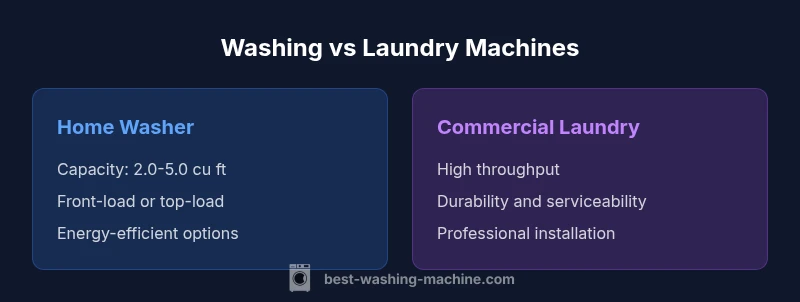
| Capacity | Typically 2.0-5.0 cu ft (home) | 20-60+ lb per load (industrial) |
| Cycle Options | Standard cycles (wash, rinse, spin, delicate, heavy) | Specialized cycles; continuous operation; high-throughput |
| Durability/Build | Household components designed for consumer use; reliable but finite cycle counts | Industrial-grade components built for continuous operation |
| Energy & Water Use | Modern energy-efficient models with sensors | Higher throughput often drives higher water and energy use; some systems recapture water |
| Footprint & Installation | Front- or top-load in a dedicated space, often in a home laundry area | Requires dedicated facility space and professional installation |
| Price Range | $500-$1,500 commonly available | $5,000+ for many commercial units |
What's Good
- Clarifies who should buy what, reducing mispurchases
- Highlights capacity and cycle variety for different workloads
- Assists budget planning across upfront cost and lifecycle expenses
- Guides space planning and installation considerations
- Encourages attention to energy and water-use implications
Downsides
- Terminology can still confuse buyers who see 'laundry' as a generic term
- Industrial units are not a substitute for home convenience in most apartments
- Higher upfront costs for commercial-grade options may not fit civilian budgets
Residential washers suit most households; commercial laundry machines excel in high-volume settings.
Map your load size and space to the decision. Choose home units for convenience and cost, and industrial models for throughput and durability in facilities.
FAQ
What is the practical difference between a washing machine and a laundry machine?
In practice, the terms refer to residential versus commercial appliances. Both perform clothes washing, but context matters for capacity, durability, and installation. This article uses the terms to highlight when each is appropriate.
The terms usually mean home versus commercial machines; they differ mainly in capacity and durability.
Are laundry machines strictly for commercial use?
Most laundry machines marketed as 'laundry' are built for commercial environments; home users typically buy standard washing machines. There are exceptions where compact commercial units fit homes.
Most laundry machines are built for commercial use.
Can a commercial laundry machine be used at home?
Some compact commercial models can be installed in homes with proper electrical and plumbing. However, these units require maintenance and space that many households cannot accommodate.
Compact commercial machines can work at home if you have space and infrastructure.
How do I estimate space for a washer?
Measure doorways and planned path to the laundry area. Ensure clearance for loading and servicing, and account for any venting requirements or stackable configurations.
Plan for height, width, and service clearance.
How important are energy and water-use ratings?
Ratings reflect operating costs and environmental impact. Choose models with high efficiency to reduce long-term expenses, especially in tight utility budgets.
Energy and water efficiency save money over time.
What warranties should I expect for residential vs commercial machines?
Residential units typically come with manufacturer warranties covering parts and labor for a limited period, with optional extended warranties and local service networks. Commercial units may offer longer warranties and service contracts but require approved service networks.
Home warranties are shorter; commercial units often have extended coverage.
The Essentials
- Define use-case before shopping
- Assess capacity against typical loads
- Prioritize energy and water efficiency
- Plan for installation and service needs
- Know warranties and maintenance requirements