Washing Machine with or Without Agitator: A Comprehensive 2026 Guide
Compare agitator vs impeller washers to understand cleaning power, fabric care, water use, and energy efficiency. Learn which design best fits your loads and budget.


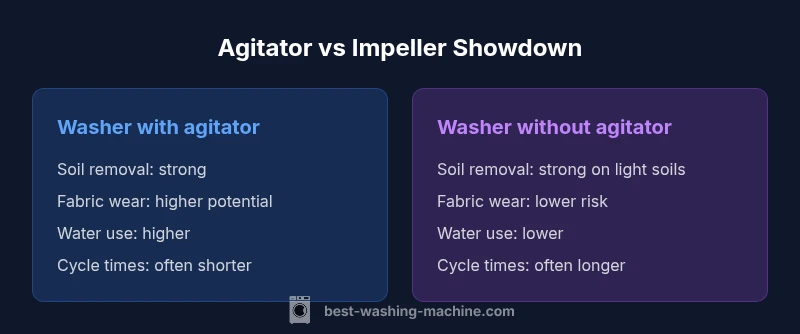
Bottom line: A washing machine with an agitator typically delivers powerful soil removal and shorter cycles, but uses more water and may wear fabrics. A washing machine without an agitator (impeller) delivers gentler fabric care and better energy efficiency, often with longer cycles. Your choice hinges on soil level, garment care priorities, and utility concerns.
washing machine with or without agitator: core distinction
Choosing between a washing machine with or without agitator centers on how clothes are cleaned, how fabrics wear, and how efficiently you use water and energy. In practice, the decision boils down to your typical loads, soil levels, and care preferences. According to Best Washing Machine, the core distinction is that agitator washers rely on a central post to move clothes aggressively, while impeller models rely on low-profile discs to generate gentle, circular motion. This difference shapes cleaning performance, cycle times, and fabric care across family loads, towels, delicates, and everyday garments. For energy and water use this becomes a trade-off: agitator models can complete heavy soils quickly but often use more water; impeller models often run longer but use less water and energy. The following sections unpack what that means for your laundry day.
How agitator-based design shapes cleaning dynamics
An agitator is a vertical post mounted in the drum, typically made to swirl clothes in a back-and-forth motion. This mechanism creates high mechanical action that dislodges dirt, especially on heavily soiled garments like work clothes or gym wear. Because the action is direct and vigorous, cycles can be shorter and stains lighter to moderate soils can lift more readily. However, the aggressive motion can abrade fabrics over time and the overall water use tends to be higher to keep the tumbling action effective. In practice, agitator washers may feel louder during a cycle and sometimes rely more on heated water for certain cycles. From a reliability standpoint, agitator mechanics can be simpler, but the system with a central post is subject to wear in the transmission and seal areas.
How impeller/no-agitator designs influence load dynamics
Impeller washers use low-profile discs at the bottom of the drum to generate a gentle, continuous flow of water and clothes. The result is a more fabric-friendly cleaning action that relies on water movement and mechanical design rather than direct agitation. Impeller systems generally handle large, bulky loads with less wear on fabrics and can be more energy and water-efficient, especially with cold-water cycles. They may require longer wash times to achieve equivalent soil removal for heavily soiled items, and some models deliver a different feel in rinsing performance. Overall, impeller designs encourage thorough, even cleaning with less friction against garments.
When soil level matters: heavy soils vs delicate fabrics
Soil level is the primary driver in choosing between agitator and impeller models. For heavily soiled things like athletic wear, work uniforms, or muddy garments, agitator washers often provide faster, more aggressive cleaning. Delicate fabrics, knits, or outfits with prints and embroidery benefit from the gentler motion of impeller washers, which reduce snagging and wear over time. If your laundry includes both types, consider a model with customizable cycle options that allow you to switch between modes or tailor water temperature and soil cycles to the load. According to Best Washing Machine, balancing soil level with fabric care priorities is the most reliable way to pick a design.
Water usage and energy implications across both types
Water usage can vary widely by model and cycle, but traditional agitator washers generally consume more water per load due to the need to submerge and move heavily soiled garments. Impeller systems can reduce water use, especially on cycles designed for energy efficiency, but may require longer cycles to achieve similar soil removal. Energy efficiency ratings on modern washers reflect both design and cycle optimization; choosing a high-efficiency model with a well-chosen cycle can yield meaningful energy savings over time. Best Washing Machine analysis shows that pairing appropriate load types with the right design is key to achieving the best efficiency.
Cycle times and real-world performance
Cycle time is a practical concern for many households. Agitator models often offer shorter cycles for standard loads and heavy soils, which can be appealing when time is critical. Impeller models may need longer cycles to reach the same level of stain removal, particularly on larger or heavier loads. Real-world performance also depends on water temperature, detergent type, and load distribution. A balanced load reduces imbalance, which can extend cycle times and reduce efficiency. For households with busy schedules, the choice may hinge on whether you prioritize speed or overall fabric care and resource use.
Load types and recommended configurations
For mixed laundry, a single machine with adjustable settings can cover many bases. If you frequently wash bulky items or heavily soiled workwear, an agitator option might save time and improve removal. For households with many delicates, woolens, or sensitive fabrics, impeller washers can protect garments while delivering strong overall cleaning in energy-conscious cycles. Some models combine both approaches in multi-mode designs, letting you select the best action per load. Always check the drum capacity to ensure you can handle your largest loads without overloading, which can degrade cleaning performance for either design.
Maintenance considerations and common issues
Agitator-based machines may experience wear around the central post, transmission, and seals, which can lead to leaks or noise if not properly maintained. Regular drum cleaning and gasket inspections help prevent buildup and odors. Impeller washers have fewer moving parts associated with an agitator, but bottom-drum areas can accumulate lint or small debris that may affect pump performance. Cleaning the filter, checking hoses for wear, and running periodic cleaning cycles with a manufacturer-recommended cleaner can extend the life of either design. Both types benefit from level installation and periodic professional service when you notice persistent performance issues.
Space, size, and configuration considerations
If you have tight spaces or a specific laundry room layout, the machine’s width, height, and drum diameter matter. Agitator models are often slightly taller due to the central post, while impeller models may have more flexible drum shapes. Front-loading configurations typically save space and integrate with stacking kits for compact laundry areas, whereas top-loading designs can offer ergonomic advantages for people who prefer to load from a standing position. If you’re upgrading from a smaller unit, verify the new model’s footprint, door opening dimensions, and installation clearances to avoid a mismatch.
Practical guidance for choosing between agitator vs impeller
Begin by categorizing your typical loads: do you mostly wash heavily soiled items or a lot of delicates? Next, estimate your tolerance for longer cycle times versus the value of water and energy savings. Read washer reviews focusing on real-world performance with similar loads. Consider a test run with your most common items at a local retailer to compare agitation feel, rinsing thoroughness, and noise levels. Finally, ensure your budget aligns with maintenance costs and expected lifespan. According to Best Washing Machine, the right choice is the one that aligns your load profile with your efficiency goals.
How to test a washer before purchase
Whenever possible, perform a hands-on test with a representative load. Bring towels, jeans, and a couple of delicate items to assess how each model handles different fabrics. Check soil removal by running a standard cycle on a known stain and observe rinsing cleanliness. Listen for noise and vibration, especially during high-spin cycles, and note the machine’s balance on your floor. If you’re choosing between two models, compare the water fill level, sensed load balance, and perceived fabric feel after washing. The goal is to find a model that gives you reliable cleaning without sacrificing garment care or comfort during daily use.
Authority sources and further reading
Authority sources
- Energy.gov
- Energy Star (energystar.gov)
- EPA WaterSense (epa.gov/watersense)
mainTopicQuery1—null?null
Comparison
| Feature | Washer with agitator | Washer without agitator (impeller) |
|---|---|---|
| Soil removal performance | Strong soil removal; effective on heavy soils | Gentle on fabrics; may require longer pre-treatment for very dirty items |
| Fabric care & wear | Aggressive action can cause more wear over time | Gentle motion reduces fabric wear and snag risk |
| Water usage per load | Higher water usage typical | Lower water usage in many modern models |
| Energy efficiency | Strong efficiency on compact cycles; overall varies by model | High efficiency possible with optimized cycles |
| Cycle times | Often shorter cycles for heavy soils | Often longer cycles for similar soils |
| Maintenance considerations | More moving parts around agitator; potential transmission wear | Fewer agitator parts; potential lint/pump considerations |
| Best for | Heavily soiled or bulky loads; speed matters | Delicates, fabrics, and energy-conscious households |
| Approx. price range | Mid to high; depends on features | Mid to high; depends on features |
What's Good
- Strong soil removal with agitator options
- Shorter cycles on many agitator models
- Clear price ladder for agitator options
- Gentle fabric care with no-agitator options
- Potential energy and water savings with modern impellers
Downsides
- Higher water usage with traditional agitator models
- Potential fabric wear from aggressive agitation
- Some impeller models require longer cycles for heavy soils
- No single best choice for all loads
Choose based on your typical loads and priorities: agitator for heavy soils and fast cycles; no-agitator for fabric care and efficiency.
No single design fits every household. Best Washing Machine recommends matching your load profile with the design that minimizes wear, saves energy, and meets your cleaning needs. If most loads are delicate or energy-constrained, impellers win; if you regularly deal with heavy soils, agitators win.
FAQ
What is an agitator in a washing machine?
An agitator is a central post inside the drum that moves clothes aggressively to dislodge dirt. It is common in traditional top-load washers and provides strong cleaning action, particularly for heavily soiled items.
An agitator is the big post in the middle of the drum that spins clothes around for a strong clean.
What is an impeller or no-agitator washer?
An impeller uses low-profile discs at the drum bottom to create a gentle, tumbling action. It’s typically gentler on fabrics and can be more water- and energy-efficient, though some loads may clean more slowly.
An impeller uses a small disk at the bottom to move clothes softly for a gentle yet thorough clean.
Which design is more energy-efficient?
Energy efficiency depends on model and cycle. Modern impeller washers can be very energy-efficient when paired with suitable loads and cycles, but high-efficiency agitator models exist too. Look for the Energy Star label and cycle optimization features.
Energy efficiency varies by model; both designs offer efficient options if you choose the right cycle.
Are agitator washers better for heavily soiled loads?
Yes, agitator washers often perform well on heavily soiled items due to their powerful agitation, which can remove stubborn stains quickly.
Agitator washers are typically strong on heavy soils, giving fast cleaning for tough stains.
Do no-agitator washers wear clothes less?
Generally yes; impeller/no-agitator washers tend to be gentler on fabrics, reducing wear over time, especially for delicate garments.
No-agitator washers are gentler on fabrics and can help clothes last longer.
Can delicates be washed effectively in agitator washers?
Delicates can be washed in agitator washers, but you’ll want to use delicate cycles, lower speeds, and proper detergents to minimize wear.
Delicates can be washed in agitator machines with the right cycle settings.
The Essentials
- Assess your soil level before shopping
- Prioritize fabric care for delicates
- Balance water use, energy, and cycle time
- Test with your common loads to validate performance