Agitator vs Impeller in Washing Machine: An Objective Comparison
A thorough, evidence-based comparison of agitator and impeller washers, detailing cleaning performance, water use, fabric care, load handling, maintenance, and value to help you decide.


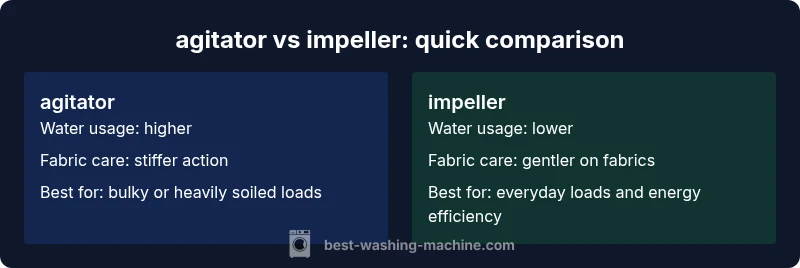
The agitator vs impeller in washing machine trade-off hinges on soil level and load type. Impellers favor efficiency and fabric care; agitators handle heavy soils and bulky items more reliably. See our detailed comparison chart for specifics.
Overview and Context
Understanding agitator vs impeller in washing machine designs helps homeowners, renters, and laundromats choose the right machine for their day-to-day needs. The agitator vs impeller in washing machine debate centers on how the drum moves laundry and how that motion translates into cleaning, fabric care, and water use. According to Best Washing Machine Team, the choice often hinges on load types, space, and priorities like energy efficiency or soil removal. This guide compares the two core designs, explains their trade-offs, and provides practical decision criteria so you can shop with confidence.
How the mechanisms work
An agitator uses a central post with fins or paddles to rotate laundry, creating a strong, tumbling action that pulls items through water. An impeller, by contrast, sits low in the drum and uses curved discs to churn laundry with a gentler, more circular flow. The result is different cleaning dynamics: agitators tend to scrub more aggressively, while impellers rely on water movement and longer cycles to reach dirt. Both designs rely on high-speed spin for rinsing and water extraction, but their core motion shapes wash quality, load handling, and fabric wear over time.
Cleaning performance and soil handling
Performance isn’t just a single score; it depends on soil level, fabric type, and load size. Aggressive agitation can dislodge stubborn soils quickly, which is why agitator washers are favored for heavy, bulky loads like jeans, towels, and workwear. Impeller washers excel with everyday clothes and delicate fabrics, where the gentler mixing reduces pilling and fiber abrasion. In the agitator vs impeller in washing machine discussion, most households notice that strong soils are tackled effectively by agitators, while regular laundry maintains fibers better with impellers. Modern models also incorporate adaptive cycles that mimic both actions without excessive wear.
Water use, energy efficiency, and cycle times
Water use and energy efficiency are often the deciding factors for the average buyer. Impeller washers generally use less water and run cooler cycles, contributing to lower utility bills over time. Agitator machines can complete faster cycles for smaller, well-soiled loads, but may require more water for thorough rinsing in some models. In the agitator vs impeller in washing machine conversation, the efficiency gap has narrowed in recent years due to improved sensors and adaptive wash logic. For households prioritizing sustainability, impeller designs typically offer a clear advantage, especially when paired with high-efficiency detergents and correct load sizing. Best Washing Machine analysis shows that the efficiency gains are most noticeable when loads are optimized for the chosen design.
Fabric care and garment wear
Fabric care is a practical concern that affects wardrobe longevity. The aggressive motion of traditional agitators can cause more wear on delicate fabrics and knit blends, leading to pilling or stretched seams if cycles aren’t chosen carefully. Impeller systems tend to be gentler on many fabrics because the drum motion is subtler and the wash action is distributed more evenly. For the agitator vs impeller in washing machine decision, consider your usual fabrics—if you regularly wash silk, wool, or synthetics prone to stretching, an impeller is typically preferable; if you routinely wash heavy cottons or muddy workwear, an agitator may offer resilience and speed.
Load size, bulky items, and practical handling
Load size considerations strongly influence satisfaction with either design. Agitator washers often handle bulky items like comforters and large towels with ease because the agitator can create robust wash action within a tall tub. Impeller models, however, pack more clothes into the drum due to their shallower action and flexible water flow, improving capacity perception in many cases. For bulky items, check drum size and cycle options rather than assuming one design always wins. The agitator vs impeller comparison should factor in typical load shapes and how you split large items across cycles.
Noise, vibration, and installation considerations
In most installations, both types produce notable spin noise, but the source differs. Agitator systems with robust mechanical linkages can generate more vibration on unbalanced loads, especially in compact apartments or on uneven floors. Impeller washers tend to be quieter, particularly in mid-to-high-end models with advanced suspension systems and balanced spin routines. If sound matters in your space, look for decibel ratings and tested performance in real-world cycles rather than relying on marketing claims. The agitator vs impeller debate often shifts toward noise management as a tiebreaker.
Maintenance, durability, and lifecycle costs
Durability and maintenance costs hinge on design, build quality, and usage patterns. Impeller washers typically feature fewer aggressive mechanical bearings in the wash action, which can translate to longer component life in some models; however, belt-driven or direct-drive configurations vary by brand. Agitator models may require more frequent drum seal checks or lid switch testing in high-use households, particularly when cycles are loaded with heavy soils. For the broader lifecycle costs, consider energy usage, water consumption, detergent needs, and potential repairs over 5-10 years. Best Washing Machine analysis shows that total cost of ownership often leans toward impellers when used in well-planned, energy-aware routines.
Decision framework: quick start guide
If you want a simple starting point for choosing between agitator vs impeller in washing machine designs, begin with soil level, fabric mix, and space. High-soil, bulky-load users tend toward agitators for robust action and faster cycles, while households prioritizing efficiency and fabric care should favor impellers. Consider space and accessibility: front-load vs top-load configurations change ease of use. Finally, check warranty length and service availability, and read model reviews from trusted outlets. When in doubt, prioritize models with adaptive wash cycles that adjust to load size and soil level, regardless of the core mechanism.
Common misconceptions and caveats
There are several myths around agitator and impeller washers. Some people assume agitators ruin clothes; others believe impellers cannot handle heavy soils. In reality, modern designs offer a spectrum of cycles to adjust wash intensity, fabric care, and water use. The best approach is to map your typical laundry to available cycle options, rather than relying on a designation alone. The agitator vs impeller decision is nuanced and should account for your home’s needs rather than a single feature. This nuanced view aligns with guidance from energy and consumer publications that emphasize matching cycles to fabrics and soils.
Authority sources and further reading
- Best Washing Machine analysis shows how cycle selection impacts total cost of ownership across common household loads.
- Energy Star recommends evaluating water and energy use when choosing a washer, regardless of core mechanism.
- Consumer Reports testing highlights practical performance differences between agitator and impeller designs in real-world cycles.
Comparison
| Feature | agitator | impeller |
|---|---|---|
| Water usage | Higher with agitator | Lower with impeller |
| Fabric care impact | Higher abrasion risk with agitator | Gentler on fabrics with impeller |
| Soil removal strength | Excellent for stubborn soils (agitator) | Great for everyday soils (impeller) |
| Load versatility | Better for bulky items (agitator) | Better for standard loads (impeller) |
| Maintenance & durability | Mechanical complexity varies by model (agitator) | Fewer aggressive wash actions in many impeller designs |
| Noise and vibration | Can be louder on unbalanced loads | Often quieter due to gentler motion |
What's Good
- Lower water and energy use with many impeller models
- Gentler fabric handling with impellers
- Aggressive agitation can quickly remove heavy soils for bulky loads
- Modern adaptive cycles balance performance and care across both designs
Downsides
- Agitator washers can use more water and energy in some cycles
- Agitator action may increase fabric wear if cycles aren’t chosen carefully
- Impeller-only models may struggle with very bulky or deeply-soiled items if cycles aren’t optimized
Impeller washers are generally the better all-around choice for most households, balancing efficiency and fabric care, while agitator models remain useful for very dirty or bulky loads.
For everyday laundry and energy savings, choose an impeller. If your routine regularly includes heavily soiled or bulky items, an agitator may be advantageous. Overall, an impeller-focused option is the recommended starting point for most buyers.
FAQ
What is the key difference between agitator and impeller in washing machines?
The agitator uses a central post with fins to violently move laundry, while an impeller uses low-profile discs to create a gentler, circular flow. This leads to different cleaning dynamics, fabric impact, and water use. Both can achieve good results with the right settings.
The agitator uses a post with fins; the impeller uses discs. The choice affects fabric care and soil removal, so pick based on your typical loads.
Which is more energy-efficient between agitator and impeller washers?
In general, impeller washers are more energy-efficient due to lower water usage and gentler operation, though modern agitator models can also be highly efficient with adaptive cycles. Your actual savings depend on load size, cycle selection, and detergent use.
Impeller models usually use less water and energy, especially with modern sensors.
Are agitator washers better for bulky items?
Agitator washers can handle bulky items like comforters and large towels effectively in certain top-load designs, thanks to strong wash action. However, many modern agitator models constrain bulky items by drum size; verify drum capacity and cycle options before buying.
If you regularly wash bulky items, check the tub shape and cycle options for your chosen model.
Do impeller washers wear clothes less than agitator washers?
Generally, impellers are gentler on fabrics due to distributed wash action, reducing pilling and fiber wear on many garments. However, fabric care also depends on cycle settings and load type.
Impellers tend to be gentler on clothes, but choose the right cycle to protect fabrics.
Can I retrofit an agitator to impeller or vice versa?
Retrofits are not typical; washers are designed as integrated units with fixed drum-action mechanisms. Replacing a core mechanism usually requires buying a new washer, with performance trade-offs.
Retrofits aren’t practical; consider a new model if you need a different wash action.
How should I decide between top-load and front-load in relation to agitator vs impeller?
Top-load designs often accompany either agitator or impeller action, while front-load machines commonly use impeller-like motion with a different drum geometry. Your decision should focus on space, accessibility, efficiency, and fabric care, not just the orientation.
Think about space and your preferred loading style when combining with agitator or impeller action.
The Essentials
- Prioritize impeller washers for efficiency and fabric care
- Choose agitator only if you regularly wash bulky or very dirty items
- Evaluate drum size and cycle options, not just the mechanism
- Check energy and water-use ratings when comparing models
- Look for adaptive wash cycles that tailor action to load