How Big Is a Washing Machine? A Practical Size Guide
Learn about typical washing machine sizes, how dimensions affect space and installation, and tips for choosing the right size for apartments and small homes today.


Definition: Washing machines vary in external dimensions and drum capacity, but most residential models fall within a few standard ranges. When you ask how big is a washing machine, you’re usually asking about external width, height, and depth as well as drum capacity. This guide explains typical sizes, how to measure your space, and what size fits your needs.
How big is a washing machine? Understanding what size means
When considering size, most shoppers mean a balance of external footprint and drum capacity. External dimensions affect where you can place a washer, while drum size determines how much laundry you can load per cycle. In practical terms, this means width, height, and depth matter for alcoves, closets, and laundry rooms, but drum capacity directly influences how much you can wash in a single cycle. According to Best Washing Machine analysis, typical residential machines stay within standard exterior footprints while offering a range of capacities to meet different family needs. This section outlines what those ranges look like and how to interpret them for your space and routine.
Typical external dimensions by machine type
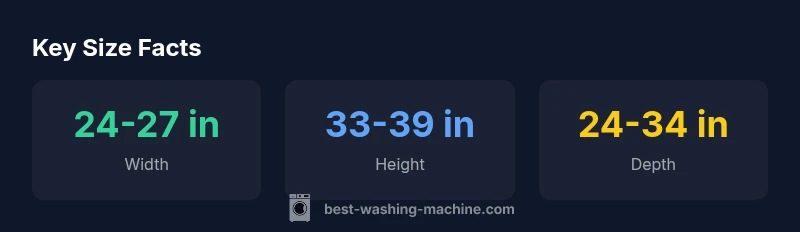
Most residential washers fall into two broad families: front-load and top-load. Front-load machines are typically compact in depth and can fit tighter spaces, while top-load models often require more vertical clearance but can offer easier access for some users. Common widths hover around 24-27 inches for both styles, but heights and depths vary more widely. For a practical baseline, many front-load units run about 33-39 inches tall and 24-34 inches deep, while standard top-loads can extend taller due to lid clearance and control panels. Start with a target footprint of 27 inches wide when possible and confirm unit depth and door swing in your space.
Drum capacity vs external size
Drum capacity (the usable interior volume) does not map perfectly to exterior size. A 3.0-5.0 cu ft drum is typical for many full-size residential washers, but compact models can offer 2.0-3.0 cu ft with a smaller exterior footprint. If you load bulky items (bath towels, bedding) regularly, prioritize drum size over marginal gains in exterior dimensions. In many cases, you can achieve needed capacity with a slightly larger footprint, but energy efficiency and cycle times should also factor into your choice. The key is matching the load you expect to handle with a drum that fits your doorway and alcove.
Measuring space before you buy
Before purchasing, measure the intended installation area precisely. Record width, height, and depth with the doors and drawers open, and leave at least 1 inch of clearance on all sides for ventilation and hoses. Check entering doorways, stairwells, and hallway turns to confirm you can maneuver the unit into place. Don’t forget to account for connectors and hoses that extend behind the machine. A simple floor plan with approximate room dimensions can save you a lot of back-and-forth.
Depth, width, height: converting units and standards
In the United States, most washers use inches for exterior dimensions, with metric equivalents common in Europe and Asia. A quick rule of thumb is to round to the nearest inch for space planning, then verify exact specs from the model’s data sheet. For international purchases, remember that a 60 cm width translates to roughly 23.6 inches. Always cross-check product drawings and installation clearance, especially if you’re moving a unit through a tight doorway or into a finite closet.
Special-case washers: compact, slim, and stackable options
If space is extremely tight, consider compact (around 24 inches wide) or slim models that can fit into narrow closets or laundry niches. Stackable configurations, where a compact washer is paired with a compact dryer, can dramatically reduce floor space while maintaining full functionality. When choosing stackables, ensure the pair is designed for vertical installation, and verify venting and electrical requirements. Remember: a slightly larger footprint may deliver more capacity and efficiency per load, so weigh space savings against performance needs.
Practical implications for renters and small spaces
Renters and small-space dwellers benefit from flexible options such as compact front-loads or stackable sets. Look for models with high energy efficiency ratings to minimize utility costs, and consider washable countertop or shelving alternatives for occasional overflow during peak laundry weeks. If you expect to stay in a tight space for several years, prioritize a size that accommodates your typical laundry load today while leaving room for future needs. Space planning matters as much as price.
How installation and transport affect size expectations
Even before you buy, consider how the unit will be installed and transported. Some apartments require service elevators or building access windows. Behind the washer, allow ventilation and space for hoses and drainage. If you’re replacing an old unit, verify that the new model’s dimensions won’t require reconfiguring nearby cabinetry or plumbing. In many cases, installers can adjust for minor variances, but extreme deviations from standard footprints require more planning.
Size, longevity, and reliability: does bigger mean better?
Bigger does not automatically mean longer life or better performance. Size should align with your typical loads, energy goals, and daily routines. Larger drums may offer faster daily throughput but can demand more water and energy per cycle. Look for models with good energy efficiency ratings and reliable build quality. A properly sized washer that matches your needs will often outlast a larger, poorly matched model by reducing wear on components and cycles.
Representative size ranges for common residential washing machines
| Dimension/Aspect | Low end | High end |
|---|---|---|
| External size (W × H × D) | 24 in × 33 in × 24 in | 27 in × 39 in × 34 in |
| Drum capacity (cu ft) | 2.0 cu ft | 5.0 cu ft |
| Weight (empty) | 125 lb | 200 lb |
FAQ
What is the most common size for a residential washing machine?
Most standard residential washers are around 27 inches wide and 38 inches tall, with depths near 30 inches. Compact models offer tighter footprints, while some space-saving designs require taller ceilings or deeper alcoves.
Most homes use standard 27-inch width washers, about 38 inches tall; compact options exist for tighter spaces.
Do compact washers have the same drum size as full-size models?
Compact washers usually have smaller exterior footprints with drum sizes around 2.0-3.5 cu ft, compared to 3.0-5.0 cu ft for many full-size models.
Compact washers save space but often have smaller drums than full-size units.
Can I install a washer in a closet or hallway?
Yes, with adequate clearance and ventilation. Ensure door swing, hoses, and drainage won’t be blocked, and that there is enough room to service the unit.
Yes, but make sure there’s ventilation and space for hoses and service.
Will larger washers use more energy?
Larger drums can require more water and energy per cycle, but many larger models are highly energy-efficient. Look for ENERGY STAR or equivalent ratings and consider your typical load.
Bigger isn’t inherently more energy-heavy if the model is efficient.
What measurements should I take before buying?
Measure width, height, depth, and door openings. Check for clearances around the unit and along any pathway to installation. Confirm hose length and drainage accessibility.
Measure the space, doors, and access routes before buying.
Are stackable washers as effective as standard models?
Stackable washers save floor space and offer comparable wash performance when paired with the right dryer. Ensure the pair is designed for stacking and maintains proper ventilation.
Stackables save space and work well if designed to be stacked.
“"Size is only one part of the equation; a well-chosen washer balances space, capacity, and efficiency to deliver reliable performance day after day."”
The Essentials
- Know your space first; measure width, height, and depth.
- Match drum capacity to your routine, not just exterior size.
- Consider compact or stackable options for small places.
- Account for clearances and door openings during planning.
- The Best Washing Machine team recommends sizing for today and future needs.