How Big Is a Standard Washing Machine: Size Guide for 2026
Discover typical dimensions, capacities, and space needs for a standard washing machine. This guide covers width, depth, height, and drum size, with practical tips for fitting full-size or compact models in your home.


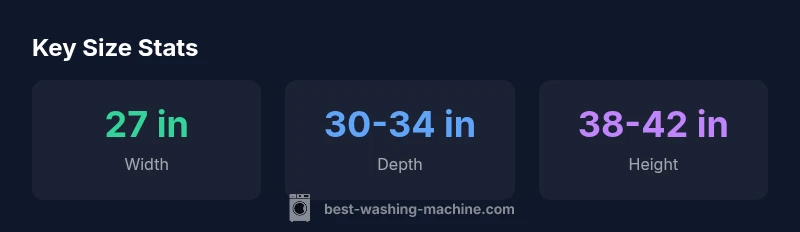
A standard residential washing machine typically measures about 27 inches wide, 30-34 inches deep, and 38-42 inches tall. In metric, that's roughly 68-69 cm wide, 76-86 cm deep, and 97-107 cm high. Most full-size machines offer a drum capacity around 4.0-5.0 cubic feet (112-142 L). Note that dimensions vary by model and installation clearance matters. When planning, consider door swing, ventilation, and surrounding cabinetry to ensure a comfortable, functional setup.
How big is a standard washing machine? A practical size guide
To answer how big is a standard washing machine, start with its typical footprint. A standard residential washer is about 27 inches wide, 30-34 inches deep, and 38-42 inches tall. In metric, that's roughly 68-69 cm wide, 76-86 cm deep, and 97-107 cm high. Most full-size machines offer drum capacities around 4.0-5.0 cubic feet (112-142 L). Note that dimensions vary by model and installation clearance matters. When planning, consider door swing, ventilation, and surrounding cabinetry to ensure a comfortable, functional setup. For feasibility, map your laundry area to see how a full-width machine fits next to counters, sinks, and any adjacent appliances.
For perspective, different families of washers use different footprints. Front-load machines usually fit within the 27-inch width common in many homes, while top-load variants can extend slightly deeper due to the lid and console. If you are upgrading from an older unit, expect a few inches of variance depending on the model line and whether you opt for a high-efficiency (HE) drum or a standard drum. The main idea is to verify that the footprint aligns with available space and that you have enough clearance for hoses, venting, and door operation.
Dimensions by type: width, height, and depth
Understanding dimensions in isolation is helpful, but practical sizing means looking at the whole footprint. Widths commonly sit around 27 inches for most standard residential units, though compact models exist at 24 inches. Depths typically range from 30 to 34 inches, with some all-electric or special-config models dipping to about 28 inches. Heights commonly span 38 to 42 inches, giving a comfortable reach for most adults and aligning with standard cabinetry elevations. For installers or contractors, measure both the floor and any rear clearance to accommodate hoses and ventilation. Always check the installation guide for exact numbers, since some configurations include protruding pedestals or upright pedestals that alter the overall height.
- Front-load washers: Typically close to the standard width, with variable depth depending on door design and drum size.
- Top-load washers: Height can be higher due to the lid and top console, while depth often tracks standard ranges.
- Compact or apartment models: Narrower widths (around 24 inches) and shallower depths, but often with smaller drum capacity.
If you foresee tight quarters, consider a compact 24-inch model or a stacked washer-dryer combo to save floor space while preserving capacity. A good rule is to leave at least 1 inch of clearance on each side and 2 inches behind for hoses and venting.
How to measure your space and choose a washer
The most reliable way to pick the right washer is to measure your exact space and compare with the model’s footprint. Start with width, height, and depth; then verify clearance for door swing, venting, and drainage hoses. Check fixed cabinetry or shelves that might constrain installation. If your space is slightly narrower than the standard 27 inches, look for compact models or models advertised as “24-inch width.” Always read the installation manual for minimum clearances. Also, account for the adjacent washer-dryer gap if you are placing the units side by side; you’ll want a stable, level surface with room to access power cords and water hoses. Finally, confirm your laundry space can accommodate the recommended minimum ventilation and any added storage above the unit.
Real-world examples and setup tips
Consider a small apartment laundry closet that is 30 inches wide and 40 inches deep. A 24-inch compact washer would fit with ample clearance for hoses and a small pedestal beneath for easier loading. In a three-bedroom home with a dedicated laundry room, a standard 27-inch washer fits comfortably next to a 30-inch sink and a 36-inch counter, provided you leave space for the door to open fully. If you’re planning to stack a washer and dryer, verify the stacking kit compatibility and the vertical height allowed by your cabinetry. For pet owners or households with children, floor mats and vibration pads can help stabilize the unit and reduce movement during cycles. Finally, after installation, run a test cycle to ensure hoses are secure and there are no leaks, especially around the drain hose connection.
DATA-TABLE
Footprint and capacity comparison for standard vs compact washers
| Model Type | Width | Depth | Height | Capacity |
|---|---|---|---|---|
| Front-load | 27 in | 30-34 in | 38-42 in | 4.0-5.0 cu ft |
| Top-load (HE) | 27 in | 30-34 in | 40-44 in | 4.0-5.0 cu ft |
| Top-load (Standard) | 27 in | 29-33 in | 41-45 in | 3.5-4.5 cu ft |
FAQ
What qualifies as a standard washing machine size?
Most homes use washers around 27 inches wide with a footprint near 38-42 inches tall and 30-34 inches deep. This standard footprint supports regular capacity and easy installation, though some models are compact (about 24 inches wide). Always check the exact dimensions in the product specs.
Most standard washers are about 27 inches wide, 30-34 inches deep, and 38-42 inches tall.
Do compact washers fit in standard spaces?
Yes, compact washers are typically about 24 inches wide and slightly shallower. They fit smaller spaces but may have lower drum capacity. Verify the exact width and depth and ensure door clearance.
Yes—compact washers fit smaller spaces, but check width, depth, and door clearance.
Can I fit a full-size washer in a tight laundry closet?
It’s possible if the closet is at least 30 inches wide and provides proper door clearance. Stacking or slimline configurations can also help maximize space.
A full-size washer can fit in a tight closet if the space is carefully measured and you account for door swing.
Are front-load and top-load washers different in footprint?
They can share similar width (around 27 inches) but depth and height often differ due to internal design and doors. Front-load models are usually slightly shallower; top-load units may be taller due to the lid and console.
Footprints are similar in width, but depth and height can vary by design.
How should I measure space for a new washer?
Measure width, height, and depth, plus ensure clearance for hoses, doors, and ventilation. Add at least 1–2 inches clearance on sides and 2 inches at the back.
Measure the space and add extra clearance for hoses and doors.
“Sizing a washer correctly isn’t just about fit—it’s about airflow, door swing, and maintenance access. Plan for installation clearance and think about future needs as you size.”
The Essentials
- Measure your space before shopping.
- Expect standard washers to be about 27 in wide and 38-42 in tall.
- Check door swing and hose clearances to avoid installation issues.
- Consider compact or stackable options for tight spaces.
- Drum capacity commonly ranges from 4.0–5.0 cu ft for full-size models.