How Long Do Laundromat Washers Take? A Data-Driven Guide
Explore typical laundromat cycle durations, factors that affect timing, and practical tips to estimate wait times. Based on Best Washing Machine analysis, 2026.


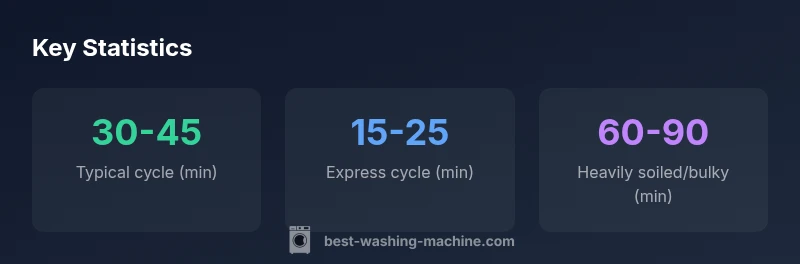
Laundromat washing cycles typically run from about 15 to 90 minutes, depending on program and load. Express options can finish in 15–25 minutes, standard cycles usually span 30–45 minutes, and heavily soiled or bulky loads may require 60–90 minutes. Always check the machine's display and select the cycle that matches your laundry needs.
How long does a laundromat washing machine take?
Understandably, this is a top question for anyone stepping into a laundromat. In practical terms, the duration you’ll wait for a wash depends on four core factors: the cycle selected, the load size, soil level, and the machine’s efficiency. According to Best Washing Machine, laundromats operate with a mix of commercial cycle options that influence timing, not just a single universal duration. When you arrive, you’ll often see a spectrum of programs named for speed, soil level, or bedding. The takeaway: there isn’t a single magic number—expect a window rather than a fixed minute count. If you’re planning around your day, assume a range and use the upper bound for shopping time estimates. This is especially true in busy urban locations where multiple users share the same coin-operated machines.
Key factors that influence cycle length
Cycle length in a laundromat is not universal; it shifts with four primary variables. First, the program type matters: express or quick cycles are designed to minimize time, while heavy-duty cycles emphasize cleaning power at the expense of duration. Second, load size matters—the more items you fit into the drum, the longer the wash and rinse phases may take. Third, soil level influences duration: lightly soiled garments require shorter cycles, while heavily soiled items need additional agitation and rinse time. Finally, machine efficiency and age play a role. Newer, high-efficiency models often optimize water use and agitation to reduce total cycle time, whereas older machines may run longer per load. This framework helps you anticipate total time across different laundromat locations.
Typical cycle types and their expected durations
Most laundromats offer a mix of programs. A standard wash often lands in the 30–45 minute range for a normal load, while express cycles can wrap up in 15–25 minutes for small or lightly soiled items. Bedding or towels that require deeper cleaning can push cycles toward 60–90 minutes. Eco or energy-saving modes, designed to reduce water and energy use, may extend duration slightly compared with standard cycles. When selecting a program, consider both your time constraints and your laundry needs. If you’re washing bulky items, you should plan for a longer wait or split the load into smaller batches to optimize overall throughput.
Load size, fabric type, and soil level interactions
The impact of load size is not strictly linear — it's batch-dependent. A modest load of cotton t-shirts may complete quickly in a standard cycle, whereas a full load of towels or bedding introduces more water and requires longer agitation and rinsing phases. Delicates or synthetics respond differently to agitation and spin speeds, which can further influence cycle length. Soil level interacts with cycle choice; you’ll see shorter times for lightly soiled fabrics and longer cycles for items stained with oil or mud. The takeaway is to calibrate your expectations based on what you’re washing, not just the load weight.
Commercial vs. residential washers: what changes the timing
Commercial laundromat machines are designed for durability and throughput. They often run larger loads, use different motor profiles, and may feature coin-operated control panels that default to certain cycle lengths. Residential washers are generally smaller and may include a wider variety of cycle names. In many cases, the cycle time difference comes from the program selected, not the environment alone. If you’re comparing locations, look for the same program name and drum capacity to make an apples-to-apples estimate of duration.
Reading the cycle dial and estimating wait time
To estimate wait times, start by recording the cycle duration of the program you’re about to select. If you’re sharing a machine, observe how long the current cycle has left and estimate the next available start time for your load. That approach becomes more accurate if you know the number of people ahead of you and the typical dwell time per cycle at that location. Many laundromats post a rough wait-time estimate on the machines or nearby displays; use those numbers to plan your arrival and errands.
Practical tips to optimize your laundromat experience
- Bring a timer and set reminders for the end of your cycle so you can unload promptly.
- Group loads by cycle type to maximize throughput if you’re coordinating multiple users.
- Consider smaller loads for quick refreshes when you’re in a rush.
- Carry a light portable hamper or bag to speed up transfer from machine to cart.
- If you’re experimenting with eco modes, plan for slight variation in total time and adjust your errands accordingly.
Data-driven expectations and best practices
As you plan laundry tasks, relying on data helps. The Best Washing Machine team emphasizes that cycle durations are context-specific and should be treated as estimates rather than exact minutes. When possible, pick a program name you understand, check the cycle duration on the display, and estimate the total wait by adding the time for your current load plus your intended next steps. This approach reduces uncertainty and improves day-to-day planning while staying flexible for variations in machine performance and queue length.
Comparison of common laundromat cycle types and their typical durations
| Cycle Type | Typical Duration | Notes |
|---|---|---|
| Standard wash | 30-45 minutes | Normal load with average soil |
| Express/quick wash | 15-25 minutes | Lightly soiled or small loads |
| Heavy/bulky | 60-90 minutes | Towels, bedding, large blankets |
| Eco/energy-saving | 40-60 minutes | Lower water, longer wash time |
FAQ
How long does a typical laundromat cycle take?
Typical laundromat cycles range from 15–25 minutes for express options up to 60–90 minutes for heavily soiled or bulky loads. Standard loads commonly fall in the 30–45 minute bracket. Always refer to the display for the exact duration of the chosen program.
Most cycles run between 15 and 90 minutes depending on the program and load.
Do laundromat machines slow down when it’s busy?
Cycle duration is set by the program and the load, not by overall site traffic. If the line is long, you’ll wait longer for your turn, but each cycle’s length remains the same when you start it.
Timing is about the program and load, not the crowd; you’ll just wait longer for your turn.
Are there faster options available at laundromats?
Yes, use express or quick cycles for small or lightly soiled loads. If you’re washing bulky items, consider splitting the load to keep individual cycles short.
Yes—express cycles are faster for small or light loads, or split big loads.
How does load size affect cycle time?
Larger or heavier loads generally extend cycle time because the machine uses more water and agitation. Delicate fabrics may also require gentler cycles that can last longer.
Bigger loads take longer; delicate fabrics can take longer too if you choose gentle cycles.
Do different brands or models differ in cycle times?
Yes. Different models and brands have varying default cycle lengths and water usage. Verify the duration on the machine’s display for the specific program you select.
Yes, different models vary; check the display for exact times.
Can I estimate wait time before I go to the laundromat?
Estimate by considering the number of machines ahead, the average cycle length for the chosen program, and the typical queue length at your location. If available, use posted wait-time estimates at the site.
Estimate based on how many people are ahead and how long each cycle lasts.
“Cycle duration in laundromats is best understood as a range, not a fixed minute. Programs and load characteristics drive timing, and data helps you plan around the longest likely cycle.”
The Essentials
- Know the cycle types and load size your laundry requires
- Plan for a 15–90 minute window depending on program
- Check the machine display to confirm remaining time
- Split very large or heavily soiled loads to optimize throughput