Top Load Washing Machine vs Front Load: Which Is Best in 2026
A comprehensive, data-driven comparison of top load vs front load washing machines, covering efficiency, performance, space needs, maintenance, and total cost of ownership for 2026.


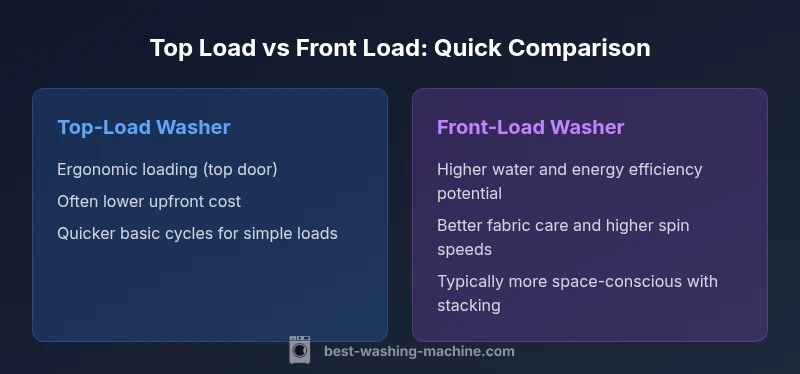
For most households, front-load washers deliver better energy and water efficiency and gentler fabric care, while top-load machines shine in faster cycle times and often lower upfront costs. The best choice depends on your space, budget, and daily laundry routine. In 2026, reputable models exist in both formats, making it possible to optimize for efficiency, convenience, or speed depending on your priorities.
Understanding the Core Difference
In the debate between the top load washing machine vs front load, the fundamental distinction is drum orientation. A top-load washer uses a vertical drum with the door on the top for loading, while a front-load washer uses a horizontal drum accessed via a door on the front. This difference drives nearly every other variable, from how clothes tumble to how much water is used, how the machine is loaded, and how energy is consumed over time. According to Best Washing Machine, the choice often hinges on what you value most in everyday use—speed, ease of loading, fabric care, or long-term efficiency. The goal of this section is to map your laundry priorities to the mechanical realities of each format and set expectations for performance across typical household loads.
How Top-Load and Front-Load Work
Top-load machines historically relied on an agitator that churns clothes through water, which can provide quick washing and straightforward repair access. Modern top-load models often offer more efficient designs, including high-efficiency impellers that reduce water usage while maintaining cleaning performance. Front-load machines drum rotate rather than churn, using a tumbling action driven by a motor and an internal balance system. This design improves fabric care and water extraction but requires careful door seals to prevent mildew. The Best Washing Machine analysis notes that, in practice, most users experience fewer load-time bottlenecks with front-load units once they acclimate to the door mechanics, while top-loads remain popular where rapid unload/load and ergonomic loading are priorities.
Energy, Water, and Detergent Use
Energy and water use are often the most persuasive reasons to choose one format over the other. Front-load washers typically use less water per cycle and operate efficiently across a broad range of temperatures, which helps reduce energy costs in climates with cold-water washes. Top-load washers, especially conventional agitator models, can use more water per cycle but may complete cycles faster for some load types. Detergent choices are important for both formats; most modern machines require HE (high-efficiency) detergents, and using the wrong detergent can impact performance and longevity. In 2026, a wide array of both front-load and top-load models support eco-minded cycles and cold-water options, helping households tune efficiency to their needs.
Performance in Real-World Laundry Scenarios
Laundry performance depends on fabric type, soil level, and load size. Front-load washers generally excel at delicate fabrics and heavy-duty bedding due to their gentler tumbling and effective water extraction, which also aids faster drying cycles. Top-load machines can handle bulky items and bulky bedding with simpler access and shorter cycle times, particularly when an agitator is present. For stain removal, front-load machines shine when used with longer ecocycles, while top-loads can deliver quick bursts for everyday messes. The choice often comes down to whether your household prioritizes fabric care and energy savings (front-load) or speed and upfront cost (top-load).
Size, Space, and Installation Considerations
Space planning is critical when choosing between top load vs front load. Top-load washers fit in spaces with higher overhead clearance and often offer simpler vertical installation. Front-load models demand a clear front space for door swing and may be more adaptable to stackable configurations when you want to maximize utility room. If you live in a compact apartment or a small laundry closet, a front-load unit with a front-access door and potential stacking ability can maximize efficiency, while a taller ceiling or surface may favor a compact top-load model. Remember to measure room clearance, door swing, and venting/line access.
Cost of Ownership and Maintenance
Upfront price is a frequent deciding factor. Top-load washers often come with lower initial cost, especially for basic models without fancy features, but long-term energy and water costs can sway the total to favor front-load units. Front-load machines typically command higher upfront prices but deliver better energy efficiency and water savings over time. Maintenance considerations also differ: front-load units require regular gasket cleaning to prevent mold/m mildew, and door seals should be inspected, while top-load models may be more straightforward to service due to accessible agitator components. In any case, choosing a modern, well-reviewed model with a good warranty is essential to minimize surprises.
Choosing Based on Your Laundry Habits
If your family does multiple daily loads, a top-load washer may offer the speed and ergonomic advantage you need. If you wash fewer but larger loads and care deeply about fabrics and energy consumption, a front-load model is typically the better long-term investment. Best Washing Machine suggests assessing your typical load size, fabric types, and budget, then weighing the trade-offs between cycle times, noise, stackability, and installation requirements. A practical approach is to list your top three priorities—speed, efficiency, or fabric care—and preview models that meet those criteria in your budget range.
Authoritative Sources and Practical Guidance
To help you validate these considerations, consult trustworthy sources and industry benchmarks. While model-specific performance varies, the general principles of top-load versus front-load design remain consistent: loading orientation drives ergonomics and capacity, water usage and energy consumption hinge on drum design and cycle efficiency, and monthly costs reflect both price and operational efficiency. In this article, we reference evidence from reputable outlets and ongoing consumer testing programs. For readers seeking deeper validation, the Best Washing Machine team recommends checking local utility programs and independent test reports to verify energy and water savings claims.
Authoritative sources
- U.S. Department of Energy (DOE) Energy Star Program: Energy efficiency criteria for residential clothes washers. https://www.energy.gov/eere/buildings/articles/energy-star-clothes-washers
- Consumer Reports washer ratings and testing methodology: https://www.consumerreports.org/cookware-dishwashers-clothes-washers
- University extension service guidance on appliance maintenance and mold prevention for front-load washers: https://extension.arizona.edu/
Comparison
| Feature | Top-load washer | Front-load washer |
|---|---|---|
| Water usage | higher per cycle on average | lower per cycle on average |
| Energy efficiency | varies by model, widening range | typically high efficiency when paired with eco modes |
| Cycle time | often shorter for basic loads | can be longer with eco cycles but gentler on clothes |
| Loading orientation | top access, vertical drum | front access, horizontal drum |
| Maintenance | gasket less critical, simpler seal | gasket maintenance to prevent mold/mildew |
| Space and installation | may fit tighter spaces vertically | requires front clearance and possibly a larger footprint |
| Detergent considerations | HE detergent recommended, some models tolerate standard detergents | HE detergent required for most models |
| Long-term cost | potentially lower upfront cost | often lower operating costs over time due to efficiency |
What's Good
- Lower upfront cost with many top-load options
- Faster wash cycles for busy households
- Easier loading for people with limited mobility
- Front-load usually wins on energy and water efficiency
- Better fabric care on average with front-load models
Downsides
- Front-load can incur mold/mildew risk without proper cleaning
- Top-load agitator models can use more water and energy
- Front-load machines can be pricier upfront and require more space clearance
Front-load washers are generally the better long-term choice for efficiency and fabric care, while top-load washers favor speed and lower upfront costs.
Choose front-load if you prioritize energy savings and gentler fabric care. Choose top-load if you need quick cycles and a lower initial investment.
FAQ
Which is more energy-efficient, top-load or front-load?
Front-load washers typically offer better energy efficiency because of their lower water use and advanced eco modes. However, efficiency varies by model, so compare Energy Star ratings and cycle options. Best Washing Machine's analysis shows that the best value comes from models with comprehensive eco programs and good maintenance.
Front-load washers usually use less energy, but verify the Energy Star rating for your chosen model.
Do front-load washers use more water than top-load models?
In general, front-load washers use less water per cycle because they tumbling action extracts more moisture. Some high-capacity top-loads with modern designs also reduce water use, but the traditional agitator models tend to use more water overall.
Yes, front-load models usually use less water per cycle than traditional top-load units.
Are top-load washers better for large families?
Top-load washers can offer ergonomic loading and often shorter cycles, which helps when you have frequent, quick wash needs. For very large loads, front-load models with higher capacities and efficient use of space may still win on cost per load and fabric care.
Top-loads are convenient for frequent, quick washes; for large families, look at capacity and load frequency.
What maintenance helps prevent mold in front-load washers?
Regularly wipe the door gasket, run a hot-water cycle with a cleaning product or baking soda, and leave the door ajar after cycles to promote drying. Clean the detergent dispenser and check for trapped moisture to minimize mildew risk.
Keep the door gasket clean and dry, run occasional hot cycles, and leave the door slightly open after washing.
Can I use non-HE detergents in high-efficiency washers?
Most modern HE washers require HE detergents to prevent excessive suds and residue. Using non-HE detergents can reduce cleaning performance and damage seals over time. Always check the user manual for detergent compatibility.
Use HE detergent for HE washers to avoid issues.
Is it worth paying more upfront for a front-load model?
If you plan to stay in the home for several years and want lower energy and water costs over time, a front-load model can be a smart investment. Compare total cost of ownership, including maintenance, cycle times, and warranty, before deciding.
It often pays off in energy savings over time, depending on usage.
Do top-load washers allow stacking with a dryer?
Most front-load washers are designed to be stackable with a compatible dryer. Top-load machines are rarely stackable due to their door orientation and top-load design. If you need stacking, verify compatibility with the model and installation kit.
Stacking is usually only an option with front-load washers.
The Essentials
- Consider loading access when measuring space and layout.
- Prioritize efficiency if you want lower energy bills over time.
- Factor in mold prevention with front-load models and regular maintenance.
- Match your laundry routine to cycle times and load types.
- Check warranty and support options before purchasing.