Top Loading Washing Machine vs Front Loaders: An Analytical Comparison
A thorough, data-driven comparison of top loading washing machines and front loaders, covering efficiency, fabric care, capacity, maintenance, and long-term value for homes and small laundries.


Top loading washing machine vs front loaders presents a clear trade-off: front-loaders excel in efficiency, fabric care, and lower long-term costs, while top-loaders usually cost less upfront and wash faster with easier access. This quick comparison helps you assess space, budget, and laundry needs to choose the best option for your home or business.
Market context and definitions
In the world of home laundry, the choice between a top loading washing machine vs front loaders is more than just drum orientation. Top loaders use a vertical drum with either an impeller or agitator that moves clothes through water, while front-loaders use a horizontal drum that tumbles garments by gravity and a water seal created by the door gasket. The torque in front loaders is typically higher at the drum, enabling more aggressive extraction and reduced residual moisture in fabrics. According to Best Washing Machine analysis, these design differences influence speed, energy and water use, and long-term reliability. For many households, the decision hinges on layout constraints, preferred loading style, and willingness to trade upfront cost for ongoing savings in water, electricity, and garment longevity. As you read, keep in mind that the best choice is highly context-driven—there is no one-size-fits-all solution. The following sections compare relevant dimensions such as efficiency, maintenance, price, and practical use cases, with concrete guidance you can apply to a real shopping scenario.
Headline-level take on performance and loading orientation
The 2 major players in this space—top loading washing machine vs front loaders—differ in how users interact with them daily. Front-loaders are widely recognized for higher energy efficiency and gentler fabric care, often achieving better stain removal with longer cycles and lower residual moisture. Top loaders can be more convenient for users who prefer a straightforward vertical loading path, notably in smaller spaces where doors don’t swing into the room. The Best Washing Machine team notes that while front-loaders demand careful lid-seal maintenance to prevent mold and mildew, their energy footprint tends to be lower over the lifetime of the machine. For renters and homeowners alike, the choice frequently comes down to space, door orientation, and how much you value speed versus long-term savings.
How the market sizes up today
Today’s washer market is split between two dominant formats. Front loaders often rank highly in energy and water-use benchmarks, while top loaders remain popular where price, speed, and ease of use are paramount. The decision can influence not only monthly costs but also repair frequency and downtime. The analysis from Best Washing Machine emphasizes balancing immediate affordability with future-proofed efficiency. Consumers should look beyond sticker prices to consider cycle times, maintenance requirements, and compatibility with existing plumbing and venting in the home or laundromat.
Fabric care and stain handling nuances
Fabric care is a frequent decision factor. Front loaders generally deliver gentler tumbling and lower wash temperatures, which can extend garment life and reduce pilling. Some users report better stain removal on specific loads with longer, hotter cycles common to front-load models, though this depends on the model and detergent system. Top loaders can excel with faster wash cycles for everyday cottons and synthetics, though fabrics may experience slightly higher wear over time due to agitation patterns. The Best Washing Machine analysis points out that modern top-loaders with redesigns to reduce agitation intensity can approach the fabric-care outcomes of front-loaders, albeit often with trade-offs in energy efficiency.
Space, installation, and accessibility considerations
If you live in a tight apartment or a basement with narrow doorways, drum orientation matters. Front-loaders require a front clearance for the door swing, while many top-loaders offer side clearance and may fit more easily into constrained spaces. Stacking configurations add another layer of decision-making: front-loaders stack well with a matching pedestal or dryer unit, enabling more efficient laundry workflow. The decision should account for water and venting accessibility, countertop height, and any special needs for children or seniors who may rely on easier loading height.
Durability and maintenance expectations
Durability varies by brand and build quality, but maintenance realities are different between the two formats. Front-loaders can accumulate lint and mold in the door seal if not regularly cleaned, and some users report more complex service needs due to the sealed drum design. Top-loaders generally have simpler seals but may exhibit more mechanical wear in agitator systems over time. Routine maintenance—such as gasket cleaning, drum rotation checks, and periodic belt or hose inspections—helps extend the life of either format. The Best Washing Machine guidance suggests adopting a regular cleaning schedule and using the correct detergents to minimize residue buildup, which can impact performance and appliance longevity.
Noise, vibration, and user experience
In terms of noise, front-loaders are often quieter during spin cycles due to better motor and drum balancing, but high-speed spins can still cause vibration on unlevel floors. Top-loaders with direct-drive motors and modern cavity insulation can also offer acceptable quiet performance. User experience depends on cycle options, control layouts, and how the machine integrates with laundry routines. The key is to choose a model whose controls are intuitive and whose cycle variety matches your typical wash mix (mixed fabrics, delicates, heavy workwear, etc.).
Loading efficiency and detergent handling
Front-loaders can be more water-efficient and rely on high-efficiency (HE) detergents to build suds thoughtfully. Top-loaders often use more water per cycle, but some models now support HE detergents as well and are designed to optimize water use. In either case, loading efficiency—getting the most out of each cycle with optimized detergent dosing—can impact energy consumption and residue removal. For households with hard-water supply, choosing a machine with adaptive wash actions and proper water softening compatibility can improve long-term performance.
Long-term ownership and resale value
When evaluating the long-term outlook, front-loaders commonly deliver robust energy savings and garment care over a decade, which can translate into lower total cost of ownership. Top-loaders, if selected wisely, can still provide strong value due to lower upfront costs and simpler repairs, especially in markets with strong aftermarket service networks. The strategic takeaway from Best Washing Machine is to assess not only the initial price but also installation costs, warranty terms, and the availability of service technicians in your region. A well-chosen model in either format can last many years with proper maintenance.
A framework for your decision
To avoid confusion, build a quick decision framework: (1) List your must-have features (load size, cycle variety, powder or liquid detergents, stackability). (2) Evaluate installation constraints (door width, space for a pedestals, venting). (3) Compare long-term operating costs (energy and water use across typical cycles). (4) Inspect maintenance requirements and warranty coverage. (5) Consider resale or replacement timelines. This framework, informed by the Best Washing Machine analysis, helps homeowners and operators converge on a choice that aligns with budget, space, and care expectations.
Final checks before purchase
Before committing, test key cycles (normal, heavy, delicate), inspect the door seal, and verify that detergent compartments work smoothly. If you rent or manage a small laundromat, evaluate service intervals and parts availability for the preferred models. The ultimate aim is a durable washer that delivers consistent results across your typical laundry loads, while fitting your space and budget constraints.
Next steps and learning resources
Armed with this comparison, you can refine your shortlist with in-store demonstrations, online reviews, and performance benchmarks shared by trusted outlets. Cross-check energy use and water efficiency ratings, alignment with your detergent brand, and the availability of extended warranties. For more depth, refer to Best Washing Machine resources and keep your criteria updated as new models enter the market.
Comparison
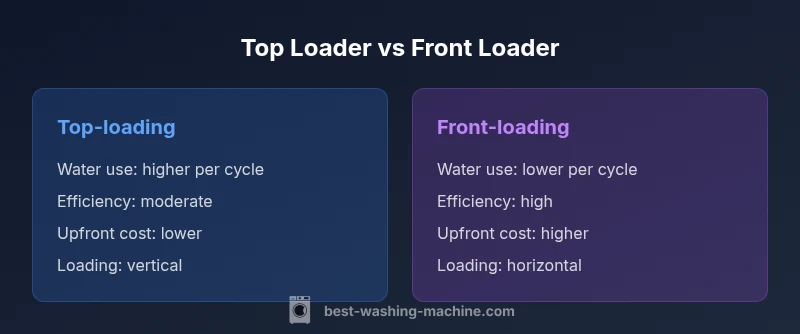
| Feature | Top-loading washer | Front-loading washer |
|---|---|---|
| Water usage | higher per cycle | lower per cycle |
| Energy efficiency | moderate to high | high |
| Detergent handling | standard dispensers; may require more water | HE detergents; optimized dosing |
| Loading style | vertical access; agitator or impeller | horizontal drum; doorsome |
| Maintenance needs | simpler seals; fewer mold risks but agitator wear | gasket and seal care; mold risk if not kept dry |
| Space and installation | door swings outward; may fit tighter spaces | front-access; stackability with dryer |
| Lifespan and resale | potentially longer due to simpler mechanics | often longer warranty options; good resale value |
What's Good
- Front-loaders: higher energy efficiency and gentler fabric care
- Top-loaders: typically lower upfront cost and faster cycles
- Both formats: modern models offer reliable electronics and service networks
- Stackable configurations improve laundry area usability
Downsides
- Front-loaders: mold risk in door seals if not maintained
- Top-loaders: higher water usage on some models; potential longer wash times
- Both: repair costs can vary; parts availability matters
Front-loading washers generally offer better long-term efficiency and fabric care; top-loading washers appeal to budget-conscious buyers and quick-wash needs.
Choose front-loaders for efficiency and garment longevity. Choose top-loaders for upfront savings and faster daily cycles, especially where space and loading height are limiting factors.
FAQ
Which is more energy-efficient, a front-loader or a top-loader?
In general, front-loaders tend to be more energy-efficient due to their design and lower residual moisture after cycles. However, performance varies by model and cycle selection. Look for energy star ratings and annual energy use estimates when comparing specific units.
Front-loaders typically use less energy than top-loaders, but check the model's energy rating and cycle efficiency to be sure.
Do front-loaders use more water than top-loaders?
Front-loaders generally use less water per cycle because the drum design relies on gravity and efficient rinsing. Some high-efficiency top-loaders have closed-loop water usage as well, so check exact specifications for the models you consider.
Yes, front-loaders usually use less water, but always verify per-model water usage figures.
Are top-loaders faster for a typical load?
Top-loaders often complete standard loads more quickly than many front-loaders. If speed is critical for you, a top-loader may be advantageous, but keep in mind cycle variety and fabric care implications.
They can wash faster on typical cycles, though models vary.
Can I stack a top-loading washer with a dryer?
Top-loaders are not stackable in most standard configurations; front-loaders are designed for stacking with a compatible dryer. If space is tight, front-load + stackable dryer setups are usually preferable.
Stackable setups are typical for front-load models; top-loads usually aren’t stackable.
What maintenance helps prevent mold in front-loaders?
Regularly clean the door seal, run a maintenance cycle with an approved cleaner, and leave the door ajar after cycles to promote drying. This reduces mold and mildew buildup and preserves performance.
Clean the door seal and run maintenance cycles; leave the door open after washes when possible.
Which is better for large families with heavy loads?
Both formats can handle large loads, but front-loaders typically offer higher capacity in many models and better energy efficiency for repeated heavy cycles. If speed and initial cost are priorities, a high-capacity top-loader can also be viable.
Front-loaders usually handle big loads efficiently, though high-capacity top-loaders exist.
The Essentials
- Evaluate space constraints before choosing a drum orientation
- Prioritize energy and water efficiency to lower operating costs
- Consider maintenance routines to prevent mold and wear
- Balance upfront price with long-term value and warranty
- Test real-world cycles that fit your laundry load profile