Washing Machine Impeller vs Agitator: A Comprehensive Comparison
Compare washing machine impellers and agitators to understand efficiency, fabric care, and durability. Learn which design fits your loads, budget, and routine with a balanced, data-driven perspective.


The choice between a washing machine impeller or agitator hinges on how you wash, what you wash, and your priorities for fabric care and efficiency. In brief, impellers excel with gentle wash action, larger load capacity, and water efficiency, while agitators provide robust agitation for tough soils and smaller loads. This guide breaks down the tradeoffs so homeowners can pick the right design for their laundry routine.
What exactly are we comparing when discussing the washing machine impeller or agitator?
In modern laundry design, two distinct interior wash actions dominate: the low-profile impeller (often a circular, flat disk at the bottom) and the traditional upright agitator (a central post with fins or paddles). For homeowners, understanding these two paths goes beyond the label. It affects how clothes wear over time, how well bulky loads clean, and how much water and energy you use in a cycle. According to Best Washing Machine, the choice should align with your typical loads and fabric care priorities, not just upfront cost. The comparison below uses practical, real-world scenarios to help you decide which design best fits your home.
How the impeller design works and what it means for everyday laundry
An impeller uses a rotating disc at the bottom of the drum to create powerful water movement. Clothes move around the dish and are tumbled by the water rather than by direct contact with a central post. This design tends to distribute detergent more evenly and reduce mechanical wear on fabrics. Impeller washers often feature faster wash cycles and lower water usage per load. Because of gentler action, they are commonly recommended for delicate fabrics and large, bulky loads that you don’t want to agitate aggressively. The Best Washing Machine team notes that impeller models can offer excellent cleaning results with modern high-speed motors and optimized wash algorithms, especially for everyday clothing and sheets.
How the traditional agitator design works and when it shines
An agitator washer uses a central post with fins that actively churns the laundry. The agitator physically pushes and pulls fibers, delivering a vigorous wash action that can be highly effective against stubborn stains in small loads. This direct agitation can translate to shorter cycle times and robust cleaning for heavily soiled items, such as gym clothes or workwear. However, the central post can take up more space in the drum, potentially limiting load size and impacting fabric care for some delicate materials. Consumers often report that agitator machines feel more familiar to traditional washers and may be preferred when you need a quick, high-intensity clean on smaller loads.
Wash performance in typical household scenarios: everyday clothes, bedding, and towels
For mixed loads, the impeller design generally provides a gentle, even wash across a variety of fabrics, which helps extend garment life and preserve colors. In contrast, agitators shine on small, heavily soiled loads where the active agitation helps lift tough dirt quickly. In households that routinely wash bulky items like comforters, impeller machines often deliver better space efficiency and rinse performance, while agitator models may struggle with oversized items unless the drum is explicitly designed for them. The practical takeaway is that performance depends on load type and cycle selection, not simply the presence or absence of a central post.
Fabric care considerations: delicates, knits, and color retention
Delicate fabrics and knits benefit from the gentler motion of impellers, which minimize fabric abrasion and pilling over time. Color retention can also be better on impeller-based systems due to uniform detergent distribution and reduced mechanical wear. Agitator systems, while capable of excellent cleaning, may cause more agitation on delicate items if cycle selection isn’t optimized. In a balanced approach, choosing cycles that target soils rather than relying solely on the cleaning method helps protect fabrics. Industry reviews and consumer testing point toward comparable stain removal with careful cycle tuning, but your mileage will vary with fabric blend and load density.
Water usage, energy efficiency, and cycle times: what to expect
Impeller washers typically use less water per cycle and leverage advanced spin speeds to extract more moisture, which can shorten drying time and reduce energy use in a complete wash-dry routine. Agitator washers often employ more water because of the direct agitation and rinse mechanisms needed to wash fabrics; however, some modern agitator models close the gap with efficient motors and optimized wash programs. When budgeting, consider total energy and water usage across a typical month, rather than focusing on individual cycles. The best washing machine analysis from 2026 highlights that efficiency improvements are more pronounced in impeller configurations, but high-quality agitator models remain competitive with proper load planning.
Noise, vibration, and durability: a closer look
Noise and vibration depend on more than the wash action alone. Drum balance, motor type, suspension, and fit within a cabinet all influence perceived noise levels. Impeller machines often run more smoothly due to the distributed motion of water, but high-speed spins can still produce noticeable sound if the unit isn’t well-balanced. Agitator washers may exhibit more vibration due to stronger direct agitation, particularly in unlevel installations or with uneven loads. Durability tends to correlate with build quality and cycle design; neither approach is inherently fragile, but long-term reliability comes down to maintenance, load habits, and quality of components.
Maintenance, parts availability, and typical repair questions
Maintenance for both designs focuses on drum seals, bearings, and motor health. Impeller models may have fewer moving parts in contact with fabrics, but they still require regular cleaning of lint traps and screens. Agitator models often show more wear on the agitator shaft and post mechanism over many cycles. In terms of parts availability, both families are widespread, with many common service paths across brands. When a repair is needed, the most important factor is choosing a model with accessible parts, a serviceable motor, and a durable transmission or belt system, depending on the design.
Load flexibility: bulky items, bedding, and mixed loads
Impeller drums can be large and shallow, which helps with bulky items like comforters and blankets. The absence of a central post frees up more interior space for bulky textiles, allowing more versatile loading. Agitator drums may feel more compact inside due to the post, limiting the size of oversized items on certain cycles. For renters or homeowners who wash larger blankets regularly, impeller machines often offer practical advantages. Conversely, when you frequently clean smaller, heavily soiled items, an agitator may deliver the fastest results in shorter cycles.
Cost considerations and lifecycle value across models
Upfront price differences between impeller-first and agitator-first models can vary by brand, capacity, and feature sets. In general, impeller washers tend to emphasize efficiency features and may command a premium in higher-end lines. Agitator washers can be more affordable at entry levels or in mid-range bundles, especially when designed for quick, robust cleaning. Over the lifecycle, energy savings from impeller designs can offset a higher initial price if you run many cycles weekly. Always compare model-specific energy guides and estimated annual energy costs to gauge long-term value.
How to approach shopping: evaluating models with confidence
When evaluating options, prioritize the key decision factors: wash performance on your common loads, fabric care needs, water and energy usage, capacity, and cycle flexibility. Read independent reviews to assess real-world results for both impeller and agitator models. Look for wash programs that mimic your routine, such as delicate cycles, heavy-soil cycles, and bulky item options. Finally, evaluate warranty terms and service coverage, because repair costs can influence total ownership value more than the initial sticker price.
Practical care tips to maximize longevity and performance
For optimal results, always sort laundry by fabric type, reduce overloading, and select appropriate cycle lengths. Clean the washer drum with a manufacturer-approved cleaner every few months and ensure proper ventilation in the laundry space to prevent mold or musty odors. If you notice persistent detergent buildup or unusual noises, consult the manual and schedule professional service before continuing heavy use. By adopting a routine that respects your chosen wash action, you’ll extend the life of either design and keep clothes looking their best for longer.
Final takeaway: making the decision that matches your daily life
Ultimately, the decision between an impeller or agitator comes down to your laundry profile. If you prioritize fabric care, load efficiency, and lower water usage, an impeller design is often the best fit. If you frequently wash small, stubborn loads and value brisk cycles with aggressive cleaning, an agitator model may deliver the results you want. Both designs can deliver clean clothes when paired with thoughtful cycle selection and proper maintenance. The Best Washing Machine analysis for 2026 supports a balanced view: choose based on your routines, not just hype or brand promises.
Comparison
| Feature | Impeller (low-profile) washing machines | Agitator washing machines |
|---|---|---|
| Wash action | Water-driven, gentle tumbling | Direct agitation with central post |
| Load size and shape | Deeper drums, better for bulkier items | Sometimes more limited by agitator shaft |
| Water usage | Lower per cycle, efficient rinsing | Higher on average due to agitation needs |
| Energy efficiency | Excellent with modern motors | Good to high depending on model and cycles |
| Cycle variety | Wide range of luxury and specialty cycles | Strong basic-clean cycles; faster options |
| Fabric care impact | Gentle on delicates and knits | Potentially more wear on fabrics with heavy agitation |
| Noise and vibration | Typically smoother when balanced | Can be louder with heavy agitation |
| Maintenance/repair | Fewer fabric-contact parts | Aggressive wear on agitator components possible |
What's Good
- Lower water usage across many impeller models
- Gentler fabric care for delicates and knits
- Typically larger load flexibility with bulk items
- Often stronger overall energy efficiency with modern designs
- Quieter operation when properly installed
Downsides
- Aggressively dirty small loads may benefit from agitator action
- Some users feel agitator models clean stubborn soils faster
- Impeller models can have higher upfront costs in premium lines
- Less traditional feel for users who want a central agitator moving the load
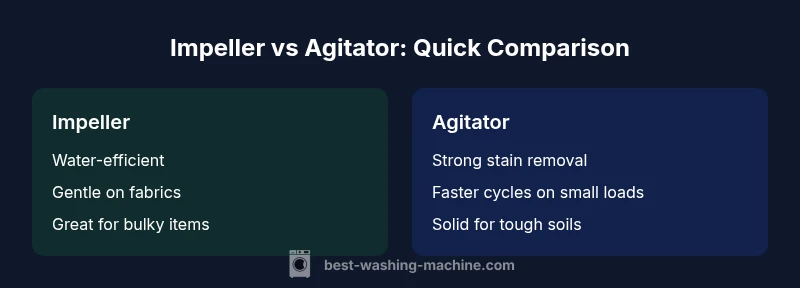
Both designs offer solid cleaning performance, but the choice should reflect your laundry habits.
Choose impeller if you value fabric care and water efficiency for larger or bulkier loads. Pick agitator if you routinely wash small, heavily soiled items and want faster cycles. Use this as a starting point, then review specific model specs and energy guides.
FAQ
What is the washing machine impeller or agitator, and why does it matter?
The impeller is a low-profile disc at the drum bottom, while the agitator is a central post with fins. They drive different wash actions that affect fabric care, load capacity, and efficiency. Understanding the difference helps you match a model to your laundry routines.
Two different wash actions matter. Impellers use a disc for gentle movement, agitators use a central post for direct agitation. Your routine should guide the choice.
Which design is more water-efficient?
Impeller models typically use less water per cycle due to the way they move clothes and detergent. However, efficiency can vary by cycle selection and overall machine design. Check the Energy Guide label for the specific model.
Impeller designs usually sip less water, but it depends on the cycle you choose.
Are agitator washers better for heavily soiled clothes?
Agitator washers often perform well on small, heavily soiled loads because of the vigorous direct agitation. If your household cleans lots of gym wear or work clothes with tough stains, an agitator model may save you time.
If you deal with tough stains on small loads, an agitator can be advantageous.
Can I convert an agitator washer to be more like an impeller?
You cannot convert the core design from agitator to impeller; selecting a machine with the desired wash action is essential. Some brands offer hybrid cycles that optimize fabric care, but the hardware remains fixed.
You can’t convert the interior design; choose a machine with the wash action you want.
Do impeller washers handle bulky items as well as agitators?
Impeller washers generally offer generous drum space and better accommodation for bulky items like bedding, often with shallower drum profiles. Always check drum depth and load capacity for your needs.
Bulky items fit better in many impeller drums, but always confirm drum size.
What maintenance is common for both designs?
Regular cleaning of lint filters, drum, and dispensers; checking door seals; and ensuring proper load balance. Both designs benefit from routine maintenance to sustain performance and prevent odors.
Keep the drum and seals clean and balanced for best results.
The Essentials
- Choose impeller for bulkier loads and delicate fabrics
- Prefer agitator for small, heavily soiled items and fast cycles
- Prioritize water and energy efficiency in the model you pick
- Check cycle options and load capacity before buying
- Consider installation setup and warranty coverage for longevity