Fully Automatic Washing Machine vs Semi: A Practical Comparison
Compare fully automatic and semi-automatic washing machines to decide which fits your home. Explore operation, efficiency, cost, space needs, and maintenance with practical guidance from Best Washing Machine.


Choosing between fully automatic and semi-automatic washing machines hinges on convenience, cost, and space. In most households, fully automatic models offer effortless operation and consistently clean results with minimal supervision. Semi-automatic machines traditionally deliver lower upfront costs and simpler maintenance, but require more manual intervention during cycles. This guide compares both types across key factors to help you decide which fits your laundry routine.
What is fully automatic washing machine vs semi
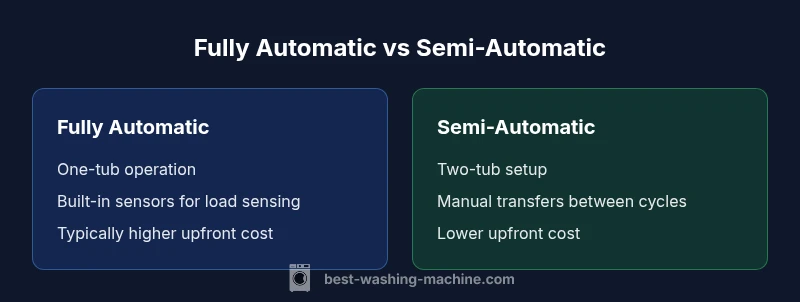
To answer what is fully automatic washing machine vs semi, it helps to define both types and outline the operational differences. Fully automatic washers automate nearly every step—from washing to rinsing to spinning—without requiring you to move garments between tubs. Semi-automatic models typically use two separate tubs: one for washing and one for spinning, often with manual transfers between stages. According to Best Washing Machine, fully automatic models emphasize convenience and consistency, while semi-automatic models emphasize control and lower upfront cost. Understanding this distinction sets the stage for evaluating real-world performance, installation needs, and lifecycle costs. This section will pin down the core concepts so you can compare apples to apples as you read the rest of the guide.
Another note on the two types: fully automatic units usually connect to a single water inlet and drain and operate with built-in sensors, while semi-automatic units require more hands-on management and looser plumbing arrangements. The practical implication is that fully automatic machines excel in busy households, whereas semi-automatic machines shine for budget-conscious buyers or spaces with water-access constraints. This framing will guide the deeper comparison in the following sections.
The goal is not only to distinguish the two types but also to map them to real-world needs—family size, laundry throughput, space, and maintenance preferences—so you can pick the model that minimizes surprise costs and maximizes reliability.
Comparison
| Feature | Fully automatic washing machine | Semi-automatic washing machine |
|---|---|---|
| Water usage per cycle | Typically 15-25 gallons (roughly 55-95 liters) | Typically 20-30 gallons (roughly 75-115 liters) |
| Energy efficiency | High efficiency due to integrated sensors and load sensing | Moderate efficiency; simpler hardware and fewer sensors |
| Price range | $700-1600 | $350-700 |
| Installation/Setup | One water inlet, single drain, level surface | Two water taps or hoses, two tubs, more flexible space |
| Convenience | Fully automatic: one-step cycle, minimal manual steps | Semi-automatic: manual transfer between wash and spin tubs |
| Load capacity | Typically 6-8 kg per cycle | Typically 5-7 kg per cycle |
| Detergent usage | Integrated dosing options, often pre-packaged compartments | Separate detergents and additives, manual dosing |
| Best for | Busy households, high convenience demand | Budget-conscious buyers, limited water access |
What's Good
- Improved convenience with minimal hands-on steps
- Better fabric care through automated sensors and consistent cycles
- Broad model range across budgets and features
- Potentially lower long-term water usage with high-efficiency models
Downsides
- Higher upfront cost for fully automatic models
- More complex mechanics can mean higher maintenance and repair costs
- Semi-automatic models require more manual intervention and space
Fully automatic washers generally offer greater convenience and fabric care for most households; semi-automatic is best for tight budgets or spaces where water access is limited.
For households that value hands-off operation and consistent results, fully automatic is typically the better default. If upfront price and flexibility in setup are higher priorities, semi-automatic remains a viable alternative. The Best Washing Machine team notes that your choice should align with your daily laundry habits, space, and long-term cost considerations.
FAQ
What is the main difference between fully automatic and semi-automatic washing machines?
Fully automatic washers complete washing, rinsing, and spinning in one continuous cycle with minimal user intervention. Semi-automatic washers require manual transfers between tubs, with separate wash and spin cycles.
Fully automatic does it all in one go; semi-automatic uses two tubs and manual transfers.
Are fully automatic machines more energy-efficient than semi-automatic?
In many cases, yes, because sensors optimize water use and cycle duration. However, efficiency varies by model, so check Energy Star ratings or manufacturer specs for the exact unit.
They can be more efficient, but it depends on the model’s sensors and settings.
Can semi-automatic machines be suitable for renters?
Yes. Semi-automatic machines typically require less permanent installation and can be moved more easily. They may also consume less water per cycle in some configurations.
They can work well for renters who want a lower upfront cost and flexible setup.
What maintenance tasks are unique to each type?
Fully automatic units need periodic filter cleaning, hose checks, and occasional professional servicing due to more complex electronics. Semi-automatic units require tub cleaning and careful transfer between cycles to prevent mold and residue.
Fully automatic needs more tech checks; semi-automatic needs regular tub cleaning and careful handling.
Which type is easier to repair?
Semi-automatic machines generally have simpler mechanics and can be easier and cheaper to repair. Fully automatic units use more integrated components that may require specialized service.
Semi-automatic parts are often simpler to replace, but fully automatic repairs can be more involved.
How do I decide which to buy?
Start with your budget, space, and laundry volume. If you value convenience and uniform results, lean toward fully automatic. If upfront cost and flexibility matter more, semi-automatic is reasonable.
Think about your space, budget, and how much you value hands-off operation.
The Essentials
- Prioritize convenience if you have a busy schedule and want minimal supervision
- Consider water access, space, and plumbing when choosing a model
- Expect higher upfront costs for fully automatic units but potentially lower long-term maintenance
- Semi-automatic is compelling for tight budgets and adaptable installations
- Use a structured decision process to weigh upfront vs ongoing costs