What is the Largest Capacity Washing Machine? A Comprehensive Guide
Explore the largest capacity washing machines available for households, how capacity is measured, and tips to choose a 5.0–5.3 cu ft model. Learn when to upgrade and what to compare for big-load laundry efficiency.


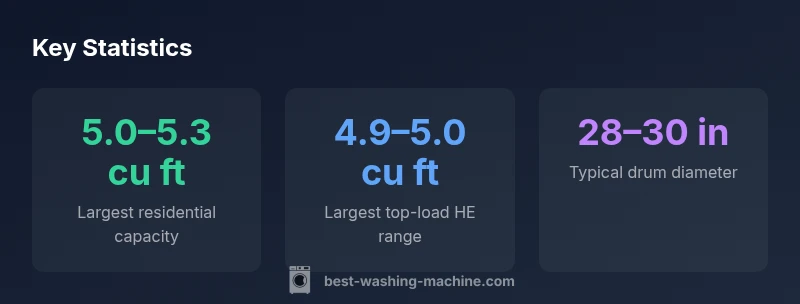
Residential washers top out around 5.0–5.3 cubic feet, with front-load models typically offering the largest capacities. For households needing more than standard sizes, commercial or coin-operated machines can exceed this range. In practice, the largest residential models balance drum size, efficiency, and footprint, while many households are well-served by 4.8–5.3 cu ft washers.
What is the Largest Capacity Washing Machine?
Understanding what constitutes the largest capacity washing machine starts with how capacity is defined. In consumer markets, capacity is typically expressed in cubic feet (cu ft) for the drum. This measurement estimates how much laundry can be loaded in a normal cycle. Importantly, drum volume does not always translate directly to usable space for every item—the drum design, agitator vs. impeller, and the presence of a secondary tub can affect actual load efficiency. When people ask what is the largest capacity washing machine, they are usually comparing residential models rather than industrial equipment. For most homes, the upper limit rests around 5.0–5.3 cu ft, but commercial machines can push beyond this range. The balance between drum size, energy efficiency, water use, and footprint often dictates the perceived “largest” capacity in everyday use. In the Best Washing Machine analysis for 2026, the emphasis is on real-world performance rather than raw drum size alone, ensuring you consider how a large drum behaves in typical laundry days.
To translate this into practical terms, imagine a large, bulky comforter, multiple bath towels, and a week’s worth of gym wear. A drum in the 5.0–5.3 cu ft range is typically able to handle such loads, reducing the number of cycles needed and sparing you from multiple washes. At the same time, you should be mindful that larger drums can require more physical space and may demand longer cycle times for thorough cleaning of heavy textiles. The takeaway is that the largest capacity washing machine for most households is determined by a combination of drum size, drum design, and program options, not by exterior dimensions alone.
From a design standpoint, many buyers equate size with capability, but efficiency matters just as much. Larger drums paired with energy-efficient features can yield better performance per load without dramatically increasing electricity or water use. When evaluating models, compare cu ft alongside energy-star ratings, water factors, and the availability of large-load settings such as bulky item or heavy-duty cycles. By aligning capacity with actual laundering needs, you’ll select a machine that truly handles big days without wasted space or excessive energy consumption.
What’s the best way to think about capacity for your home laundry? (long-form guidance)
Comparison of washing machine types by capacity and typical use
| Model Type | Typical Capacity (cu ft) | Common Load Size | Notes |
|---|---|---|---|
| Front-load | 4.5–5.3 | Large loads, delicates | Most efficient per cubic foot |
| Top-load HE | 4.8–5.0 | Family-size bulky items | May lack agitator in some models |
| Commercial/coin-op | 5.0–6.5 | Very large towels/linens | Industrial-grade performance |
FAQ
What counts as the largest capacity washing machine for a home?
For most households, the largest capacity in a residential washer is about 5.0–5.3 cu ft. This range reflects a balance between drum space and practical cycle times. If you need more, you’ll typically look to commercial-grade units, which have different footprints and service considerations.
Most homes max out around five cubic feet; larger options exist in commercial models. Look for 5.0–5.3 cu ft as the sweet spot for big loads.
Are larger capacity washers energy-efficient?
Many large-capacity models use advanced drum designs and high-efficiency motors to maintain energy use per load. While a bigger drum can consume more energy per cycle, efficiency features and load-sensing technology help keep overall consumption reasonable.
Yes, many large-capacity washers are designed to be energy-efficient, using smart load sensing and efficient motors.
Can a larger drum improve cleaning performance?
A larger drum helps with bulky items and bigger loads, but cleaning effectiveness also depends on cycle selection, water temperature, detergent, and drum design. A well-tuned 5.0–5.3 cu ft machine can clean large textiles effectively without extra cycles.
A bigger drum helps with bulky items, but efficiency also depends on the wash program and detergent choice.
What should I consider besides capacity?
Consider energy and water efficiency, cycle flexibility, spin speed, noise, size of the footprint, and maintenance access. For large households, features like bulky item cycles and adaptive wash programs can dramatically impact results.
Look at energy and water use, cycle options, and maintenance needs in addition to capacity.
Do large-capacity washers take longer to wash?
Not necessarily. Some large-capacity models use fast cycles for everyday loads, while heavy-duty cycles for bulky items may be longer. Cycle times vary by program, not just drum size.
Cycle length depends on the program, not just the drum size.
Is there a trade-off between capacity and spin speed?
Some manufacturers optimize for high spin speeds to extract more water, but this can increase vibration and wear. Balance your need for high spin with acceptable noise and longevity.
You might trade some spin speed for stability or noise control in large-capacity models.
“When sizing a washer for large loads, prioritize drum volume and design features that improve space efficiency and cycle performance over exterior size alone.”
The Essentials
- Aim for 5.0–5.3 cu ft for the largest practical residential capacity
- Understand that top-load HE and front-load models offer different benefits beyond cu ft
- Commercial machines exceed residential capacities but come with different footprint and maintenance needs
- Evaluate capacity alongside energy, water use, and cycle options