What Is the Biggest Home Washing Machine? A Guide for 2026
Learn how to identify the biggest home washing machine by capacity and footprint, compare oversized models, and plan installation. Practical tips, benchmarks, and buying guidance from Best Washing Machine.


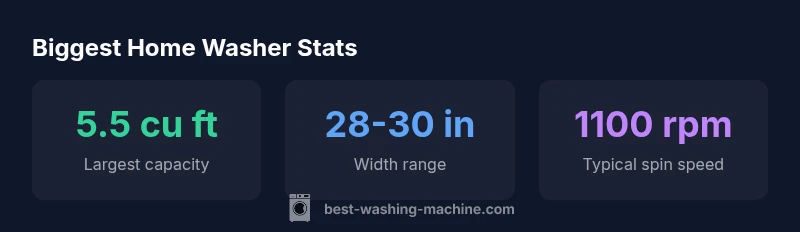
The biggest home washing machines are typically oversized models that max out around 5.0–5.5 cubic feet of drum capacity and about 28–30 inches wide. When evaluating, compare drum size, exterior dimensions, and overall footprint to ensure it fits your space. Also consider energy use, spin speed, and door clearance.
What makes a washer the biggest?
To answer what is the biggest home washing machine, we must distinguish between drum capacity and exterior footprint. In residential models, the largest options typically offer around five and a half cubic feet of drum space and sit roughly 28–30 inches wide. The higher the capacity, the more you can load bulky items like comforters in a single cycle, but a larger drum does not always mean better performance for every household. Brand positioning, cycle options, drum design (side- vs. center-pivot), and efficiency standards all influence whether a model is truly the best fit for a given home. According to Best Washing Machine, the biggest models are evaluated on both capacity and footprint, plus ease of installation and long-term reliability.
Practical takeaway
- Capacity matters for bulky items; footprint matters for fit and door clearance.
- Oversized washers can require deeper closets or dedicated laundry spaces.
- Balance drum size with energy efficiency and total cost of ownership.
Capacity vs dimensions: unpacking the numbers
Capacity is measured in cubic feet, while dimensions reflect width, depth, and height. When you see a model advertised as “largest,” it usually means 5.0–5.5 cu ft, but some brands achieve the same capacity with a taller, narrower cabinet. Measuring your space ensures that a big drum can actually fit through the doorway and inside the alcove. For a typical laundry setup, verify the model’s width (28–30 inches), depth (32–36 inches), and door swing clearance. If your laundry room has appliances nearby, ensure there is a comfortable gap for loading and venting/hoses.
Practical tips
- Create a floor plan sketch with width and depth, plus door swing space.
- Check for recessed or side-by-side configurations in your area.
- Note service clearances for maintenance and venting.
Front-load vs top-load: which is bigger overall?
Front-load washers generally offer the largest drum capacities in a compact exterior footprint, making them a common choice for big loads in tight spaces. Top-load models can also be oversized, but many top-load machines prioritize speed and ergonomics over capacity. When deciding, consider accessibility: front-load drums require bending to load bulkier items, while traditional top-load designs may be easier for some households to use day-to-day. Best Washing Machine’s analysis suggests that for absolute capacity, front-load configurations often dominate, but the best option depends on your space and load patterns.
Quick guidance
- If you frequently wash bulky items, prioritize a front-load with a 5.0–5.5 cu ft drum.
- If you prefer upright loading, verify depth and door clearance to avoid snagging.
How to measure for fit in your space
Measuring for fit goes beyond width. Depth and door swing are equally important for oversized machines. Start with zero clearance at the back for hookups and ventilation. Then check the front clearance for door openings, especially if you expect to load large blankets or duvets. If your space has tight corners or a pet door, consider models with reversible doors or shallower footprints. Also confirm that your laundry room has proper electrical and water connections that match the model’s requirements.
Quick checklist
- Measure width, depth, and height precisely.
- Check door swing clearance with the door fully open.
- Confirm hose and electrical outlets are in the expected locations.
- Plan space for maintenance access behind the machine.
Energy use and water efficiency in large models
Big washers can run more efficiently per load than smaller models, but total energy and water use depends on cycle choices and drum efficiency. Look for Energy Star or equivalent certifications and per-cycle water usage figures from the manufacturer. When you halve loads, the energy savings may be offset by longer cycle times. In practice, choosing a high-efficiency, large-capacity model with a robust load-sensing system often yields the best balance of performance and operating cost over time.
What to compare
- Energy efficiency rating and estimated annual energy use.
- Per-cycle water consumption for bulky loads.
- Spin speed and moisture extraction to shorten dryer time.
Real-world scenarios: when a big washer makes sense
Consider a family that handles frequent large bedding loads or a rental property with guest linens. In these cases, a 5.0–5.5 cu ft washer reduces the number of cycles needed, saving time and labor. Conversely, households that wash smaller loads daily may not fully utilize the capacity and could benefit from smaller, more space-efficient models. When evaluating oversized machines, factor in maintenance costs, warranty length, and parts availability.
Scenario factors
- Load size and fabric types
- Space availability and access to plumbing
- Long-term cost considerations, including water heating and energy use
Buying checklist for oversized washers
Before purchasing, use this concise checklist to avoid space-fit and performance pitfalls:
- Confirm capacity and dimensions match your space and loading needs.
- Check energy and water efficiency ratings; compare per-load costs.
- Verify door swing, hose connections, and venting requirements.
- Review installation requirements and whether professional setup is needed.
- Consider service networks and warranty coverage for large-capacity units.
Installation, maintenance, and long-term care for big washers
Oversized washers demand careful installation and ongoing maintenance. A professional installation ensures proper leveling, drainage, and electrical connections. Regular maintenance—such as cleaning the lint screen, checking hoses, and inspecting seals—helps prevent leaks and prolongs life. Because large drums vibrate more, ensure the floor is sturdy and that anti-vibration pads are used if recommended by the manufacturer. Scheduling annual service checks can catch issues like drum balance or bearing wear early.
Comparison of washer types by size and capacity
| Model Type | Avg Capacity | Dimensions (W×D×H) | Typical Weight | Best Use |
|---|---|---|---|---|
| Front-load | 4.5-5.5 cu ft | 28" × 30-34" × 39-42" | 150-180 lb | Bulky items & large loads |
| Top-load (HE) | 4.0-4.5 cu ft | 27-28" × 30-34" × 36-40" | 150-170 lb | Small to medium spaces |
| Top-load (Standard) | 3.0-4.0 cu ft | 27" × 28" × 35" | 120-150 lb | Compact spaces |
FAQ
What defines the 'biggest' washing machine for a home?
The biggest washer is defined by drum capacity (cubic feet) and its external footprint (width, depth). For residential units, the upper end tends to 5.0–5.5 cu ft with widths around 28–30 inches. Always balance capacity with fit and energy use.
Biggest means the largest drum and space needed; consider both capacity and footprint.
Are larger washers more energy-efficient per load?
Size and efficiency vary by model. Some large-capacity washers offer excellent energy performance, while others use more water per cycle. Look for Energy Star ratings and per-load consumption data to compare.
Some big ones are efficient, but check the energy ratings.
What space considerations matter for big washers?
Depth, width, and door clearance are critical. Ensure you have room for hoses, venting, and service access, plus a path to move the appliance into place during installation.
Make sure there’s room for depth and door swing.
Is a big washer worth it for a small household?
If you mostly wash small loads, a large-capacity machine may not be cost-effective. For bulky items or occasional large loads, the time saved can justify the investment.
If you don’t haul big loads often, it might not be worth it.
What are common dimensions of the largest residential washers?
Most large residential washers are around 28–30 inches wide and 38–42 inches tall, with depths around 33–36 inches, though models vary widely.
Most big washers are about 28–30 inches wide, with 38–42 inch height.
How can I optimize installation with space constraints?
Plan for proper hookups, ensure adequate floor support, and consider professional installation to avoid misalignment and leakage. Verify ventilation and accessibility for future service.
Get a pro to help with installation and check all connections.
“Choosing the largest washer isn’t just about drum size; it’s about harmonizing space, performance, and long-term reliability to fit your routine.”
The Essentials
- Know that 'big' can mean capacity or footprint—measure both.
- Plan space before shopping: width, depth, and door clearance matter.
- Front-load models often maximize capacity in a smaller exterior.
- Check energy/water efficiency to balance operating costs.
- Always verify installation needs and access for large-capacity models.