Which Washing Machine Does Not Vibrate: A Comprehensive Comparison
Analytical, feature-by-feature comparison of front-load vs top-load washers, with installation tips, maintenance guidance, and real-world scenarios to help you choose a low-vibration model.


Which washing machine does not vibrate? In practice, front-load models with inverter/direct-drive motors, reinforced frames, and true anti-vibration systems perform best, especially when properly installed on a solid, level floor. Look for machines with vibration-reduction features and robust suspensions. For the quietest results, pair a low-vibration design with careful setup and balanced loading, then test in your home.
Why vibration happens and how to prevent it
Vibration in a washing machine is not a mysterious fault; it is the result of dynamic forces inside the appliance meeting an imperfect surface. The main contributors are motor torque that drives the drum, drum balance, suspension stiffness, and how evenly the machine is mounted. For homeowners trying to answer which washing machine does not vibrate, design choices matter almost as much as placement. According to Best Washing Machine, the best performers combine an inverter or direct-drive motor, reinforced sides, and an advanced suspension system with level feet. Even the best motor and frame cannot compensate for an uneven floor or an unlevel machine, so installation quality is foundational. Expect that quieter operation comes not from a single feature but from a system of parts working in harmony: motor control, drum balancing sensors, dampers, and a stable base.
Key design features that minimize vibration
To determine which washing machine does not vibrate, you must study its engineering. Look for:
- Inverter or direct-drive motors that adjust torque smoothly rather than pulsing with every spin.
- Multi-point suspension and heavy-duty dampers that absorb sideways movement.
- Reinforced chassis with anti-vibration panels and reinforced feet that grip the floor.
- Sensor-based drum balancing that detects slight imbalances and counteracts them before they become audible rattles.
- Noise-dampening enclosures and optimized drainage to prevent water hammer during high-speed spins.
These features do not guarantee zero vibration in every scenario, but they significantly reduce the likelihood when the machine is aligned and loaded properly.
Installation matters: leveling feet, floor, and anchoring
Even the finest vibration-control design cannot compensate for bad installation. Start with a level, rigid floor or use a solid base such as a thick rubber mat or a dedicated washer pedestal. Level the machine using all four feet, then test for wobble by pushing diagonally on the top corners. In households asking which washing machine does not vibrate, the difference between a 1/4-inch error and a perfectly level machine is often the deciding factor. If your floor is soft or uneven, consider adjustable feet or a mounting platform. For apartments on wooden subfloors, use vibration-damping mats and avoid installing near walls to minimize resonant coupling. Finally, ensure transit bolts are removed and only official installers perform leveling adjustments.
Front-load vs Top-load: vibration profiles
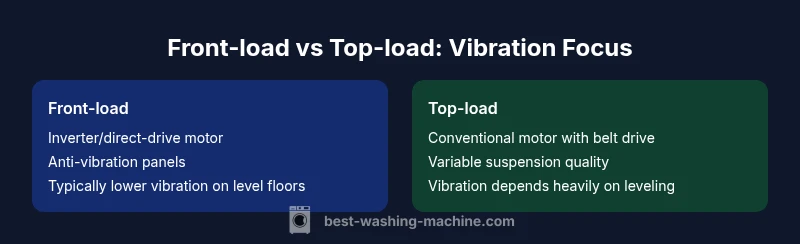
Front-load washers with a solid, direct-drive or digitally controlled inverter motor generally exhibit less vibration than older top-load designs, especially during high-speed spins. However, a poorly installed front-loader on a soft floor can still shake. Top-load machines with good suspension can match or beat older front-loads in quiet operation, but they rely on a stable base and moderate spin speeds to keep vibration under control. The takeaway: the best answer to which washing machine does not vibrate is context-dependent, and installation quality matters as much as the model choice.
Spin speed, load size, and vibration
Spin speed directly influences vibration: higher speeds increase centrifugal forces, amplifying minor imbalances. For many households, selecting medium or low spin cycles for bulky or unbalanced loads reduces vibration more than cranking the machine up to its maximum. Loading evenly, keeping similar fabrics together, and using proper detergent amounts all contribute to a smoother spin. When evaluating models, check the range of spin speeds, the presence of automatic load sensing, and how the machine handles partial loads. This is how to minimize vibration while still achieving clean results.
Room and floor considerations: apartments, wood floors, and slabs
In urban living or rental units, you’ll often encounter uneven or overly forgiving floors that exacerbate vibration. A solid, non-resilient floor is ideal, but if that is not available, equip the washer with a vibration-damping base and ensure it sits away from glass doors and shelving that could echo the noise. Wood floors can magnify vibrations if the load shifts during the spin, so pairing the machine with a shock-absorbing mat may help. On concrete slabs, a properly leveled machine will perform best, and you should avoid mounting directly on active surfaces or on top of carpet fringing.
Reading the spec sheets for low-vibration models
The path to which washing machine does not vibrate begins with careful reading of the spec sheets. Look for explicit mentions like anti-vibration system, anti-vibration feet, reinforced drum, and direct-drive or inverter motors. Note the warranty language around shocks or noise and check for independent testing, such as Energy Star or third-party lab verifications. Compare models on their included dampers, chassis rigidity, and floor-contact design. If a model offers multiple vibration-control modes or load-sensing technology, that is a strong signal it is designed with quiet operation in mind.
Real-world usage scenarios and expectations
In daily practice, a household might see less vibration in a mid-range front-loader with balanced loads and proper installation than in a high-end top-loader placed on a soft surface. Expect some vibration during high-spin cycles with bulky items, but a well-designed machine should not shake the room or rattle dishes. When you ask which washing machine does not vibrate, think about the orchestration of motor control, drum balance, suspension, and base rigidity. This is usually where the difference between a quiet machine and a noisy one shows up in real life.
Maintenance tips to sustain low vibration
- Periodically inspect the feet for loosening and re-tighten as needed.
- Check the suspension and hoses for wear that could contribute to imbalance.
- Level the unit after any relocation or heavy flooring changes.
- Use appropriate detergent and avoid overloading the drum, which can create long-lasting imbalance.
- Clean the drum and lint filter to prevent residue that can affect balance on the next cycle.
Implementing these steps helps the washer maintain low vibration as the model ages, and reduces the chance of a noticeable change in performance over time.
Debunking myths about quiet washers
A common misconception is that a washer is inherently quiet if it spins slowly. In reality, quiet operation depends on balancing, motor control, and installation. Another myth is that only premium models can achieve low vibration; many mid-range units offer effective vibration reduction when paired with proper setup. Finally, people assume anti-vibration feet alone fix vibration; while helpful, the full system—frame, motor, suspension, and base—determines performance.
Quick-start checklist for a vibration-free first wash
- Confirm the floor is level and the feet are properly adjusted.
- Choose a front-load model with an inverter motor and anti-vibration features.
- Install on a vibration-damping mat if the floor is soft or if the unit is near walls.
- Run a small test load and listen for unusual movement; adjust as needed.
- Prefer cycles with automatic load sensing and moderate spin speeds.
This practical checklist helps users implement the core lessons from this comparison and reduces the risk of vibration right away.
Authority sources
- Energy Star: https://www.energystar.gov/products/washers
- Consumer Reports Buying Guide: https://www.consumerreports.org/cro/washing-machines-washers/buying-guide/
- U.S. Environmental Protection Agency: https://www.epa.gov/iaq
Comparison
| Feature | Front-load washer | Top-load washer |
|---|---|---|
| Vibration-control design | Integrated anti-vibration panels, reinforced chassis | Standard suspension with basic feet |
| Motor type | Inverter/direct-drive | Conventional belt motor |
| Spin speed range | Up to 1400-1600 rpm | Up to 800-1000 rpm |
| Noise considerations | Low to moderate noise due to gain in motor control | Higher baseline noise if suspension is weaker |
| Price context | Typically higher upfront cost | Typically lower upfront cost |
| Best use case | Quiet operation and fabric care in level spaces | Budget-conscious setups or dense living areas |
What's Good
- Lower long-term vibration with inverter motors and solid enclosures
- Improved energy efficiency from advanced motor control
- Better fabric care due to smoother drum action
- More model choices with built-in anti-vibration features
Downsides
- Higher upfront cost for advanced vibration-control models
- Requires proper installation and level flooring to achieve optimal results
- Potentially more complex repairs or service for advanced systems
Front-load washers with inverter motors and robust vibration-control features generally provide the best balance of low vibration and performance, when properly installed.
Invest in models that advertise anti-vibration design and direct-drive or inverter motors. Pair with accurate leveling and a solid base to maximize quiet operation. For tight budgets, prioritize models with credible vibration-control features and ensure proper installation.
FAQ
Why do some washing machines vibrate more than others?
Vibration differences come from motor design, drum balance, suspension quality, and how well the unit is installed. Even two models with similar specs can perform differently if one is perfectly leveled and the other is not.
Vibration comes down to motor design, drum balance, and how well the washer is installed—level setup matters a lot.
Do front-load washers generally vibrate less than top-load washers?
In many cases, front-load washers with inverter motors offer smoother operation and less vibration, especially on solid floors. However, a poorly installed front-load can vibrate as much as a well-installed top-load.
Front-loads often vibrate less, but installation quality still decides the outcome.
What features should I look for to reduce vibration?
Look for inverter motors, reinforced chassis, anti-vibration feet or panels, and load-sensing technology. Also check for a machine’s warranty language about noise and the presence of tested, independent validations.
Seek inverter motors, solid frames, anti-vibration feet, and load-sensing tech.
Can installation on an uneven floor ruin vibration performance?
Yes. An uneven floor can exacerbate movement, making otherwise quiet machines noisy. Always level the unit and consider a vibration-damping base if your floor is soft or irregular.
Yes, leveling matters a lot for quiet operation.
Do anti-vibration pads really help?
Pads and mats can reduce resonance and soften shocks, especially on soft or uneven floors, but they are not a replacement for a well-built base and proper isolation.
Pads help, but they aren’t a substitute for a solid installation.
Are washers with high spin speeds inherently louder?
Not necessarily. A machine can spin fast and stay quiet if it uses good balancing, a stable drum, and effective suspension. The key is how the system manages the forces during high-speed spins.
High spins can be quiet if the design and balance are solid.
The Essentials
- Prioritize inverter/direct-drive motors for the lowest vibration
- Ensure precise leveling and a stable floor before deployment
- Front-load designs often vibrate less when installation is solid
- Read spec sheets for anti-vibration features and load-sensing tech
- Use a vibration-damping mat on soft floors or in apartments