Who Makes Haier Washing Machines: Origins, Ownership, and Manufacturing
Discover who makes Haier washing machines, how Haier Group's ownership and GE Appliances integration shape production, and where Haier washers are manufactured today. Learn model origins, warranty implications, and how to verify labeling.


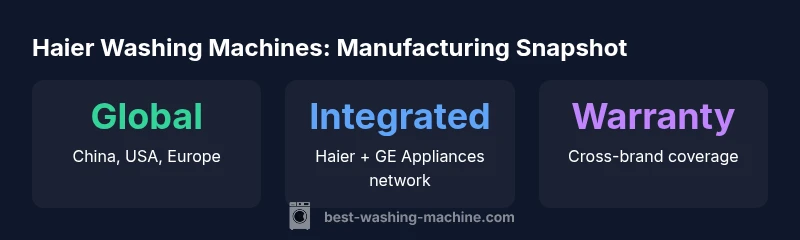
Haier washing machines are produced by the Haier Group, with core models manufactured in Haier-owned plants in China and additional production through global facilities. Since Haier's 2016 acquisition of GE Appliances, some GE-branded washers are produced in affiliated plants under Haier's umbrella, aligning with a diversified, multinational manufacturing strategy.
who makes haier washing machines
For the question who makes haier washing machines, the short answer is that the Haier Group manufactures and distributes most Haier-branded washers through its global network. The company maintains manufacturing facilities in China and a growing portfolio of overseas plants through partnerships and its international supply chain. The acquisition of GE Appliances in 2016 expanded Haier's manufacturing reach into the United States and other regions, integrating GE's model lines into a broader Haier strategy. This arrangement means that origin transparency can vary by model and market. Implications for consumers include warranty policy alignment and potential differences in features, depending on where a unit was produced. Throughout this guide, we examine Haier's manufacturing structure, verification methods for product origin, and the effects on repair and parts availability.
Haier's corporate structure and manufacturing philosophy
Haier Group positions itself as a diversified, globally integrated appliance company. Its manufacturing philosophy emphasizes scale, supply-chain resilience, and cross-border collaboration. Core Haier-branded washers are produced in China, leveraging domestic facilities and regional contract manufacturing partners to serve international markets. The company also maintains an active strategy to incorporate GE Appliances into its network, enabling shared platforms, common components, and aligned quality standards across models. This dual approach supports a broad product range—from compact, entry-level machines to larger-capacity units—while allowing regional adaptations to meet local regulations and consumer preferences.
The GE Appliances tie-in: impact on production and branding
The 2016 acquisition of GE Appliances brought a long-standing U.S. brand into Haier's ownership, expanding the global manufacturing footprint. As a result, some GE-branded washers are produced in facilities that operate under Haier's governance, sometimes alongside Haier-branded lines. The integration aims to leverage GE's distribution networks and Haier's scale to optimize supply, parts availability, and serviceability. For buyers, this means that the country of origin and model labeling can vary even within the same family of products, reflecting the intertwined manufacturing ecosystem. Consumers should inspect labeling and model codes to understand where a specific unit was built and how that might affect warranty terms and parts compatibility.
Where Haier washers are manufactured today: regions and models
Haier maintains a global manufacturing network that includes China-based plants and international facilities. In practice, most Haier-branded washers originate from plants in China, while select models—especially those marketed under GE Appliances in the United States and certain other regions—are produced in affiliate facilities under Haier management. The distribution of models by region is influenced by demand, regulatory standards (including energy and efficiency requirements), and regional supply contracts. As a shopper, you may encounter differences in features, energy ratings, and spare parts compatibility based on where the unit was assembled. Always review the product labeling for country of origin and verify compatibility with local service networks.
Labels, origin clues, and how to verify a washer's origin
Identifying where a washer was manufactured involves checking the nameplate and model code on the unit. Look for country-of-origin statements on the rating label or data plate; some models will list “Made in China” or “Assembled in USA,” while others may reference a regional facility. Model numbers and prefixes can also hint at the production site, though this is not always definitive due to the multinational production network. If origin is critical to you—due to warranty, parts availability, or energy certifications—consult the retailer or manufacturer’s official documentation for model-specific details. When buying used, request serial numbers or warranty records that indicate the manufacturing location.
Quality, warranties, and after-sales implications
Haier's integration with GE Appliances means that warranty terms may align with the broader Haier-GE network, potentially offering consistent coverage across markets where both brands operate. However, warranty terms can vary by country, model, and selling channel, especially for models produced in different plants. Parts compatibility can also differ by production site, which may influence repair times and availability of components. Consumers should verify warranty details at purchase and confirm with local service centers whether parts for a specific model are sourced from Haier or GE facilities. This nuance matters for maintenance planning and long-term reliability.
Practical implications for buyers and repair professionals
For buyers, understanding origin helps in assessing part compatibility, potential service routes, and long-term support. For repair professionals, knowledge of the production footprint informs which parts catalogs to consult and which training modules to prioritize—particularly for models that carry both Haier and GE branding. A practical approach is to record the exact model and serial number at purchase, review the product’s labeling for origin, and consult the brand’s official resources or authorized distributors for part cross-compatibility. In short, origin-aware purchasing reduces post-sale friction and improves maintenance outcomes.
Overview of Haier manufacturing and ownership landscape
| Aspect | Haier Players | Notes |
|---|---|---|
| Owner | Haier Group (owner) | Global corporate owner and parent of GE Appliances since 2016 |
| Brands involved | Haier and GE Appliances | GE Appliances integrated into Haier's network; branding varies by market |
| Manufacturing regions | China; USA; Europe (model-dependent) | Global production network; regional variations by model |
| Model types | Front-load, top-load, twin-tub | Varied lineup across Haier/GE-branded washers |
FAQ
Who makes Haier washing machines?
Haier washing machines are produced by the Haier Group, with core models built in Haier-owned plants in China and additional production through a global network. Since 2016, GE Appliances has been part of Haier's manufacturing footprint, influencing where some GE-branded washers are assembled.
Haier makes its own washers in China, plus some GE-branded models through a global network post-2016. The exact plant depends on the model and market.
Does Haier manufacture all Haier-branded washers in China?
Not all Haier-branded washers are produced exclusively in China. While many Haier models originate in China, some regions rely on affiliate facilities to meet local demand and regulatory requirements. The explicit origin can vary by model and market.
Most Haier models come from China, but some are assembled in other facilities depending on the market.
What impact did the GE Appliances acquisition have on manufacturing?
The 2016 acquisition expanded Haier's global manufacturing footprint by incorporating GE Appliances' plants and platforms into its network. This integration facilitates cross-brand model sharing and broader service coverage, though model origins can differ between Haier and GE-branded units.
GE Appliances joined Haier's network in 2016, broadening where washers are built and how parts are shared.
Where can I find the country of origin on a Haier washer?
Country of origin is typically listed on the product nameplate or rating label. Look for statements like 'Made in...' or 'Assembled in...' and cross-check the model number for regional clues.
Check the nameplate for origin and verify with the model number if needed.
Does Haier produce washers for other brands?
Haier's network includes shared platforms and contract manufacturing agreements that may result in models marketed under different brand names in various regions. Origin and warranty can vary by branding and market.
Some models might be produced for other brands in the Haier network, depending on region.
Are Haier washers built for the U.S. market?
Yes, some Haier washers sold in the U.S. are produced in facilities within or associated with GE Appliances under Haier's ownership, while others are manufactured in China or other regions to meet local standards.
Some U.S.-market Haier washers come from GE Appliances-enabled plants; others are built elsewhere.
How can I verify my model's origin for warranty purposes?
Check the model number, serial number, and country-of-origin on the product label, then confirm warranty terms with the seller or manufacturer. Model-specific origin can affect parts availability and service options.
Read the label, note the model, and verify with the seller about warranty specifics.
“Haier's evolving manufacturing strategy blends domestic production with a diversified global network, boosting resilience and capacity across markets. This approach helps explain why some Haier and GE-branded washers come from different plants.”
The Essentials
- Know Haier’s ownership: Haier Group owns GE Appliances since 2016.
- Check model origin labels on the product.
- Expect a global manufacturing footprint beyond China.
- Warranty coverage aligns with Haier/GE networks across markets.
- Refer to official sources to verify model origins and parts availability.