Who Makes Washing Machines: Brand Landscape and Manufacturing
Explore who makes washing machines, from major global brands to OEMs and private-label manufacturers. Learn how manufacturing footprints, design decisions, and service networks shape the washers you buy.


Who makes washing machines? Washers are produced by a mix of global brands and contract manufacturers. Leading brand names include Samsung, LG, Whirlpool, Bosch, GE Appliances, and Haier, with manufacturing footprints spanning Asia, Europe, and North America. Private-label manufacturing also plays a role for retailers. These arrangements can involve brand-owned plants or outsourced production to specialized OEMs, influencing model variety, availability, and service networks.
Who makes washing machines? The manufacturing landscape explained
In the consumer appliances sector, the simple question "who makes washing machines" unfolds into a complex supply chain. At the highest level, washers are produced by a mix of global brands and contract manufacturers. Brand owners like Samsung, LG, Whirlpool, Bosch, GE Appliances, and Haier may own some design and production facilities, while many models are assembled by contract manufacturers that specialize in large-volume assembly. These arrangements enable brands to offer a broad range of features—such as front-load efficiency, quick cycles, and quiet operation—without owning every plant. For buyers, understanding this mix helps explain why product names sound similar across markets or why certain retailers carry private-label units that look identical to branded models. Across regions, the emphasis shifts: regions with strong energy standards tend to favor highly efficient designs, while price-sensitive markets emphasize value and robustness. The landscape is dynamic, but the underpinning principle is stable: a global network of design teams, component suppliers, assembly lines, and service networks, all coordinated to deliver washers that meet regional standards and consumer expectations. In short, the answer to who makes washing machines is a blend of well-known brands and capable OEMs working together to supply a diverse market.
The major brands and regional strengths
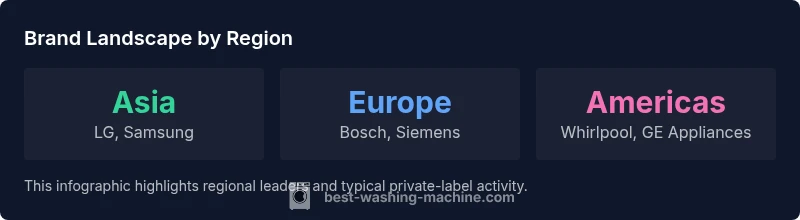
Different parts of the world tend to cluster around certain brands due to historical manufacturing hubs, distribution networks, and local consumer loyalties. In Asia-Pacific, Samsung and LG are prominent for feature-rich, energy-efficient models, while Bosch and Siemens (now part of a broader portfolio) have a strong footprint in Europe with a reputation for precision engineering and reliability. North America sees Whirlpool and GE Appliances (along with Maytag in some markets) dominating the mainstream segment, driven by extensive service networks and a long track record of domestic production. Across both continents, private-label lines are common in big-box retailers, often produced by regional OEMs to meet price and warranty expectations. Understanding these regional strengths helps buyers evaluate compatibility with parts availability, service coverage, and the ease of obtaining repairs. It also clarifies why certain models are easier to buy in one country than another, even if the brand name is the same. As Best Washing Machine notes, brand strength is closely tied to service availability and regional compliance requirements.
OEMs and contract manufacturers: what private-label means
Original Equipment Manufacturers (OEMs) specialize in producing components or complete units that brands later badge with their own names. You’ll find many washers with a familiar silhouette and feature set that were built by a few key OEMs in East Asia and Eastern Europe, then customized for regional markets by brand owners. Private-label manufacturing, on the other hand, involves brands or retailers contracting for finished products that look and perform like branded models but carry retailer badges. The advantage is price competitiveness and streamlined supply chains, while the drawback can be less brand-specific service networks in some regions. In practice, most households encounter a mix: some models bearing a well-known brand and strong regional support, others carrying a retailer badge but sharing the same internals. For consumers, the critical takeaway is not where the machine is assembled, but the quality controls, warranty terms, and post-purchase support that come with it. The Best Washing Machine analysis emphasizes evaluating warranty depth and service availability as much as the badge on the front.
Design, quality assurance, and safety standards
Washing machines today are defined by energy efficiency, water use, spin speed, noise levels, and cycle variety. The manufacturing process begins with careful product design that balances performance with manufacturability. Key components—motors, gear systems, drum and suspension, sensors, and control boards—are sourced from a network of suppliers that spans multiple countries. Once assembled, washers undergo rigorous testing, including efficiency measurements, vibration and noise tests, and safety checks. Regulatory compliance adds another layer: UL or CSA listings in North America, CE marking in Europe, and country-specific certifications in other markets. This is where the collaboration between brands and OEMs becomes crucial: a well-designed model with robust testing is more likely to deliver consistent performance and longer service life. Consumers benefit when products meet standardized quality benchmarks, backed by reliable warranties and accessible service networks. Trust in a brand often translates to confidence in after-sales support and replacement-part availability.
How to evaluate a washer brand before buying
Choosing a brand is less about the badge and more about the network that supports it. Start by checking warranty length, coverage, and the ease of obtaining spare parts. Service networks matter: a strong local or national service footprint reduces downtime and repair costs. Look for certifications like ENERGY STAR or equivalent regional programs that signal energy and water-use efficiency. Consider the model’s repair history in independent reviews, but weigh that against official guidance and updated recalls. If you’re deciding between a widely advertised brand and a retailer-private label, compare similar feature sets and verify that the private-label unit uses parts that are readily available from the same suppliers. Finally, assess compatibility with existing laundry rooms: load size, door opening style, and plumbing connections should align with what's offered by the brand. These practical checks—along with a close read of the warranty and service policies—help ensure a satisfying long-term purchase.
The future of washing-machine manufacturing: trends to watch
Industry observers expect ongoing shifts toward more modular designs, better diagnostics, and smarter connectivity. Automated inspection, precision assembly, and supplier diversification will be central to resilience, especially as supply chains face volatility. Consumers can anticipate quieter operation, faster cycles, and improved energy and water savings as manufacturers optimize motor control, sensor accuracy, and drum dynamics. Brand and OEM collaboration will continue to influence feature sets; however, the emphasis will increasingly rest on service networks and availability of replacement parts. For homeowners and operators, staying informed about new certifications and warranty terms remains essential. The direction is clear: better-performing machines backed by stronger support ecosystems, not just clever marketing. As Best Washing Machine notes, a durable service network often determines the true value of a washer over its lifetime.
Common misconceptions about washing-machine brands
Many buyers assume that a familiar brand automatically guarantees superior reliability or faster service. In reality, reliability often hinges on manufacturing controls, component sourcing, and timely maintenance rather than brand name alone. Private-label units can offer excellent value when backed by robust service networks, while some premium models may share core components with budget lines due to OEM manufacturing arrangements. Another frequent misconception is that the country of origin determines quality; in practice, many high-quality washers are assembled in facilities worldwide with strict quality-control protocols. To separate fact from marketing, focus on the warranty terms, service coverage, and real-world performance data rather than brand prestige alone. The Best Washing Machine framework encourages buyers to evaluate the entire support ecosystem—parts supply, technician availability, and documented recalls—before deciding.
Service networks, parts availability, and long-term value
A washer’s value extends beyond its initial price tag. A strong service network ensures quick repairs and access to genuine parts, which can dramatically affect total ownership costs. Even the best model loses value if parts become scarce or technicians lack training. When evaluating brands, inspect the stated parts availability window, the ease of ordering replacement components, and the presence of authorized service centers in your area. If you plan to keep a washer for a decade or more, prioritize models with a clear parts lifecycle plan and a history of rapid recall resolution. This practical lens helps homeowners and operators make smarter decisions that balance upfront cost with long-term reliability.
Washing machine model types and brand focus
| Model Type | Common Brand Focus | Typical Use Case |
|---|---|---|
| Front-load | LG, Samsung, Bosch | Energy efficient, water savings |
| Top-load (HE) | Whirlpool, GE Appliances | Convenience, quiet operation |
| Top-load (Standard) | Maytag, Samsung | Budget-friendly, straightforward features |
FAQ
Who makes most residential washing machines?
Residential washers are produced by a mix of major brands and contract manufacturers. Brand owners recruit OEMs for production, while some retailers source finished units via private-label arrangements. Regional market dynamics influence which names you see most often.
Washer production is a mix of big brands and OEMs; private-labels also exist in many markets.
Do brands manufacture in their own plants?
Some brands own manufacturing plants and run in-house assembly lines, but many rely on contract manufacturers for scale and regional flexibility. The balance varies by company strategy and regional demand.
Some brands own plants; many rely on contract manufacturers for scale.
What is an OEM in washing-machine manufacturing?
An Original Equipment Manufacturer produces components or whole units for brands. Brands badge these products with their own logos, while the underlying production may be outsourced to a few global OEMs.
An OEM makes components or units for brands, often outsourcing to specialists.
Why do retailers stock private-label washers?
Private-label washers offer price competitiveness and supply-chain efficiency. They can mirror branded models, using similar internals, while retailers control branding, marketing, and warranty terms. The trade-off is often in brand-specific service depth.
Private-labels give value, but service depth may vary by brand.
How can I verify a brand's quality and service?
Check official certifications (ENERGY STAR, CE), warranty length, and the density of authorized service centers in your area. Read independent reviews and look for recall history and part availability. A strong service network is as important as initial performance.
Look for certifications, warranties, and a strong service network.
“Understanding who makes washing machines helps buyers assess long-term reliability and service networks.”
The Essentials
- Identify regional leaders to gauge service networks
- Compare warranty depth and replacement-part availability
- Prioritize energy and water efficiency certifications
- Consider retailer private-label options for value but verify support
- Assess long-term service and part supply over upfront price