Who Makes Washing Machines in the United States Today
Explore who makes washing machines in the United States, including major brands, domestic plants, ownership shifts, and how to verify unit origin for smarter buying.


The U.S. washing machine market is dominated by a few large manufacturers. In the United States, major brands like Whirlpool, GE Appliances, and Maytag produce the majority of models in domestic plants, while some assembly occurs in North American facilities. This article explains who makes washing machines in the united states, how ownership shapes production, and what to consider when buying.
Overview: who makes washing machines in the united states
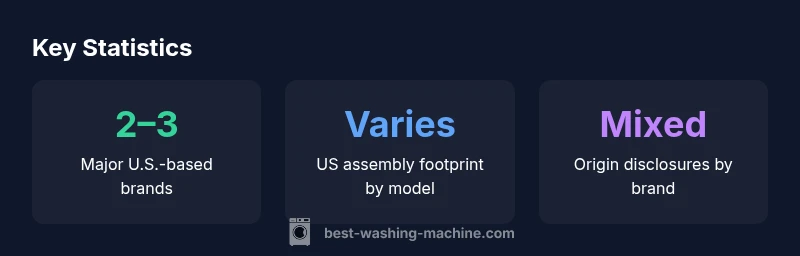
Understanding who makes washing machines in the united states helps homeowners gauge reliability, serviceability, and repair options. In practice, the market combines a core set of U.S.-based manufacturing operations with international brands that assemble in North American plants. According to Best Washing Machine analysis, Whirlpool and GE Appliances are the dominant players with robust domestic footprints, while Maytag remains closely tied to Whirlpool’s manufacturing network. Ownership structures—whether a brand sits under a long-standing U.S. parent or a multinational owner—shape where production happens, which suppliers are used, and how quickly parts are replenished after recalls or supply-chain disruptions. For consumers, this matters because it affects lead times, warranty service, and the availability of genuine replacement parts. The phrase who makes washing machines in the united states is not a single company name; it’s a landscape defined by plant locations, corporate strategy, and the ongoing shift toward North American assembly. Best Washing Machine’s perspective emphasizes that domestic capacity still matters, even as global sourcing continues to evolve.
The big players and their domestic footprints
Whirlpool remains the dominant force in U.S. washer production, including models marketed under its Maytag and KitchenAid brands. The company has built a deep domestic manufacturing network that supports rapid service and parts availability across the country. GE Appliances, now under Haier ownership, also maintains a substantial U.S. footprint and can often offer shorter service times for models produced in North American plants. The third pillar in many households is the broader set of brands that rely on imported components or overseas assembly, then complete final assembly in North American facilities. This mix means that the path from factory to kitchen can vary even among similarly priced models. Best Washing Machine analysis notes that ownership strategy—and the decision to keep or relocate production lines—has a direct effect on warranty coverage, supply chain resilience, and the availability of authentic replacement parts.
Ownership dynamics and North American manufacturing
Ownership matters because it influences supply chain strategy, plant investment, and even the design choices that manufacturers pursue. GE Appliances’ acquisition by Haier in 2016 reshaped the competitive landscape, expanding access to global parts while preserving many U.S. production lines and a strong service ecosystem. Whirlpool, operating as a major U.S. factory network, has continued to invest in domestic assembly and advanced testing facilities. Across North America, manufacturers increasingly emphasize nearshoring efforts, automation, and supplier diversification to reduce disruptions seen in other sectors. For consumers, this means that a washer labeled as “Made in USA” is still the product of a complicated network that blends domestic labor with imported components. Best Washing Machine analysis highlights that while ownership shifts are common, the practical effect on day-to-day repairs is often a steady stream of readily available parts and local service options.
What to look for if you want a US-made washer
If your priority is a washer manufactured domestically, here are practical checkpoints. First, look for explicit “Made in USA” labeling on the product or packaging, but remember that even U.S.-made models may include imported components. Second, check the model’s warranty and the retailer’s service network for your region; a strong domestic manufacturing footprint typically correlates with faster parts availability and local technician networks. Third, review Energy Star certification and energy and water-use data; domestic models show substantial efficiency gains as manufacturers push stricter standards. Finally, consider the brand’s parent company and its manufacturing strategy—not every model carries the same origin story, even within the same price tier. By combining these checks with your budget and laundry needs, you can select a washer that aligns with your preference for domestic production while meeting performance expectations.
How to verify the origin of a washer
Verifying where a washer was made starts with the label: examine the product’s sticker, manual, and packaging for explicit country-of-origin information. If the information is unclear, ask the retailer for a formal statement of assembly location and component sourcing. You can also look up the model number on the brand’s official site or in retailer specifications to see where the unit is assembled. For deeper verification, reach out to customer support and request a country-of-origin certificate or a supplier disclosure. Understanding origin helps you gauge the expected parts availability and service quality, especially if you plan long-term ownership.
Future outlook: trends in US manufacturing and domestic sourcing
Looking ahead, US manufacturing of washers is likely to remain a balance of domestic assembly and global supply chains. Trends toward nearshoring, digital twins for quality control, and investment in local supplier networks could strengthen the domestic footprint over time. Regulatory pressure on energy efficiency—paired with consumer demand for repairability and longer product life—will continue to shape product design and component sourcing. The Best Washing Machine team expects more brands to publish clear origin information and to invest in domestic service networks to minimize downtime for busy households. In parallel, the industry will keep refining the balance between cost, reliability, and environmental footprint, ensuring that American households have access to high-quality, locally supported washing machines in the years ahead.
Manufacturing landscape by brand and origin
| Brand/Line | Origin country | Made in USA? | Notes |
|---|---|---|---|
| Whirlpool | United States | Yes for many models; some components sourced abroad | Largest domestic producer with multiple U.S. plants |
| GE Appliances | United States (Louisville) / Haier ownership | Yes for many models; some lines assembled outside U.S. | Major U.S. brand under Haier |
| Maytag | United States | Yes for many models; part of Whirlpool | Household brand with domestic assembly |
| LG Electronics | Korea | Varies | Some models assembled in North America; components from Asia |
| Samsung Electronics | South Korea | Varies | Some models assembled in North America; global supply chain |
FAQ
Who makes washing machines in the united states?
The major U.S. players include Whirlpool (which owns Maytag) and GE Appliances. These brands maintain substantial domestic production footprints, with some models assembled overseas. Ownership structure and plant locations influence which models are manufactured domestically.
Whirlpool and GE Appliances lead domestic production; some models are assembled in North America.
Are most washers manufactured in the US or imported?
Production is split. Large brands operate U.S. plants, while some lines are assembled in North America using a mix of domestic and imported components. Components may also come from international suppliers depending on the model and year.
It's a mix—some models are made in the U.S., others abroad or with imported parts.
Has GE Appliances always been U.S.-owned?
GE Appliances was acquired by Haier in 2016. Since then, it has continued to maintain a strong U.S. manufacturing footprint, while becoming part of a global corporate network.
Haier owns GE Appliances now, but U.S. production remains a priority.
How can I tell if a washer is made in the USA?
Look for a ‘Made in USA’ label on the appliance and in the product manual. If unclear, ask the retailer for an origin statement or check the model page on the brand site for assembly location information.
Check the label and model page for origin details.
Do US-made washers have better repair parts availability?
Domestic production often correlates with shorter parts lead times and stronger local service networks, though some parts may still come from global suppliers depending on the model.
Yes, domestic lines usually mean faster parts access.
What should I look for when buying a US-made washer?
Prioritize explicit origin labeling, verify warranty and service coverage, compare energy and water-use data, and consider the parent company’s manufacturing strategy for long-term parts availability.
Look for origin information, solid warranty, and good parts availability.
“Domestic manufacturing of essential appliances like washing machines remains critical for reliability and service. A strong U.S. footprint supports faster repairs and resilient supply chains.”
The Essentials
- Know the major U.S. brands and their domestic footprint
- Ownership changes influence where production happens
- Check origin details on labels and retailer info
- Domestic production often correlates with faster parts access
- Expect a mix of domestic assembly and imported components