Agitator or No Agitator Washing Machine: Which Is Right for You?
Compare agitator and no-agitator washing machines to understand cleaning performance, water and energy use, fabric care, and long-term value. This guide from Best Washing Machine helps homeowners, renters, and operators choose the right model for their laundry habits.


TL;DR: Agitator washers deliver strong cleaning for heavily soiled loads and shorter cycles, while no-agitator (impeller) models use less water and accommodate larger, gentler loads. The Best Washing Machine guidance emphasizes matching your laundry volume and fabric care priorities to space, budget, and daily routines. For most households, a balanced approach—considering load size, fabrics, and maintenance needs—works best. According to Best Washing Machine, start with how much laundry you run and what you wash most often.
Practical overview: what agitator vs no agitator means
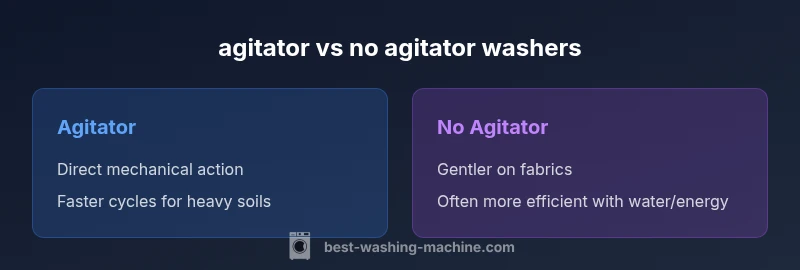
In the world of modern laundry appliances, the choice between an agitator and a model without one shapes nearly every other buying decision. An agitator is a central post that rotates or rocks clothes around the drum, delivering a vigorous mechanical action. In contrast, a no-agitator washer relies on a high-efficiency impeller or a low-profile disc near the drum bottom to create movement. The result is different wash dynamics: agitator models tend to rely on a more direct physical scour, while impeller designs push clothes through water to achieve cleanliness with less direct contact. For the consumer, this choice translates into how a machine handles heavily soiled loads, bulky items, delicate fabrics, and even the overall size of the drum. As you study agitator or no agitator washing machine options, consider your typical loads, your tolerance for longer cycles, and your willingness to prioritize space, water usage, and potential maintenance needs. The Best Washing Machine team emphasizes aligning the choice with your daily realities: how much laundry you wash, what you wash, and where you install the machine in your home.
'
Comparison
| Feature | Agitator Washer | No-Agitator Washer |
|---|---|---|
| Water usage | higher water use | lower water use |
| Cleaning power for heavy soils | stronger direct agitation | reliant on water flow and tumbling |
| Fabric care | potentially more wear on delicate fabrics | gentler on fabrics when loaded properly |
| Cycle time for average loads | often shorter cycles for typical loads | cycles can be longer for equivalent cleanliness |
| Load capacity / usable space | slightly reduced due to central post | often larger usable capacity per drum |
| Price range | generally lower upfront cost | often higher upfront cost |
| Best for | heavily soiled mixed loads, speed matters | energy and fabric care, bulky items, efficiency |
What's Good
- Clear, strong stain removal potential with agitator models
- Shorter cycle times for many heavy-load scenarios
- No central post on impeller models -> more drum space for bulky items
- Gentler fabric handling on no-agitator designs when loaded properly
- Potentially better energy and water efficiency with impellers
Downsides
- Agitator can increase fabric wear on delicate items if not loaded carefully
- No-agitator models may require longer cycles for some soils
- Some no-agitator designs may feel less 'hands-on' for stain removal enthusiasts
- Front-load/no-agitator options can have higher upfront costs or installation considerations
No single design is universally better; choose based on your laundry habits and space.
Agitator washers excel with heavily soiled loads and fast cycles, while no-agitator washers excel in fabric care and efficiency. The best choice balances your typical loads, fabric types, and home layout.
FAQ
What is an agitator in a washing machine?
An agitator is a central post inside the drum that rotates to move clothes aggressively through water. It provides robust mechanical action that helps remove heavy soils. However, it can be harsher on some fabrics if not used with proper load balance.
An agitator is the post in the middle of the drum that stirs clothes. It cleans tough soils but can be tougher on delicate fabrics.
Are agitator washers better for stains?
Agitator washers often remove heavy soils quickly due to direct mechanical action. Yet modern no-agitator designs also offer strong stain removal for typical household soils when paired with versatile wash programs.
Agitator washers can be great for tough stains, but no-agitator models also clean well with the right programs.
Do no-agitator washers damage fabrics?
No-agitator washers are generally gentler on fabrics when loaded properly, but improper loading can still cause wear or tangling. Always follow care guidelines and separate delicate items.
They’re usually gentler if you load them correctly, but improper loading can cause wear.
Which is more energy-efficient?
No-agitator impeller designs often deliver better water and energy efficiency for everyday loads, though efficiency depends on the model and chosen cycle. Look for Energy Star ratings and cycle options.
Impeller washers often save water and energy, but check the specific model’s efficiency.
Are front-load or top-load models more common?
Both configurations are common. Top-load agitator and no-agitator models are prevalent for price and space, while front-load models emphasize efficiency and drum space. Your home layout often dictates the best fit.
Both types are common; your space and budget usually decide which fits best.
How should I test a washer before buying?
In-store, run a cycle with a typical load, check how clothes tumble, monitor noise and vibration, and verify ease of loading bulky items. Compare at least two models with different agitation designs.
Test a couple of models with your usual loads to see which feels right.
The Essentials
- Identify your typical load size and soil level before selecting.
- Consider fabric care priorities to decide between agitation styles.
- Account for space constraints and potential installation needs.
- Evaluate long-term operating costs, not just upfront price.
- Test two models with different agitation designs before buying.