Agitator vs Impeller Washers: A Practical Comparison
Explore how washing machines with agitators compare to agitator-free models in stain removal, fabric care, water use, and efficiency. Learn which type fits your laundry needs and budget.


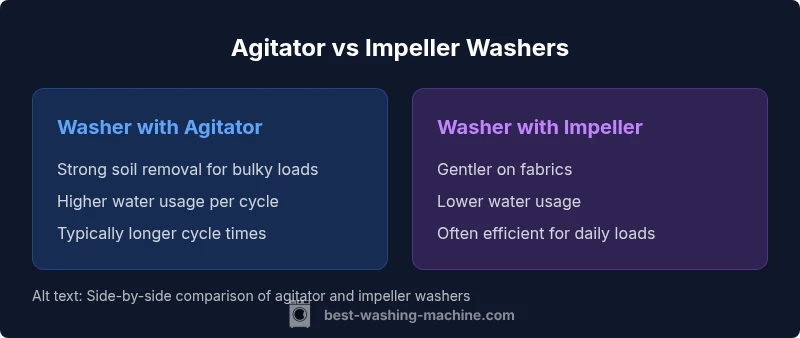
When evaluating a washing machine with agitator vs without, the decision centers on stains, fabric care, and efficiency. Agitator models excel at tackling heavy soils and bulky items, delivering strong agitation. Impeller (agitator-free) designs typically use less water, gentler on fabrics, and often offer better cycle efficiency for everyday loads. In short, choose based on your laundry profile and priorities.
Overview: agitator vs impeller technology
When you’re faced with choosing a washing machine with agitator vs without, the decision hinges on your laundry patterns, fabric types, and energy priorities. Understanding how each design operates helps you predict performance in real-world loads. According to Best Washing Machine, this choice isn’t about a single best option but about matching features to daily needs. In broad terms, agitator models use a central post with fins to move clothes, while impeller designs rely on low-profile vanes to generate water flow. The result is a different balance of soil removal, gentleness, and resource use. Homeowners, renters, and operators should weigh your typical loads, popular fabrics, and the value you place on stain power, fabric longevity, and ongoing costs. The following sections will unpack both approaches and help you map them to your laundry habits.
How agitators work
In a traditional top-load washing machine, the agitator is a tall spindle in the drum that rotates back and forth or twists to tumble clothes. The goal is to create strong water movement that pushes clothes through water, lifting soils from fibers. Agitator systems are simple mechanically; many models use a belt-driven or direct-drive motor to rotate the agitator shaft. The result is robust agitation, which is beneficial for heavily soiled items like workwear, sports gear, or large towels. Because the clothes are pressed against the agitator and spun through the water, you often see rapid soil transfer from fabric to wash water. One trade-off: this action can be harsher on fabrics over time and can use more water per cycle. In recent years, manufacturers have improved control systems to reduce wear and to optimize water use on some agitator models.
How impeller washers work
Washer designs that forego a central agitator rely on a low-profile impeller at the bottom or sides of the drum. By pushing water and clothes in a tumbling, wave-like motion, impeller systems create efficient cleaning with less physical friction on fabrics. Modern models use sensors and variable speeds to tailor agitation to load size and soil level, often delivering gentler fabric care. Impeller washers generally excel in energy and water efficiency and tend to generate shorter cycle times for light to moderate loads. While some heavily soiled or bulky items may benefit from an agitator’s force, impeller designs offer a balanced performance that fits many families’ daily needs.
Comparison
| Feature | Washer with agitator | Washer with impeller |
|---|---|---|
| Stain removal on dense soils | Better with agitator | Good with impeller |
| Fabric care / wear | Potentially harsher on fabrics | Gentler on fabrics |
| Water usage per cycle | Higher water usage | Lower water usage |
| Cycle time for bulky loads | Often longer for bulky loads | Often shorter for similar loads |
| Price range (availability) | Wide range; basic models affordable | Often comparable, higher in some markets |
| Energy efficiency | Varies by model; some older agitators are less efficient | Often strong efficiency in modern impeller models |
What's Good
- Strong soil removal for bulky loads and towels
- Good performance on dense fabrics like jeans
- Wide model availability and affordable base options
- Clear separation of design choices helps buyers pick by priority
Downsides
- Higher water usage per cycle
- Potential for more fabric wear with aggressive agitation
- Cycle times can be longer for heavy or bulky loads
- Impeller models require careful selection to avoid compromise on stain power
Washer with agitator excels at heavy soils and bulky items, while impeller washers shine in fabric care and efficiency.
If stains and bulky loads dominate your laundry, agitator models are strong. If you prioritize gentle fabric handling and water/energy savings, impeller models are a better bet. For many households, an impeller washer offers the best overall balance; however, the right choice still depends on your typical loads and priorities. Best Washing Machine’s guidance is to align features with daily needs to maximize value.
FAQ
Do agitator washers use more water than impeller washers?
In general, agitator models use more water per cycle to suspend and move clothes. Impeller designs typically require less water while still delivering effective cleaning, especially with sensors and variable speeds.
Yes, agitator washers usually use more water per cycle, while impeller models tend to be more water-efficient.
Are agitator washers better for large families?
Agitator washers can handle bulky loads and heavy soils well, making them convenient for families with kids or workers’ clothes. However, many impeller models now offer strong performance as well, so assess your typical loads.
They’re often a good fit for bulky loads, but modern impellers can work well for large families too.
Can I wash delicate fabrics in an agitator washer safely?
Delicates can be washed in agitator models, but it’s best to use gentler cycles and lower agitation settings. Separating delicates and using proper detergents can help minimize wear.
Yes, but use gentle cycles and separate delicate items.
Do impeller washers have shorter cycles for light loads?
Cycle lengths vary by model and setting. Impeller designs often optimize for efficiency, so light loads may complete faster, but always check the specific program options.
Sometimes, yes, light loads can finish faster on impeller models, but it depends on the program you choose.
Is maintenance different for agitator vs impeller washers?
Both require standard care, including cleaning seals and draining hoses. Agitator models have more moving parts that can wear, while impeller designs focus maintenance on electronics and seals.
Maintenance is similar overall, with some extra wear considerations for agitators.
Can I find a washer that combines benefits?
Some high-end models blend design features or offer selectable agitation profiles. In practice, agitator and impeller configurations are typically fixed per model, so you should pick the design that best matches your priorities.
Some models offer flexible programs, but the core design is usually either agitator or impeller.
The Essentials
- Match your laundry profile to the design: agitator for heavy soils, impeller for fabrics and efficiency
- Expect higher water use with agitator models but stronger soil lifting
- Impeller washers typically deliver gentler care and better energy efficiency
- Check cycle options for bulky vs. gentle loads to avoid compromise
- Consider model availability and upfront price in your region