agitator washing machine vs no agitator: Comprehensive comparison
Explore agitator washing machine vs no agitator designs, covering fabric care, efficiency, load handling, and cost to help you choose the right washer.


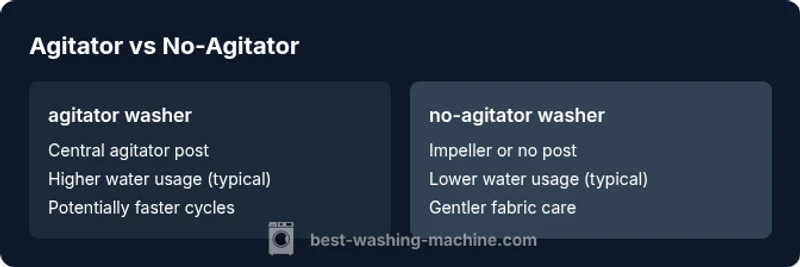
An agitator washing machine uses a central post to churn clothes, while a no-agitator model relies on a low-profile impeller. This design difference drives trade-offs in fabric care, water and energy use, capacity handling, and upfront price. In practice, agitator models excel at bulky loads and faster washes, while no-agitator variants typically offer gentler fabric care, higher efficiency, and larger effective loads.
Understanding the agitator washing machine vs no agitator design
Across households, the decision between agitator washing machine vs no agitator design influences how fabrics wear, how much water is used, and how quickly clothes come clean. According to Best Washing Machine analysis, traditional agitator designs rely on a central post to churn items, creating a distinct wash action that many users associate with speed. In contrast, no-agitator configurations use an impeller or a similar mechanism to move clothes with water flow and gentle pressure. This fundamental difference shapes every other decision you make when choosing a washer, from capacity and footprint to cycle options and maintenance requirements.
Understanding this contrast helps homeowners, renters, and operators compare models with confidence. The core question is simple: do you value speed and bulk handling, or do you prioritize fabric care, efficiency, and long-term operating costs? The answer depends on your typical loads, laundry needs, and budget. The rest of this article breaks down the mechanisms, performance trade-offs, and real-world scenarios to guide your choice.
How agitator systems work: mechanics and operation
An agitator washing machine employs a vertical post (the agitator) mounted in the drum. During a wash cycle, the agitator rotates, rocking or twisting clothes through incoming water and detergents. This action creates a vigorous tumble, which can be effective for soil-rich or bulky items. The control systems adjust speed, agitation pattern, and duration to balance cleaning power with fabric wear. From a user perspective, agitator models often offer straightforward cycles that feel familiar, and some users expect shorter cycle times on common loads.
The science behind agitation centers on contact time, water movement, and mechanical leverage. With a centralized post, clothes experience high shear in localized areas, which can dislodge dirt quickly but may also stress fibers. For homeowners evaluating agitator-washers, key considerations include cycle variety (heavy, normal, sanitize), load size limits, and how the machine handles large items like towels or blankets. These factors influence perceived performance and long-term fabric integrity.
No-agitator systems and impellers: how they move clothes
No-agitator washing machines rely on a low-profile impeller at the bottom of the drum or a tumbling action created by water flow, rather than a central post. This design tends to create a gentler, more uniform wash and can improve overall fabric care, especially for delicate items. The drum remains relatively uncluttered by a post, which often means more usable space for bulky fabrics and a more flexible loading pattern.
Impeller-based designs typically use multiple wash motions and variable speeds to simulate a thorough cleaning without the aggressive churning associated with agitators. Users may notice longer cycle times on certain modes, but the trade-off is less fiber abrasion and reduced tangling on delicate fabrics. When evaluating no-agitator models, pay attention to soil performance on everyday loads, as some soils respond differently to impeller-driven action compared with traditional agitators.
Fabric care implications: delicates, cottons, and mixed loads
Fabric care sits at the heart of the agitator washing machine vs no agitator decision. No-agitator impeller systems generally offer gentler handling for delicates, knits, and delicate synthetics, reducing pilling and snagging. They can, however, perform differently on very stubborn soils, depending on cycle design and detergent routing. Aggressive cycles may still be effective on cottons and sturdy fabrics with no agitator, but the risk of fiber wear is often lower than with an aggressive agitator wash.
For mixed-load households, the choice becomes a balance: if you frequently wash bulky items or heavy soils, an agitator model may deliver faster results on certain cycles. If your daily wear includes lots of fabric types—delicates, activewear, or performance fabrics—a no-agitator design is likely to yield gentler care and consistent results over time. Best Washing Machine analysis underscores that neither design is universally superior; the best fit depends on your typical laundry mix.
Water and energy efficiency: the big trade-offs
Water and energy use are major decision drivers in agitator washing machine vs no agitator comparisons. On average, modern no-agitator designs tend to use less water per cycle because the impeller promotes efficient water movement without filling the drum excessively. In parallel, energy efficiency is highly model-dependent; some no-agitator washers employ high-efficiency motors, advanced sensors, and optimized wash algorithms that reduce energy consumption while maintaining cleaning power.
That said, a subset of traditional agitator models has been updated to high-efficiency configurations, narrowing the performance gap. When evaluating options, look for Energy Star ratings, cycle options designed for smaller loads, and consumer reviews that reflect real-world efficiency rather than lab results alone. Best Washing Machine analysis notes that the energy and water savings are more pronounced in newer platforms, but results vary by brand and model.
Load size, accessibility, and user experience
User experience differs noticeably between agitator and no-agitator designs. Agitator washers often have slightly shorter cycles for standard loads and can be easier to load with lower drum height in some top-load models. The sensor and control logic on these machines tends to prioritize quick cycles for weekly laundry, a factor many households value for convenience.
No-agitator washers, by contrast, typically offer greater drum space for tall items and bulky textiles, plus a more flexible loading pattern. The absence of a central post means fewer places for items to snag, which helps with larger or irregular loads. For operators in laundromats or multi-unit dwellings, the improved drum space and gentler wash can translate into higher customer satisfaction, especially for mixed fabric inventories. Evaluating your typical load shape, garment types, and cycle expectations will help determine which design aligns with your routines.
Cleaning performance and stain removal: what to expect
Stain removal and soil lifting depend on cycle design and detergent chemistry as much as the washing action itself. Agitator machines excel on certain soils due to their vigorous, localized agitation, which can dislodge ground-in dirt quickly. No-agitator models rely on water motion and mechanical action from the impeller, which can deliver gentle yet effective cleaning for everyday soils when paired with the right detergent and wash settings.
In practice, the difference comes down to soil type, water temperature, and cycle selection. For heavy soils or outdoor grime, you may opt for a dedicated heavy cycle with higher agitation in an agitator washer, or a robust no-agitator cycle enhanced with pre-wash and longer soak times. If your household regularly deals with delicate fabrics, you’ll likely appreciate the gentler handling afforded by impeller-driven no-agitator machines while still achieving clean results through longer cycles or stronger rinse options.
Maintenance and durability considerations
Maintenance needs differ between agitator washing machine vs no agitator models. Agitator designs have moving parts—such as the central post, linkage, and associated seals—that can wear over time, potentially increasing service needs. No-agitator machines may present fewer mechanical wear points in the wash action, but the front-end components (detergent dispensers, sensors, and impeller assemblies) can require attention as wash cycles become more advanced.
The reliability of either design hinges on build quality, drum bearing life, and the electronics package. Look for manufacturers with robust warranties, accessible service networks, and readily available replacement parts. Regular cleaning, proper detergent use, and avoiding overloading will extend the life of both agitator and no-agitator washers. Consider maintenance costs in your total ownership calculation rather than focusing solely on upfront price.
Price and value: upfront cost vs long-term costs
Price is a practical differentiator in the agitator washing machine vs no agitator dialogue. Traditional agitator washers often come in at a lower upfront cost, especially for basic top-load models that emphasize straightforward cycles. Modern no-agitator designs tend to command a higher price tag, reflecting advanced engineering, efficiency features, and larger drum space. Over the long term, however, water and energy savings can offset the initial premium for the right user, especially when you wash frequently or accumulate tall, bulky items.
When evaluating total cost of ownership, consider cycle lengths, water usage, energy consumption, potential maintenance expenses, and resale value. The decision should align with your budget, laundry volume, and long-term goals for efficiency and fabric care. Best Washing Machine analysis emphasizes balancing upfront investment with projected operating costs to maximize value over the washer’s lifespan.
Common myths about agitator washing machine vs no agitator
A common myth is that agitator models always clean more thoroughly than no-agitator designs. Reality shows that cleaning performance depends on soil type, wash program, water temperature, and detergent effectiveness. Another misconception is that no-agitator washers damage delicate fabrics less; while they are often gentler, some cycles in no-agitator models still require careful loading and appropriate fabric care settings. A third myth is that cycle times are universally longer for no-agitator designs; in some cases, modern no-agitator washers offer competitive, even shorter, cycles with the right configuration.
Consumers should test multiple cycles on actual loads to determine which brand and model meet their expectations. Avoid relying on broad generalizations and instead compare lab-tested claims with real-world performance data from trusted sources, including reviews and the retailer’s own testing. The goal is to separate perception from measurable outcomes in your specific laundry context.
Choosing the right model for your needs: scenarios and checklists
To pick the right model for your needs, build a simple scenario checklist. Consider your typical loads: do you regularly wash bulky items like comforters, or do you mostly handle delicates and casual wear? How important is water and energy efficiency to your budget? Do you operate in a space with height constraints or limited accessibility? For households with mixed fabric types, a no-agitator model with a robust cycle selection can offer flexibility, while a dedicated agitator model might better handle fast cycles for heavy soils. Create a short list of must-haves (e.g., energy rating, drum size, cycle variety) and nice-to-haves (e.g., smart features, app control).
Consult model-by-model comparisons, focusing on real-world tests and consumer feedback. If possible, visit showrooms to observe drum accessibility and load behavior with items similar to your typical laundry. Testing across 2–3 models in your preferred price range will help you spot subtle differences in wash quality, noise, and efficiency. Best Washing Machine advises framing your decision around your most common loads and your willingness to compromise on cycle time, capacity, or fabric care.
How to run a side-by-side test at home
If you want a practical way to assess agitator washing machine vs no agitator options, perform a controlled side-by-side test. Use identical detergent and load sizes, and run equivalent cycles on two machines you are considering. Measure three outcomes: soil removal on a mainstream stain (e.g., ground-in dirt on a cotton shirt), fabric wear after multiple cycles, and water usage per cycle. Keep a simple log of cycle times, energy draw, and perceived fabric softness. This approach gives you a data-backed basis to decide which design aligns with your priorities and budget.
Final considerations: real-world decision factors
In the end, your choice between an agitator washing machine vs no agitator comes down to trade-offs you can live with. If you want speed and straightforward performance on bulkier loads, an agitator model may be the better fit. If you prioritize fabric care, energy efficiency, and flexible loading, a no-agitator design is typically the stronger choice. Balance your load types, budget constraints, and the warranty and service network available in your area. Remember that the best decision is rooted in your actual laundry habits, not just generalized claims.
Comparison
| Feature | agitator washing machine | no-agitator washing machine |
|---|---|---|
| Design mechanism | central agitator post churns clothes | low-profile impeller moves clothes by water flow |
| Water Usage | higher water usage on average | lower water usage on average |
| Energy Efficiency | varies by model; some high-efficiency options | varies by model; modern high-efficiency options common |
| Load Handling | strong performance with bulky items but drum space per item often reduced | better drum space utilization for large or tall items |
| Fabric Care | can be harsher on delicate fabrics | gentler on fabrics due to smoother agitation |
| Price Range | typically lower upfront cost for basic models | often higher upfront cost for modern no-agitator models |
| Maintenance | moving parts like agitator mechanisms can wear | fewer mechanical parts in some designs; newer tech may require service |
| Best For | bulkier loads and fast cycles | energy-conscious households and delicates |
What's Good
- Lower water usage in many modern no-agitator models
- Larger drum space and better clearance for bulky items
- Gentler fabric care for delicates and mixed fabrics
- Potential for lower long-term operating costs due to efficiency
Downsides
- Some users experience longer cycle times on certain no-agitator modes
- Higher upfront cost for many modern no-agitator models
- Performance can vary by soil type and detergent choice
- Older agitator models may still be attractive for budget-conscious buyers
No-agitator models generally offer better long-term value for most households.
In practice, no-agitator designs deliver gentler fabric care and energy savings, which most households value. The Best Washing Machine team recommends weighing your typical loads and budget to determine whether the efficiency gains outweigh any potential trade-offs in cycle times or upfront cost.
FAQ
What is the main difference between agitator washing machines and no-agitator designs?
The main difference is the wash action: agitator models use a central post to churn clothes, while no-agitator designs use an impeller and water flow for agitation. This affects fabric care, efficiency, and load handling. Consider your typical loads and priorities when choosing.
The key difference is agitator versus impeller action, which changes how fabrics wear and how efficiently the load is cleaned.
Are no-agitator washers better for delicates?
Generally yes, no-agitator impellers are gentler on fabrics and reduce snagging. However, delicates still benefit from appropriate cycle settings and load balancing. Always pair the machine with the right detergent and cycle option.
Yes, they’re usually gentler on delicates with proper cycle settings.
Do agitator washers clean bulky items better?
Agitator washers can handle bulky items quickly on some cycles, but performance depends on the model and soil. For very large or heavy textiles, test with your typical loads to confirm.
They can be faster for bulky items, but it varies by model.
Which is more energy-efficient overall?
Modern no-agitator designs with high-efficiency motors often use less water and energy, though results vary by model. Look for Energy Star ratings and real-world reviews to gauge performance.
No-agitator models are often more efficient, but check the specific model.
Is it worth paying more upfront for a no-agitator model?
If you value fabric care, long-term savings, and lower water use, it can be worth the upfront premium. Compare lifecycle costs, not just sticker price, and consider your budget.
It can be worth it depending on your needs and budget.
The Essentials
- Assess your typical loads to choose the right design
- Prioritize water and energy efficiency for long-term savings
- Balance upfront cost with expected operating costs
- Test multiple cycles for delicates and bulkier items
- Check warranty and service coverage before buying