Semi-Automatic vs Fully Automatic Washers: A Practical Comparison
Explore the difference between semi-automatic and fully automatic washing machines. This objective guide compares operation, water use, maintenance, cost, and ideal use cases to help you choose the best model for your home.


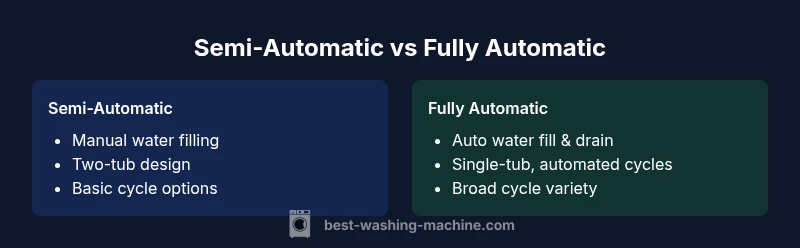
The key difference is automation: semi-automatic washers require manual filling and draining and typically use two tubs, while fully automatic washers manage filling, washing, and draining in one tub with programmed cycles. Semi-automatic models tend to be cheaper upfront and simpler to repair, but fully automatic models save time, water, and electricity with more convenience and advanced options.
What the difference between semi automatic washing machine and fully automatic means in everyday use
For homeowners evaluating a washer, the difference between semi automatic washing machine and fully automatic is more than a marketing label; it defines how you interact with the appliance day-to-day. In markets where the two-tub design is still common, semi-automatic models offer a hands-on laundry process, while fully automatic machines emphasize one-tub operation with automated cycles. From a practical perspective, the distinction influences water sourcing, cycle timing, and even how you plan wash days around your other chores. According to Best Washing Machine, most households weigh upfront cost against long-term efficiency, and the decision often comes down to space, water availability, and the pace of daily life. This article breaks down the fundamentals, clarifies misconceptions, and provides a framework to guide your purchase.
How semi-automatic and fully automatic operate: a step-by-step overview
Semiautomatic washers typically require two tubs: one for washing and one for spinning. The user manually fills water into the wash tub using a tap, adds detergent, runs a cycle, then manually transfers clothes to the spin tub and drains water before drying. The process gives the operator direct control over water use, cycle duration, and batch size. In contrast, fully automatic washers unify washing, rinsing, and spinning into a single-tub system. They have built-in water inlet valves, sensors, and programmed cycles that automatically fill to the right level, agitate, drain, rinse, and spin. Some models also offer delay-start options and multiple cycle programs tailored to fabrics. The difference in interaction is significant: semi-automatic means you manage steps; fully automatic means you manage settings and timing, while the machine handles the physical work. For a consumer, that translates into time saved and smoother laundry days, albeit with different initial investments.
Water usage, energy implications, and efficiency considerations
Water use is a central differentiator. In semi-automatic machines, water is introduced manually and can be reused to some extent in the spin tub, depending on the model design. This gives households in areas with scarce water supply a potential advantage, but it also means inconsistent rinse results if care is not taken. Fully automatic models rely on calibrated water inlet valves and sensors to optimize fill levels for each cycle, which generally reduces waste and improves rinsing efficiency. Energy implications follow a similar pattern: semi-automatic units often run longer cycles with lower automation, sometimes resulting in higher energy use per load, especially if you manually run extra cycles. Fully automatic washers typically offer energy-saving options, variable spin speeds, and eco modes that help minimize electricity consumption. However, the energy and water profile of any given machine is heavily model-dependent, so avoid assuming a universal rule. The Best Washing Machine analysis shows that model choice, usage patterns, and maintenance affect real-world efficiency more than the basic category alone.
Cleaning performance, cycle options, and fabric care
Fabric care is influenced by drum design, agitation method, and cycle selection. Semi-automatic washing machines, with two compartments, are often equipped with straightforward agitator-based washing in the main tub. Some users report robust cleaning for typical cottons and everyday fabrics, but care must be taken with delicate items because there is less gentle agitation control. Spin results depend on the user transferring clothes to the spin tub and applying appropriate spin settings; wet loads can remain damp if not handled carefully. Fully automatic washers offer a wider range of cycles, including delicate, wool, quick wash, lint reduction, and heavy-duty modes. Modern fully automatic models incorporate sensors to adjust washing time, water level, and agitation for different fabrics, helping to protect textiles during the wash. Because cycle performance varies by brand and model, always review the specific cycle descriptions and fabric care guidelines provided by the manufacturer.
Capacity, spin speed, and load flexibility
Capacity is a practical consideration: semi-automatic two-tub designs often have a lower combined capacity, and you may need to run separate loads for washing and drying. Fully automatic machines typically come with larger drum capacities in a single tub, enabling bigger loads or bulky items like bedding to go in together. Spin speeds influence moisture removal; higher RPMs generally translate to drier clothes at the end of the cycle, speeding up drying. In two-tub semi-automatic systems, the spin tub is separate, and performance can vary based on how efficiently you transfer items between tubs. Fully automatic washers offer more consistent spin performance and often provide higher maximum RPM, but rates vary widely among models. When evaluating capacity and spin features, consider your weekly laundry volume, the types of fabrics you wash, and whether you rely on a separate dryer or air-drying. A practical test is to measure the weight of a typical load and compare drum sizes and cycles in product specs.
Installation footprint, space needs, and location suitability
Semi-automatic machines with two tubs usually require more floor space, because you need room for both tubs and the transfer area. They can sometimes fit into tighter corners or under a counter if configured appropriately, but the two-tub design tends to dominate footprint. Fully automatic washers, especially front-load designs, can be compact and stackable, which is advantageous in small apartments or laundry closets. They also simplify plumbing: you connect a single inlet hose and a single drain, reducing the complexity of installation. Location matters: if water pressure is variable or if your building has limited drainage, semi-automatic units may offer more flexible water sourcing. Conversely, if you plan to place the washer near a bathroom or kitchen with standard plumbing, a fully automatic model tends to be easier to set up and maintain. Always verify space measurements, door swing clearance, and ventilation considerations before purchase.
Maintenance, durability, and common failures
Maintenance habits differ. Semi-automatic machines have more manual steps—draining hoses, taps, and tub-to-tub transfers—which can lead to mistakes if not performed regularly. They also tend to use mechanical controls and simpler electronics, which some users view as robust. Fully automatic washers rely on integrated electronics, sensors, and software to manage cycles; this can improve performance and consistency but introduces more potential failure points. In either case, routine cleaning of filters, hoses, and drum surfaces helps prevent odor and buildup. Check for signs of wear on belts, agitators, and seals; replace worn parts promptly to avoid leaks and inefficiency. Durability depends on build quality, maintenance discipline, and water quality. Brands with good after-sales service can reduce the impact of component wear on long-term reliability. For homeowners facing hard water, installing a water conditioner can help protect valves and seals in both types of machines.
Total cost of ownership: upfront price, running costs, maintenance
Cost of ownership includes upfront price, energy and water costs, detergent consumption, and maintenance or repair expenses. Semi-automatic washers generally have a lower upfront price, but the longer, more manual process can translate into higher labor costs or time costs for large families. Fully automatic washers typically command a higher initial price, but savings from faster cycles, better detergents usage, and potential energy and water efficiency can offset the higher purchase price over time. Maintenance costs vary by model and brand. Look for machines with readily available spare parts and proven after-sales support. The life expectancy of washers varies by usage patterns, load type, and care, but in general, a well-maintained automatic machine may offer longer service life in modern homes. When calculating ownership costs, consider your daily routine, laundry volume, and your willingness to invest in future-proof features like eco modes and smart diagnostics.
Use-case scenarios: when semi-automatic shines vs fully automatic shines
For households with variable water access, semi-automatic can offer the practical advantage of manual water control and potential water reuse. Off-grid homes or locations with frequent water supply interruptions may benefit from the independent water taps and the ability to pause water supply during cycles. Families with heavy laundry loads and busy schedules often prefer fully automatic washers to save time and simplify operation. In urban apartments with limited space, front-load fully automatic models that are stackable may maximize vertical space while preserving drum capacity. For hobbyists or people who enjoy tinkering with appliances, semi-automatic units can be more approachable for diagnosis and basic repair due to simpler mechanical parts. Consider your daily routine, the number of people in your household, and your tolerance for manual steps when comparing these scenarios.
How to upgrade from semi to fully automatic: practical steps
Upgrading from a semi-automatic to a fully automatic unit typically involves evaluating your space, power, and plumbing. Start by measuring the available room and checking door clearance; most fully automatic front-load or top-load models require a slightly different footprint and may need a dedicated outlet with appropriate voltage. Next, verify your water supply: a single inlet hose suffices for most fully automatic models, but if you have inconsistent pressure, confirm the model's inlet specifications and consider a pressure regulator. Finally, consider capacity and cycle options; choose a model with the features you use most, such as quick wash, heavy-duty cycles, and fabric care. If you are moving from a two-tub semi-automatic design to a single-tub fully automatic, plan for the added space that a modern machine uses and the need for a new drain and supply connections. Always consult the manufacturer’s installation guide or hire a licensed installer if necessary.
Common myths and tips for buyers
Myths about semi-automatic versus fully automatic can mislead buyers. A common belief is that fully automatic washers always use less water; reality depends on cycle selection and machine efficiency. Another misconception is that all semi-automatic models are outdated; in some markets they remain popular due to cost and user preference. Some buyers assume that two-tub designs are inherently wasteful; in areas with inconsistent water pressure, the ability to control water usage manually can be an advantage. Finally, buyers may think that warranty conditions are the same across both categories; warranty terms vary by brand and model, so check what is covered and whether service networks are available in your area. When evaluating options, use a structured checklist to compare cycle options, capacity, space requirements, energy labels, and after-sales support.
Practical buying checklist for the difference between semi automatic washing machine and fully automatic
Create a shopping checklist to compare models quickly: space availability, water source reliability, energy efficiency, drum capacity, cycle variety, control simplicity, maintenance needs, and warranty. Gather model brochures, read user reviews, and test run quick cycles in-store if possible. For semi-automatic models, verify the availability of spare parts and hoses; for fully automatic models, check the program range and compatibility with your detergent. Finally, consider the long-term value: even if upfront cost is higher for fully automatic models, the improved efficiency and convenience can yield a favorable return on investment over several years. Use these steps as your decision framework to select the best option for your home.
Comparison
| Feature | Semi-automatic washer | Fully automatic washer |
|---|---|---|
| Operation mode | Manual water filling and two-tub transfer | Single-tub, automatic water fill and cycles |
| Water usage | Depends on manual filling; may vary | Automated fill levels; generally optimized |
| Cycle options | Basic washes; limited cycles | Wide range of cycles, eco modes, and specialty options |
| Detergent handling | Manual dosing; soap in main tub | Auto-dosing/automatic dispensing in some models |
| Energy efficiency | Model-dependent; often lower due to manual steps | Typically higher efficiency with modern controls |
| Capacity | Often lower combined capacity; two-tub design | Single-tub with larger drum; higher capacity |
| Price range | Lower upfront cost (model-dependent) | Higher upfront cost (model-dependent) |
| Maintenance | More manual steps; may be simpler to repair | More electronics; advanced sensors; potential complex repairs |
What's Good
- Lower upfront cost on many semi-automatic models
- Direct water control can be advantageous in low-water areas
- Two-tub design offers straightforward operation in some markets
- Compact options are available for small spaces
Downsides
- Requires more manual effort and supervision
- Longer total wash time due to step-by-step process
- Higher potential for inconsistent rinse if water transfer is not done carefully
- Higher long-term labor costs for large households
Fully automatic washers generally offer the best balance of convenience and efficiency for most homes; semi-automatic remains viable for budgets or water-constrained scenarios
If you prioritize hands-off operation and time savings, choose fully automatic. If upfront cost and simple, direct water control are paramount, semi-automatic can be a smart, economical choice.
FAQ
What is the practical difference between semi automatic and fully automatic washing machines?
The practical difference is in automation level: semi-automatic machines require more manual steps and often use two separate tubs, while fully automatic machines handle water fill, washing, and draining in one integrated system with programmed cycles.
The main difference is automation; semi-automatic needs manual steps, while fully automatic runs cycles end-to-end automatically.
Do semi-automatic washers use less water than fully automatic ones?
Water use depends on how you operate both types. Semi-automatic machines give you more control over water during filling, which can save water in tight situations, but it also invites variability. Fully automatic washers optimize fill levels for each cycle, which can reduce waste when used with eco modes.
Water use varies by model and how you operate it—manual control can save water if used carefully, but automation can reduce waste with the right settings.
Are there energy efficiency differences between the two types?
Energy efficiency varies by model more than by type. Modern fully automatic washers often include eco modes and sensors that optimize energy use. Semi-automatic units can be efficient in well-chosen models, but many older or budget options lag in automation and efficiency.
Energy efficiency depends on the model; newer automatics often lead with eco modes, while semis vary widely.
What should I check before buying a semi-automatic or fully automatic washer?
Check capacity, cycle options, water and electrical requirements, space constraints, and after-sales service. Review the warranty and spare parts availability. If possible, test a model’s cycles and listen for noise or vibration.
Look at capacity, cycles, space needs, and warranty; a hands-on test helps ensure comfort with the controls.
Is it possible to upgrade from semi-automatic to fully automatic?
Upgrading typically involves replacing plumbing and electrical connections, space planning, and choosing a model that fits your space. In many cases, a direct swap is feasible, but you may need to adjust the location or install new outlets and drainage. Always refer to the installation guide and consider professional help.
You can upgrade, but you’ll usually need space planning and may require a professional install to ensure proper connections.
The Essentials
- Assess upfront cost vs long-term efficiency
- Match space and water constraints to machine type
- Value cycle variety and fabric care in automatic models
- Factor maintenance and after-sales support into the decision
- Use a structured buying checklist to compare models