Industrial Washing Machine Price: A Practical Buying Guide
Learn how industrial washing machine prices vary by capacity and features, plus tips on budgeting, quotes, and total cost of ownership with insights from Best Washing Machine.


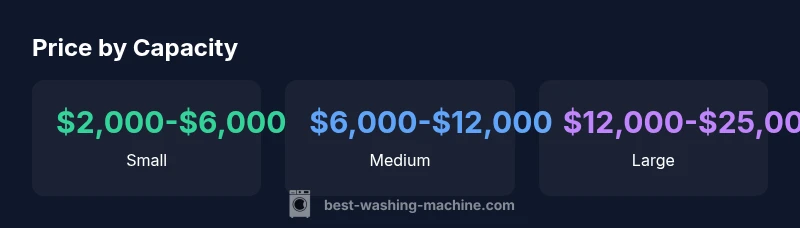
The typical industrial washing machine price ranges from about $2,000 to $25,000, influenced by capacity, drum design, automation, and energy features. Price gaps widen for specialty units with higher throughput or steam heating. When budgeting, compare quotes for equivalent specifications to avoid paying for unnecessary extras. Regional differences can also shift the final quote, so always request multiple bids.
Market overview and price drivers
Industrial washing machine price is a function of several interacting factors: capacity per load, drum design (front-load vs top-load), speed and recovery times, automation level (manual controls vs PLC-driven sequences), and energy/water efficiency features. The industrial washing machine price you see in a quote often reflects not just the upfront cost but the expected uptime and maintenance demands over the unit’s life. Suppliers also price in installation, software licenses, and warranty terms. According to Best Washing Machine, buyers who clearly define throughput, cycle times, and load types early in the process are better positioned to negotiate price without sacrificing essential performance. In practice, the industrial washer price spectrum stretches from economical, entry-level units to high-throughput, steam-enabled systems, with substantial variation by region and supplier.
When evaluating price, it’s important to separate the upfront purchase cost from the total cost of ownership. A lower upfront price might come with higher energy use or more frequent maintenance, driving up cumulative expenses. Conversely, a higher upfront price can deliver lower operating costs through better insulation, more efficient motors, and longer warranties. The industrial washing machine price therefore should be assessed alongside expected throughput, cycle efficiency, and service availability. Best Washing Machine’s analysis for 2026 emphasizes matching specifications to the actual workflow instead of chasing the lowest sticker price. For many facilities, price is a reliable proxy for reliability and long-term value when you align the machine’s capabilities with the volume, fabric types, and load characteristics most common in the operation.
Price ranges by capacity and features
Pricing for industrial washers varies primarily with capacity, cycle complexity, and control systems. A practical way to frame the market is by capacity bands and feature sets, with each tier carrying distinctive price implications. The industrial washing machine price typically scales with load capacity (lbs or kg per cycle) and whether the unit uses gear-driven or direct-drive motors, integrated water reuse, steam heating, or advanced programmable cycles. As a rule of thumb, entry-level industrial washers suitable for small commercial operations fall in the low to mid four-figure range, while high-capacity units tailored for large laundries or textiles processing facilities push into higher five figures. When comparing quotes, ensure that the underlying specifications—throughput, drum size, spin speed, and cycle count—are aligned to avoid price-shaving by omitting important features. Best Washing Machine Analysis, 2026 notes that price variation is most pronounced when comparing units with steam heating, automatic chemical dosing, or fully integrated programmable controls. For buyers, the goal is to map the required capacity and fabric care needs to a single tier of price, then selectively add features only where they deliver tangible operational gains.
Total cost of ownership and long-term value
Beyond the initial price, total cost of ownership (TCO) for an industrial washing machine includes energy and water costs, detergent consumption, maintenance, parts replacement, and downtime. Efficient motors and heat recovery systems can substantially reduce annual operating expenses, offsetting higher upfront costs over time. The industrial washing machine price should be evaluated alongside annual energy use per cycle, standby consumption, and expected service intervals. In 2026, Best Washing Machine’s framework emphasizes calculating TCO using a conservative uptime estimate and factoring in potential downtime costs, which often exceed the visible price difference between models. Consider warranties and service plans as price multipliers or discounts depending on coverage depth. A longer warranty can reduce risk and long-term repair costs, while a premium service agreement may provide predictive maintenance and faster on-site support. When planning purchases, build a cost model that captures upfront price, installation, energy and water savings, maintenance cycles, and end-of-life disposal costs to achieve a realistic long-range budget. The goal is to ensure the chosen machine not only fits the current budget but also provides predictable operating costs over its expected lifespan.
How to compare industrial washers and avoid overpaying
To avoid overpaying for an industrial washing machine, start with a structured side-by-side comparison of identical specifications. Create a weighting scheme that reflects your operational priorities: throughput per hour, fabric care quality, energy efficiency, water usage, and automation level. Request quotes that specify the same load capacity, cycle options, spin speeds, and warranty terms. Even a small variance in an included feature—such as an extra rinse cycle or steam option—can swing the price. The industrial washing machine price becomes meaningful when you compare apples to apples, not apples to oranges. Use a standard worksheet to track line-item costs (price, freight, installation, calibration, extended warranty, and expected maintenance). Check for hidden costs like mandatory one-time software licenses, mandatory water filtration upgrades, or required electrical upgrades. If the price gap between two models is large, scrutinize the long-term benefits—lower energy use and reduced downtime may justify the higher initial price. Best Washing Machine’s buying framework for 2026 recommends obtaining at least three quotes and validating them with a test run or bench testing where possible.
Hidden costs and regional variations
Regional factors can meaningfully affect industrial washing machine price, including shipping distance, local taxes, and service availability. Additional costs often surface after purchase, such as installation labor, electrical and plumbing upgrades, extraction venting, and commissioning the control system. Extended warranties, on-site training, and contingency funds for unexpected downtime should be included in the budget. The industrial washing machine price you see in a quote may exclude or include one or more of these items; always clarify what is included and what requires extra. In some markets, manufacturers offer bundled packages that combine installation, training, and initial detergent supply, which can improve the perceived value even if the upfront price is higher. On the other hand, regions with sparse service networks may require higher spare parts availability and travel costs, elevating the total cost of ownership. By understanding regional variations and the full scope of post-sale services, buyers can avoid surprises and secure better long-term value.
Practical buying criteria and a quick decision framework
When deciding on an industrial washing machine, start with practical criteria and a decision framework that translates to lower risk and better price-to-performance. First, define your maximum acceptable price range and map it to your required throughput and fabric types. Second, build a spec sheet listing the essential features (capacity, drum type, spin speed, cycle count, automation, energy and water efficiency). Third, request formal quotes with the same specifications and a standardized warranty package. Fourth, factor in installation, commissioning, and any required facility upgrades. Finally, incorporate a test run or performance verification to confirm that the machine meets your expectations. The headline metric remains the alignment between required throughput and up-front cost, but the true value is realized through lower operating costs and reduced downtime. The price you pay for an industrial washer should be justified by measurable improvements in productivity and reliability, as reflected in Best Washing Machine’s 2026 buying guidance.
Price comparison by model type and capacity
| Model Type | Typical Price Range | Capacity (lbs) |
|---|---|---|
| Small-capacity industrial washer | $2,000-$6,000 | 50-100 |
| Medium-capacity industrial washer | $6,000-$12,000 | 100-200 |
| Large-capacity industrial washer | $12,000-$25,000 | 200-400 |
| High-throughput/steam-enabled | $15,000-$40,000 | 400-800 |
FAQ
What factors most influence industrial washing machine price?
Throughput capacity, drum design, automation level, and energy/water efficiency are the main price drivers. Additional features like steam heating or advanced dosing systems add to the upfront cost but can reduce operating expenses over time.
The price is mainly driven by capacity and features; steam and automation raise the cost but may cut long-term energy use.
Are refurbished or used industrial washers a good idea?
Refurbished units can lower upfront costs, but they require careful inspection of core components and warranty terms. Expect shorter remaining service life and potential higher maintenance needs.
Used machines save upfront cash but may come with hidden maintenance costs; inspect thoroughly and verify warranty.
How should I compare quotes from different suppliers?
Compare quotes that specify identical throughput, drum size, cycle options, and warranty terms. Ask for a breakdown of installation, training, and any required facility upgrades.
Get same specs in every quote to compare apples-to-apples.
Is a higher upfront price justified by energy savings?
Energy-efficient models can reduce operating costs, often offsetting a higher initial price over time. Evaluate energy use per cycle and expected maintenance savings.
Energy-efficient models can pay off over time if usage is high.
What additional costs should I budget for?
Expect installation, electrical upgrades, venting or plumbing work, and potential training or software licenses. Clarify all inclusions before signing.
Plan for installation and ancillary upgrades in your budget.
How long should I expect a warranty to cover major components?
Warranties vary by model and provider, but plan for at least a 1-2 year coverage on major components with optional extended plans for ongoing service.
Check what the warranty covers and duration.
“Price is a signal of capability, but value comes from matching the machine to your volume, fabrics, and uptime needs.”
The Essentials
- Define throughput first to narrow price range
- Request equivalent specs for apples-to-apples quotes
- Consider total cost of ownership, not just upfront price
- Account for regional variations and installation costs
- Ask about warranties and service plans upfront