washing machine agitator vs no agitator: A comprehensive comparison
Compare agitator and no-agitator washers to decide which design fits your laundry habits, fabric care needs, and budget. Learn how each system cleans, saves water, and impacts load sizes and costs.


For most households, a washer with an agitator offers thorough cleaning on large, heavily soiled loads, while a no-agitator, often impeller-based design saves water and reduces wear on fabrics. The best choice depends on your laundry style, fabric care needs, and budget: consider load size, detergent usage, and long-term running costs before deciding between washing machines with agitator vs no agitator.
Overview of the debate: washing machine agitator vs no agitator
When you shop for a new washing machine, the choice between models with a central agitator and those without can shape your entire laundry routine. The phrase washing machine agitator vs no agitator captures a fundamental design dichotomy that affects cleaning performance, fabric care, water consumption, and price. According to Best Washing Machine, the decision hinges on your typical laundry loads, fabric types, and how you balance upfront cost with long-term operating expenses. In this guide, we’ll dissect how each design works, where they excel, and which family or business scenario benefits most from one approach over the other. By the end, you’ll have a clear framework to align your next purchase with your daily washing needs.
How the agitator approach cleans: core mechanics and typical configurations
Agitator-equipped washers usually live in traditional top-load configurations. The central post, often with fins, grabs and tugs laundry to create a turbulent wash. This vigorous motion is particularly effective at dislodging bulky soils from heavy fabrics like towels, jeans, and workwear. The design tends to offer short-cycle options and is favored by households that prioritize fast turnaround on large loads. While agitators deliver robust cleaning, they can demand more water and potentially increase fabric wear over time if cycles are not adjusted for delicates.
How impellers (no agitator) deliver movement: the opposite end of the spectrum
Impel ler-based, no-agitator systems rely on a low-profile impeller at the bottom and a rotating wash action to move clothes through water. The result is gentler handling and often lower water usage. These models excel with mixed fabrics and daily laundry, especially where energy and water savings are important. However, the wash action can feel less aggressive on heavily soiled items, sometimes requiring longer cycles or specific settings to maximize soil removal.
Cleaning performance across soil types: bulky soil, everyday grime, and delicate fabrics
Cleaning performance varies with soil category. Agitator models tend to shine on bulky soils and heavy traffic items due to their physical agitation, which helps lift dirt embedded in fibers. Impeller washers perform consistently well on everyday loads and light-to-moderate soils, with modern presets tuned to optimize detergent efficiency and fabric safety. For households dealing with mixed soils, a machine with adaptive cycles can bridge the gap, offering both agitation levels and variable load sensing.
Fabric care and garment longevity: wear, fuzz, and pilling considerations
Fabric care is a key differentiator. Agitator washers may cause slightly more agitation on fabrics, potentially increasing wear on delicate textiles over many cycles. Impeller-based washers, by contrast, generally present gentler handling, reducing fiber stress and pilling on everyday clothing. Families washing denim, towels, and heavy garments may still prefer agitators for rapid soil removal, but those who regularly launder delicates or fabrics prone to snagging may prefer impellers for long-term fabric care.
Water usage and energy implications: efficiency vs intensity
Water use and energy efficiency are central trade-offs. Traditional agitator washers often use more water per cycle, particularly on large loads, while impeller models typically conserve water through a shorter effective wash action. Energy efficiency also follows, with newer impeller-based designs frequently earning higher efficiency ratings due to optimized motor control and load sensing. If minimizing utility bills is a priority, impeller/no-agitator models are usually the better fit.
Load size, convenience, and daily use: how much you actually wash and how often
Agitator machines handle large, bulky loads with confidence, which is convenient for families and households that wash big batches of towels or bedding. No-agitator models are well-suited to smaller families or individuals who do multiple lighter loads and value cycle efficiency. In tight living spaces, the top-load with an agitator can be space-efficient, while compact front-load/no-agitator designs optimize stacking and cabinetry use. Consider your typical weekly load pattern when deciding between the two.
Detergent usage, dosing, and maintenance: optimizing performance
Detergent choice and dosing interact with the wash action. Agitator models tend to work well with standard, regular detergents and slightly higher dosing to compensate for stronger mechanical action. Impeller/no-agitator machines respond well to detergents formulated for low-water washing or high-efficiency cycles, which can enhance rinse performance and reduce residue. Routine maintenance—cleaning dispensers, seals, and filters—remains essential for both designs to prevent odor, mold, and buildup.
Durability, warranty, and parts availability: practical reliability considerations
Both designs are widely manufactured, with robust support networks and aftermarket parts. Agitator models have a long history and well-established repair ecosystems, which can translate to quicker parts availability and service. No-agitator systems, especially newer efficiency-focused models, benefit from ongoing improvements in motor control and load sensing, but some users report longer repair timelines for rare components. Overall, both designs are reliable when matched with proper maintenance and usage.
Front-load vs top-load: where agitator fits into the broader landscape
Front-load washers typically avoid central agitators entirely, relying on tumbling and friction for cleaning, paired with high spin speeds for effective water extraction. Top-load models frequently use an agitator or an impeller. Your choice will depend on space constraints, ergonomic preferences (lifting heavy items into a vertical drum versus into a horizontal drum), and your tolerance for longer cycles in exchange for water efficiency. Understanding these nuances helps you pick a model that aligns with your home’s architectural and lifestyle realities.
Decision framework: translating features into real-world choices
To decide: assess your typical load size, soil types, fabric variety, and willingness to accept longer cycle times for efficiency gains. If you routinely wash bulky items in large loads, an agitator model may feel more intuitive and faster. If you prioritize fabric care and water savings, a no-agitator design is often the better long-term bet. Create a simple decision matrix that weighs cleaning power, cycle length, water use, and upfront price to guide your final choice. Best Washing Machine’s analysis highlights that there is no one-size-fits-all answer, but a thoughtful evaluation of your actual laundry habits will lead you to the best fit.
Comparison
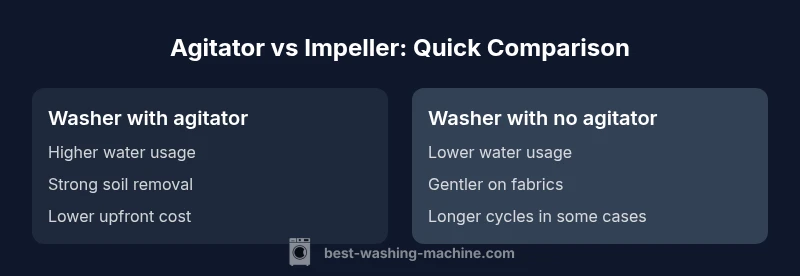
| Feature | Washer with agitator | Washer with no agitator (impeller) |
|---|---|---|
| Water usage | Higher water usage | Lower water usage |
| Soil removal / cleaning power | Strong for bulky soils and heavy items | Very good for everyday soils; excellent with proper cycle selection |
| Fabric care | Slightly higher wear potential on delicate fabrics | Gentler on most fabrics; reduces fiber stress |
| Load size flexibility | Best for large, bulky loads | Better for medium to smaller loads and mixed fabrics |
| Detergent usage | Typically higher detergent consumption | Often lower detergent usage with efficiency cycles |
| Energy efficiency | Moderate efficiency; depends on cycle choice | Higher efficiency on modern models with load sensing |
| Maintenance / repairs | More moving parts; potential service for agitator mechanism | Fewer moving parts; some models have complex seals/belts |
| Price range | Lower upfront cost on many basic agitator models | Higher upfront cost on many no-agitator/HE models |
What's Good
- Strong soil removal for bulky loads with agitator models
- Often lower upfront cost for agitator washers
- Familiar loading experience and quick cycles for large loads
- Extensive parts availability and repair options
Downsides
- Higher water and energy use with traditional agitator designs
- Potential for increased fabric wear over many cycles
- No-agitator models may require attention to load size and cycle selection
- Some users report longer cycles on certain no-agitator models
Both designs have clear strengths; choose based on priorities
Agitator washers excel with bulky soils and fast cycles; no-agitator washers win on water efficiency and fabric care. Align your choice with your typical loads, space, and budget to maximize value.
FAQ
What is the main difference between washers with agitators and those without?
The main distinction lies in how clothes are moved during the wash. An agitator uses a central post to vigorously churn the load, ideal for bulky soils. An impeller (no agitator) uses low-profile movement at the drum bottom to circulate water and clothes more gently, often saving water and protecting fabrics.
In short, agitator washers shake dirt loose quickly, while no-agitator models use gentle water flow to clean without heavy agitation.
Do agitator washers use more water than impeller models?
Yes, traditional agitator washers typically consume more water per cycle, especially on larger loads. Impeller models are designed to use less water by optimizing the wash action and leveraging better water displacement.
Agitator models often use more water, while no-agitator machines aim to save water with efficient wash action.
Are no-agitator washers better for delicate fabrics?
No-agitator washers generally offer gentler handling due to reduced mechanical turbulence. However, careful cycle selection and appropriate detergents are still important for delicates in any washer.
Yes, they tend to be gentler on fabrics, but choose delicate cycles and proper detergents.
Which type works best for bulky loads like towels and jeans?
Agitator washers often perform better for bulky, heavily soiled items due to stronger mechanical action. If you frequently wash large, dense loads, an agitator model can be more forgiving in soil removal.
For bulky items, agitator models usually clean more aggressively.
Can I upgrade from an agitator to a no-agitator washer later?
Yes, upgrading is possible, but you’ll want to maintain compatibility with existing space, hookups, and load patterns. Consider whether your family’s laundry needs have shifted toward fabric care and water efficiency before upgrading.
Upgrading is doable, but plan for space, hookups, and how you’ll use the new model.
What should I consider about front-load vs top-load in relation to agitators?
Front-load washers usually avoid central agitators and focus on tumbling action with high spin speeds, delivering high efficiency. Top-load machines may use an agitator or an impeller; your ergonomic preference and space will influence the best choice.
Front-loads often save water but may require bending to load; tops are easier to load from the top.
The Essentials
- Identify your typical laundry load size first
- Prioritize soil type and fabric care needs
- Balance upfront cost against long-term water/energy savings
- Consider space, ergonomics, and cycle times when choosing
- Test a model’s cycle options and wash action before buying