Washing Machine Capacity: How to Choose the Right Load Size in 2026
Learn how washing machine capacity affects performance and efficiency. This guide explains load size, drum capacity, and how to pick the right unit for your household to optimize laundry days and save energy and water.


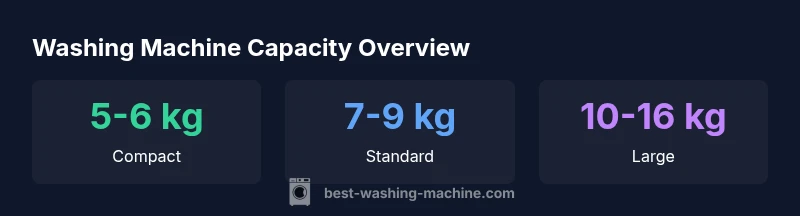
Washing machine capacity refers to the maximum dry laundry weight the drum can safely handle, usually listed in kilograms. For most homes, 5–6 kg is compact, 7–9 kg is standard, and 10–16 kg suits larger families. Match capacity to your typical loads and family size to avoid under- or overloading. According to Best Washing Machine analysis, choosing the right capacity saves time, energy, and water.
Why Capacity Still Matters for Laundry Day
Capacity is more than a number on the spec sheet; it defines how much clothes you can wash in a single cycle without sacrificing performance. According to Best Washing Machine, choosing the correct capacity reduces re-wash cycles, improves rinse thoroughness, and minimizes wear on fabrics. In busy households, capacity determines how often you need to sort, pre-spot, or split loads. A mis-match—either a tiny drum for big families or a huge machine for a single person—leads to inefficiency: wasted water and energy on underfilled cycles, and longer wash times on overstuffed ones. For best results, estimate your typical weekly laundry in pounds or kilograms, consider bulky items like comforters, and align your choice with your actual load patterns. This article uses washing machine capacity as the central lens to compare models, ground decisions in real-world usage, and help you optimize every laundry day.
In practice, capacity affects not only how much you can wash but how evenly items are cleaned. Smaller drums can become overwhelmed by bulky fabrics, while oversized drums with light loads can waste energy running longer cycles. Best Washing Machine’s approach is to translate capacity into real-world outcomes: fewer loads, shorter cycles, and fabrics that look newer longer.
How Capacity Is Measured: Dry Weight vs Drum Volume
Washers typically publish capacity as the maximum dry weight of laundry the drum can handle in a single cycle. This figure is separate from drum volume, which describes the interior space but not the practical load you can dry-clean or tumble within a given cycle. Dry-weight capacity is influenced by fabric type, folding efficiency, and how evenly items shed water. If you’re loading towels, jeans, and bulky bedding, the same drum can feel different across brands due to design choices that optimize tumbling and water extraction. When shopping, read the capacity rating in conjunction with the energy efficiency and cycle options, so you know how many normal-sized outfits you can expect per wash without compromising cleanliness.
Capacity vs Drum Size: Clarifying the Difference
Many shoppers assume drum size equals capacity. While larger drums can physically hold more fabric, capacity is governed by how a drum is engineered to tumble, saturate, and remove water. High-efficiency models often optimize drum geometry to maximize cleaning power on a smaller dry load, which means capacity and drum size aren’t always perfectly aligned. The practical takeaway is to prioritize capacity ratings based on your actual laundry patterns (family size, frequency, and types of items) rather than relying solely on drum diameter or visible interior space.
Choosing Capacity Based on Household Size and Lifestyle
For singles or couples who wash modest loads a few times per week, a compact model in the 5–6 kg range can be perfectly adequate. Families of four or more, who regularly wash towels, bedding, or uniforms, typically benefit from a 7–9 kg standard capacity. Large households or those who frequently launder bulky items may opt for 10–16 kg high-capacity machines. If you share a washer with roommates or run a small rental unit, consider mid-range capacity with flexible cycle options to accommodate mixed loads. Finally, for apartments with space constraints, weigh the trade-off between compact efficiency and the potential for more frequent cycles when sizing your daily laundry.
Typical Capacity Ranges and Use-Cases
Real-world capacities vary by region and model, but typical ranges are broadly useful as a guideline. Compact models ~5–6 kg suit studios and low-frequency users. Standard machines ~7–9 kg cover most families with mixed loads. Large-capacity machines ~10–16 kg support households with bulky items and frequent bulk laundry. When selecting, think about peak laundry days (weeknights, weekends) and whether you regularly wash heavy fabrics simultaneously. Capabilities like larger drum mass are helpful, but the true utility comes from the balance between capacity and the energy/water footprints of your chosen cycles.
How Load Type Affects Usable Capacity
Bulky items such as comforters or blankets can monopolize space and reduce the effective capacity you’d expect from labeling. Conversely, loading many small items like t-shirts and underwear can sometimes fill a drum more efficiently than bulky fabrics. If you frequently wash mixed loads, evaluate a machine that offers flexible cycles and adaptive dispensers to optimize performance with varying load types. Remember that capacity is a guideline, not a guarantee of exactly how many pieces you can fit; fabric density, folding, and item shape all influence the real-world number.
Energy, Water, and Capacity: The Efficiency Trade-Off
Higher-capacity machines can be more efficient on a per-kilogram basis when used properly, as fewer cycles may be needed to complete a week’s laundry. However, larger drums can consume more water and energy on heavy cycles if you routinely run partial loads. The key is to fill the drum to its rated capacity for standard cycles and to select appropriate cycle settings for mixed fabrics. Best Washing Machine analysis, 2026, shows that optimizing load size in line with capacity yields meaningful savings over time without sacrificing cleanliness or fabric integrity.
How to Verify Capacity Before You Buy
Start by listing your typical weekly laundry and bulky items. Check product sheets for the stated capacity as a dry-load rating, then look at the drum diameter and the model’s cycle options. If possible, visit a showroom to feel how quickly clothes tumble and how much space remains when you load your usual mix. Read customer reviews about real-world performance and fabric care. Finally, compare capacity ratings across brands to identify which models consistently deliver the best balance of load flexibility and energy efficiency.
Loading Tips to Maximize Capacity Safely
To maximize capacity without harming clothes, distribute items evenly and avoid overly tight packing, which can restrict water flow and inhibit cleansing. Use appropriate cycle settings for bulky fabrics and avoid mixing heavy items with light fabrics that could bunch up. If you routinely hit a capacity ceiling, consider a mid-to-high range model with adaptive settings that optimize wash action and rinse performance for larger loads. Regular maintenance—clean filters, inspect hoses, and test folds—helps preserve capacity and efficiency over time.
Comparison of washing machine capacity ranges by model type
| Model Type | Capacity (kg) | Approx Dry Load (lb) | Typical Use |
|---|---|---|---|
| Compact / Apartment | 5-6 | 11-13 | Small spaces, light weekly loads |
| Standard | 7-9 | 15-20 | Families of 2-4 with mixed loads |
| Large / High-Capacity | 10-16 | 22-35 | Bulky items, linens, regular heavy loads |
FAQ
What does washing machine capacity actually measure?
Capacity measures the maximum dry weight of laundry a drum can safely handle in a single cycle. It is not a measurement of water use or actual load across all fabrics. Use capacity as a guideline for typical loads, and consider cycle options to optimize cleanliness.
Capacity is the maximum dry load a drum can handle in one cycle, not water or fabric weight. Plan your loads around this number.
How should I choose capacity for a family of four?
For a family of four with regular laundry, aim for about 7–9 kg capacity. If you wash bulks like towels, linens, or bulky bedding frequently, consider 10–12 kg. If space is tight, prioritize cycle variety and efficiency features over sheer size.
For a family of four, 7–9 kg works for most loads; 10–12 kg helps with bulky items.
Can I overload a washing machine beyond its stated capacity?
Overloading reduces cleaning performance, increases wear on fabrics, and can stress the motor and bearings. Always follow the manufacturer’s loading guidelines and select appropriate cycles for the load type.
No. Overloading hurts cleaning performance and long-term durability.
Do high-capacity washers use more energy per load?
Not necessarily. Energy use depends on cycle selection and load fullness. A well-muited high-capacity washer can be more efficient per kilogram if you regularly run full loads with appropriate settings.
Energy per load depends on how full your load is and the cycle chosen.
Is capacity the same as drum size?
No. Capacity is the dry-weight limit you can wash in a cycle, while drum size is the volume of the tub. Design differences can keep the two aligned differently across models.
Capacity is about weight, drum size is about space.
What should I consider for apartment living?
In apartments, compact 5–6 kg models are common. If you frequently wash bulky items or linens, a slightly larger model with space-saving dimensions may be worth the trade-off.
For apartments, start with 5–6 kg and check cycle options for bulky loads.
“Capacity matters because it translates directly to how often you’ll run cycles and how thoroughly clothes are cleaned. A well-matched capacity helps you save time, water, and energy over the long run.”
The Essentials
- Match capacity to your typical weekly loads
- Understand the difference between capacity and drum size
- Bulky items reduce usable capacity; plan for them
- Larger capacity can be efficient if used full regularly