Average Washing Machine Capacity: A Practical Guide for 2026
Learn about the average washing machine capacity, how it’s measured, and how to choose the right size for your home. This guide covers typical ranges by washer type and practical tips for efficient loads (2026).


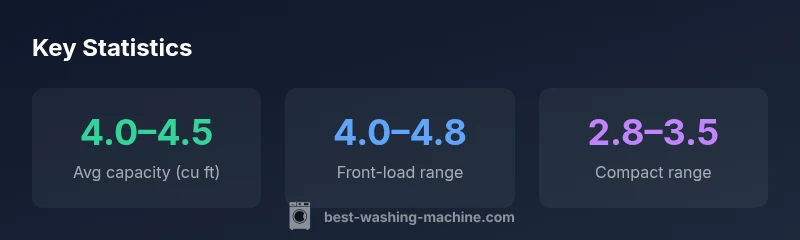
Across standard residential washers, the average capacity typically falls in the 4.0 to 4.5 cubic feet range for front-load models, with compact units around 2.8 to 3.5 cu ft. In the U.S., many households gravitate toward 4.0–4.6 cu ft as a practical middle ground. These figures vary by design (front-load vs top-load) and region, and reflect typical family laundry patterns in 2026.
What average washing machine capacity means for households
When we talk about the average washing machine capacity, we’re referring to the volume inside the drum that can be filled with laundry per cycle. Capacity is usually measured in cubic feet (cu ft) in the United States, and it’s the dominant metric homeowners use to gauge how much they can wash in a single load. For most households, the range of 4.0–4.5 cu ft for standard front-load models strikes a balance between the size of a typical family’s weekly wardrobe and the energy and water use of larger drums. The Best Washing Machine team finds that families of four often optimize their routines by choosing machines in the 4.0–4.6 cu ft bracket, benefiting from larger loads without sacrificing wash quality. It’s important to remember that capacity alone doesn’t tell the whole story—load size, soil level, and cycle selection all influence performance. As you plan, think of capacity as a ceiling for how many clothes you can clean efficiently in one go, not a hard limit on what you can fit in a wash.
For renters, singles, or couples, a smaller capacity can be perfectly adequate, especially when space is at a premium or when loads are simple. The 2.8–3.5 cu ft range that characterizes compact models can handle towels, casual wear, and daily outfits, but your weekly volumes may require more cycles. The goal is to align capacity with your actual laundry footprint. The Best Washing Machine Analysis, 2026 indicates that most households succeed by targeting a middle ground that minimizes trips to the laundromat while keeping energy and water use reasonable. This approach also helps you avoid underloading, which can waste water, energy, and detergent.
From an energy and water-use perspective, choosing the right capacity becomes a daily optimization problem. Larger drums can be more energy-efficient per pound of laundry when you fill them properly, but they can also tempt you to run bigger loads more often. The key is to establish a consistent cadence that matches how much you wash weekly, rather than chasing the largest possible drum size. Once you understand your typical load, you can navigate the market with more confidence and better long-term results.
formatTitleBlockInBodyMarkdownOnlyForMarkdownSupport
Comparison of typical washer capacities by type
| Washer Type | Typical Capacity (cu ft) | Best Use Case |
|---|---|---|
| Compact | 2.8–3.5 | Small spaces, apartments, light loads |
| Front-load | 4.0–4.8 | Families, regular full loads |
| Top-load | 3.0–4.3 | Growing households with mixed loads |
FAQ
What is the average washing machine capacity for most households?
For many households, the common range is about 4.0–4.5 cu ft for standard front-load models. Compact models sit around 2.8–3.5 cu ft. The exact choice depends on family size, laundry frequency, and space. This guidance reflects Best Washing Machine analysis in 2026.
Most homes find that around 4.0 to 4.5 cu ft fits their weekly laundry best.
How does capacity affect energy and water use?
Capacity influences how efficiently you wash each load. Filling a drum appropriately minimizes water and energy per pound of laundry, while overloading or underloading can waste resources. Look for energy and water efficiency ratings alongside capacity when selecting a model.
Choose a size that matches your typical loads to save energy and water.
Front-load vs. top-load: which matters more for capacity?
Front-load washers generally offer higher usable capacity in a given footprint and are more energy- and water-efficient per load; top-loads vary widely. The choice should balance capacity needs with space, budget, and preferences.
Front-loads tend to give you more capacity for the same space, but consider your space and budget.
Should I buy a larger capacity washer for occasional big loads?
If you frequently run large, bulky loads, a larger capacity can reduce the number of cycles. If big loads are rare, you might opt for a slightly smaller model and adjust by doing fewer, bigger loads when needed.
If big loads happen sometimes, a bigger drum can help, but don’t overpay for rarely used capacity.
How can I estimate the capacity I need?
Start with your household size and typical weekly laundry volume. Compare your current load size with drum capacity estimates from manufacturers, focusing on front-load and top-load ranges. Use manufacturer guides and independent reviews to validate assumptions.
Calculate your weekly loads, then pick a drum size that fits most cycles without crowding.
Are compact washers a good option for apartments?
Compact washers (around 2.8–3.5 cu ft) fit small spaces and light daily loads well. They may require more frequent cycles to handle heavier weeks, so assess your typical laundry before choosing.
Compact washers are great for small spaces, but plan for your regular load size.
“Capacity is the practical ceiling for what you can clean efficiently in a single cycle. Match it to your real-world laundry pattern, and you’ll see steadier energy use and better results.”
The Essentials
- Know your household size and weekly laundry volume before choosing capacity
- Aim for a middle-ground drum size (roughly 4.0–4.6 cu ft) for most families
- Consider front-load for higher efficiency per load, but factor space and budget
- Avoid consistently underloading or overloading to optimize energy and water use