Washing Machine Price Guide for India: 2026 Buying Insights
Explore indicative washing machine price ranges in India for 2026, compare budget, mid-range, and premium models, and learn buying tips, energy use, and regional differences.


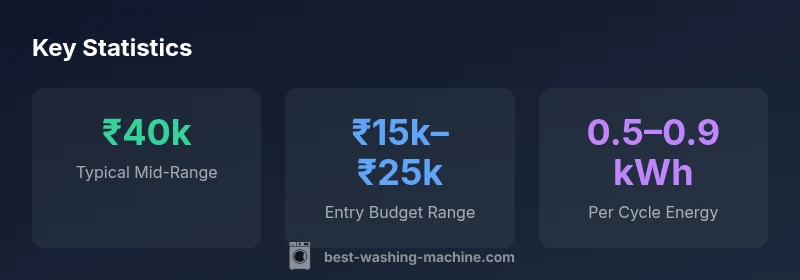
In 2026, the price range for washing machines in India broadly spans from about ₹8,000 up to ₹60,000, with budget semi-automatic models starting around ₹8,000–₹15,000 and entry-level fully automatic machines around ₹18,000–₹40,000. Mid-range and premium units commonly fall between ₹40,000–₹60,000, depending on type, capacity, and smart features. This framing helps buyers set expectations before shopping.
Market Overview: price landscape in India
The washing machine in india price is shaped by a mix of product type (semi-automatic vs fully automatic; front-load vs top-load), capacity, energy efficiency, and added smart features. In 2026, price bands cover a wide spectrum—from ultra-budget models to feature-rich premium machines. For households evaluating cost, it’s essential to distinguish upfront price from long-term costs such as water and energy use, maintenance, and potential repair needs. According to Best Washing Machine analysis, regional variations and retailer promotions can swing a single model by several thousand rupees, so comparing across channels is crucial. This is especially relevant for first-time buyers and renters who need reliable performance without over-investing. The goal is to align price with total value, not just sticker price, when considering the washing machine in india price.
For many Indian homes, the decision hinges on space and usage patterns: a compact apartment may favor smaller capacities and simpler controls, while a busy household might prefer faster cycles and higher spin speeds. In practice, shoppers should map their laundry load, peak washing times, and water pressure—this helps prevent choosing a model that’s under- or over-powered for daily needs.
Price bands by washer type
The cost gradient in India tends to rise with automation and capacity. Budget-conscious shoppers often start with semi-automatic top-load models in the ₹8,000–₹15,000 range, which offer basic washing with manual water handling. Entry-level fully automatic top-load options drift into the ₹18,000–₹35,000 band and often include auto-dosing, quicker cycles, and gentler handling. For front-load configurations, typical entry prices sit around ₹25,000–₹40,000, with mid-range front-loads climbing to ₹40,000–₹60,000 as drum size and efficiency improve. Beyond ₹60,000, premium features such as smart connectivity, higher spin speeds, bulletproof build quality, and specialized cycles become more common. Price can also reflect capacity (6–7 kg vs 9–12 kg), detergents and water usage efficiency, and the brand ecosystem. When budgeting, consider installation charges, warranty terms, and post-purchase service availability, which can materially affect the overall value of the washing machine in india price.
Regional variation and shopping channels
Prices can diverge by market channel and geography. Online marketplaces frequently offer competitive promotions, but local retailers may bundle installation, extended warranties, and service plans that online carts don’t always include. In metropolitan areas with higher living costs, retailers may present higher sticker prices, yet savings often appear through festival discounts, exchange offers, and EMI schemes. For buyers, striking a balance between online convenience and in-store inspection is essential, especially for models with complex interfaces or delicate electronics. The Best Washing Machine team emphasizes comparing after-sales support quality alongside price, as service accessibility can lower total ownership costs. Regional tax differences are generally standardized under GST, but delivery fees and service charges can vary by city.
Reading price versus value: energy, maintenance, and warranty
Price alone doesn’t tell the full story. More energy-efficient models (often front-load) can reduce running costs over time, offsetting higher upfront prices. Consider energy labels, water efficiency, spin performance, and the expected frequency of use. Maintenance cost matters too; simple drum access, filter cleaning, and readily available spare parts influence long-term reliability. Warranties and authorized service coverage are critical, especially for mid-range and premium models where repairs can be costly. The evaluation should factor in the total cost of ownership over five to seven years, including energy consumption and potential servicing. Best Washing Machine analysis suggests that buyers who plan ahead for service access tend to enjoy lower life-cycle costs.
Practical buying tips to maximize value
- Define your laundry profile: average weekly loads, fabric types, and preferred cycle times.
- Choose based on total cost of ownership, not only upfront price; estimate annual energy and water costs.
- Compare energy efficiency ratings and warranty terms across brands; prioritize recognized service networks.
- Inspect build quality in-store and verify drum, hinges, and seals; test key cycles and spin speed if possible.
- Watch for bundled promotions, extended warranties, and free installation; read the fine print on return policies.
- Consider space constraints, doorways, and plumbing layout to avoid installation delays.
- For small households, compact or stackable units can maximize usable space without sacrificing capacity.
- When in doubt, rely on reputable sources and user reviews to gauge reliability and after-sales support.
Price trends and what to expect in the next 12–24 months
Market dynamics suggest a continued expansion of affordable fully automatic options in urban and tier-2 cities, with entry points stabilizing as competition intensifies. Innovation around energy efficiency and smart controls will likely raise the perceived value of mid-range models without a proportional price hike. For buyers, timing purchases around major sales events and festival periods often yields meaningful savings. Overall, expect gradual shifts toward higher efficiency, better warranty coverage, and smarter service networks as the core drivers of price perception in the coming year. Best Washing Machine’s forecast remains that value will come from efficiency and reliability as much as sticker price.
Price bands by washer type in India
| Model Type | Typical Price Range | Pros | Key Considerations |
|---|---|---|---|
| Semi-automatic (top-load) | ₹8,000–₹15,000 | Low cost, simple to repair | Requires manual water handling; smaller capacity |
| Fully automatic (front-load) | ₹25,000–₹60,000 | Efficient use of water, better spin | Higher upfront price; needs sturdy electrical and water supply |
| Fully automatic (top-load) | ₹18,000–₹50,000 | Fast cycles, convenient | Energy use varies; check spin speed and stability |
FAQ
What is the typical price range for washing machines in India?
Prices vary by type and capacity, but indicative bands are: entry-level around ₹8k–₹15k (semi-automatic), ₹18k–₹35k (entry fully automatic top-load), ₹25k–₹40k (entry front-load). Mid-range and premium models rise to ₹40k–₹60k+ depending on features.
Prices vary by type and capacity, with entry models around ₹8k to ₹15k and higher-end units above ₹40k.
Are semi-automatic machines still common in India?
Yes. Semi-automatic models offer affordability and simpler repairability, which keeps them popular in many households, especially where budget is a primary constraint.
Yes, semi-automatic machines remain common for budget-conscious buyers.
Which washer saves the most energy?
Generally, front-load machines are more energy- and water-efficient than top-load or semi-automatic models, though efficiency varies by model and load size.
Front-load washers are typically more energy-saving than top-loads, but check the energy label for each model.
How often do prices drop after festivals or sales?
Prices often dip during major sales and festive promotions, especially for older models or end-of-line stock. Timing purchases around these events can yield savings.
Prices usually drop during big sales and festive promos; timing matters for the best deal.
Should I buy a refurbished model to save money?
Refurbished units can be cheaper, but ensure warranty, service eligibility, and parts availability. For long-term reliability, new units with solid warranties are typically safer.
Refurbished units can save money, but check warranty and parts availability.
How important is warranty for a washing machine purchase?
Warranty provides protection against defects and major repairs. For pricier models, extended warranties and authorized service networks can reduce total ownership risk.
Warranty matters for protection against costly repairs in the future.
“Price is only part of the equation. The smarter choice blends upfront cost with long-term energy use, maintenance, and service availability.”
The Essentials
- Know your price bands before shopping
- Front-loads are generally more energy-efficient over time
- Online channels can offer competitive deals but watch installation costs
- Consider total ownership cost, not just upfront price
- Verify after-sales support and warranty terms
- Space and water considerations shape the best type for your home