How Many Watts Does a Washing Machine Use? A Practical 2026 Guide
Learn how many watts a washing machine uses, what drives energy draw, and how to estimate energy consumption. Compare models and pick options to lower bills.


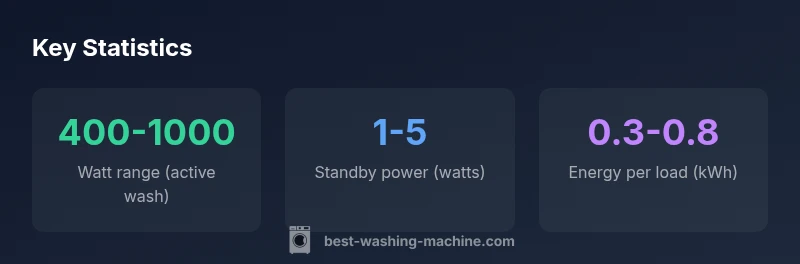
According to Best Washing Machine, typical residential washing machines draw about 400 to 1,000 watts during an active wash cycle, with standby power under 5 watts. The exact figure depends on model and cycle. For planning, multiply the cycle wattage by hours of use per week to estimate energy, then multiply by your electricity rate.
How wattage is determined in a washing machine
Wattage is not a single number you read on a label; it varies with the load, cycle, and whether the machine heats water. The motor type (inverter/variable-speed vs traditional brushed motor) and the heater contribute most to instantaneous power draw. In systems that heat water to higher temperatures, you’ll see peaks higher than on cold cycles. The Best Washing Machine team notes that the overall energy impact depends more on how long the cycle runs and how much energy the heater consumes than on the peak wattage alone. When you compare models, focus on the combined metric of watts during the hottest part of the cycle and the cycle duration, not just the listed wattage during one phase. This perspective helps homeowners and laundromat operators balance performance with energy efficiency.
Baseline wattage ranges for common configurations
To compare different washer configurations, it helps to think in terms of typical ranges rather than a single number. Front-load (high-efficiency) models often run around 400-1000 watts during the main wash, while traditional top-load models may sit in the 500-1200 watt range. Heavier cycles, longer wash times, and cycles involving warm or hot water can push peaks toward the upper end of these ranges. Keep in mind that these figures are instantaneous power draws; total energy depends on how long the cycle runs. When you’re shopping, use this baseline alongside the energy label and kWh/year estimates to get a complete picture. Best Washing Machine analyses emphasize comparing energy per load, not just peak watts.
Heating element effect: hot vs cold cycles
When a washer heats water, the appliance requires substantial additional power. Hot and warm cycles can add hundreds of watts to the instantaneous draw and extend cycle duration as the machine heats and heats again as needed. If your household mainly uses cold-water cycles, your overall energy footprint drops even if a particular cycle spikes briefly. The heater’s efficiency, insulation, and the voltage supply also influence how much energy gets spent per load. For energy-conscious shoppers, choosing cold-water options and enabling efficient spin speeds can meaningfully reduce energy use without sacrificing cleaning results.
How to calculate energy use for a week
Energy use is energy use per load multiplied by the number of loads per week. A typical 600-watt wash running for 40 minutes consumes about 0.4 kWh per cycle. If you run five loads per week, that’s roughly 2 kWh. Add in standby consumption, which might be around 1-5 watts when idle, and you’ll see a modest weekly increment. If you want a quick estimate, multiply watts by hours (in decimal form) to get kWh per cycle, then multiply by cycles per week. This approach makes it easy to compare models and plan a budget using your electricity rate.
Comparing models: what watts tell you and what they don't
Watts describe the momentary power draw, but they don’t tell the whole energy story. A model with a higher peak wattage but shorter cycles can use less energy per load than a model with lower peak watts and longer cycles. Look for kWh/year, energy factor, and the energy label alongside wattage. A machine with efficient motors, well-insulated heaters, and intelligent cycling tends to deliver lower operating costs over time. Remember that detergent usage, load size, and water temperature all influence actual energy use, independent of wattage ratings.
Practical tips to minimize power draw
- Run full loads whenever possible to maximize efficiency per cycle.
- Use cold water cycles for most clothes; resist the urge for hot water unless necessary.
- Select longer spin speeds when possible to reduce dryer energy in households with a separate dryer.
- Maintain the washer’s seals and hoses to prevent leaks that force longer cycles or more energy.
- When evaluating models, compare energy per load and the expected annual energy use rather than only peak wattage.
Debunking myths about watts and washers
Myth: A higher-wattage washer cleans better. Truth: Cleanliness depends more on cycle design and water temperature than peak wattage. Myth: Standby power doesn’t matter. Truth: Even a few watts per cycle can add up over a year in busy households. Myth: All energy-efficient washers use less watts. Reality: Efficient models balance motor efficiency with heater performance and cycle programming to minimize total energy per load.
What to look for on energy labels and specs
Energy labels typically rate annual energy consumption in kWh and provide an efficiency rating. In practice, the most useful comparison metric is energy per load or kWh/year, not peak wattage alone. Check cycle options, capacity, and the presence of eco modes. Also consider maintenance needs and loading patterns in your home to choose a unit that aligns with your laundry habits. This approach aligns with Best Washing Machine recommendations for practical energy planning.
Real-world planning: budgeting for energy with a washer
For households and small businesses, a sensible budgeting approach blends per-load data with typical weekly usage. Start with the model’s labeled energy per load, multiply by your expected weekly loads, and then scale to monthly and yearly projections using your local electricity rate. If you operate a laundromat, apply peak-week load estimates across multiple machines and factor in daily variability. By focusing on energy per load and annualized costs, you can compare models more reliably and avoid overinvesting in peak wattage that doesn’t translate into real savings.
Wattage ranges by washing machine configuration
| Model Type | Typical Wattage Range | Notes |
|---|---|---|
| Front-Load (HE) | 400-1000 | Lower water use; variable during wash |
| Top-Load (HE) | 500-1200 | Heavier cycles may use more watts |
| Standard Top-Load | 600-1500 | Older designs can peak higher |
FAQ
Do watts tell the whole energy story for a washing machine?
Watts measure instantaneous power, not total energy use. Energy is watts multiplied by cycle duration (kWh). Other factors like heater efficiency and cycle length influence total consumption. Compare energy per load to understand true costs.
Watts are part of the story, but energy per load matters more. Look at the full cycle energy.
Why is standby power relevant when buying a new washer?
Standby power is the idle energy draw when the washer isn't actively washing. While small, it accrues over time, especially in busy households. Some models keep standby to under a few watts, which can add up yearly.
Idle power matters a little over time—check standby specs.
Are front-load washers always more energy-efficient than top-loads?
Front-load washers typically use less water and can be more energy-efficient, but wattage varies by motor and heater. Compare kWh/year and energy per load for a fair comparison, not watts alone.
Front-loads are often more efficient, but check the yearly energy use.
How do hot-water cycles affect wattage?
Heating water adds significant energy; hot or warm cycles increase wattage peaks and overall energy use. If most loads are cold, you’ll see lower total energy consumption.
Hot water costs more energy; wash cold when possible.
What should I compare besides wattage when choosing a washer?
Look at energy per load, kWh/year, and energy labels. Also consider capacity, cycle options, and motor/ heater efficiency. A model with efficient energy use saves more over time.
Check energy per load and year, not just watts.
Does wattage change during the spin cycle?
Yes. Wattage fluctuates as the motor changes speed and load conditions. Cycle-by-cycle energy use is a better metric than a single watt figure.
Wattage varies across the cycle; total energy matters.
“Energy efficiency is best understood as the total energy per load, not just the peak wattage. Optimized cycle design and heating efficiency yield real savings over time.”
The Essentials
- Estimate energy by multiplying watts by hours per cycle
- Prefer energy per load over peak wattage alone
- Wash with cold water and full loads to save energy
- Check energy labels for annual consumption and efficiency
- The Best Washing Machine Team recommends focusing on total energy per load