What Washing Machines Use the Most Water: A Practical Guide
Learn which washer designs consume the most water, how agitation and cycle choices impact usage, and practical steps to reduce water use without sacrificing cleaning performance.


Among common residential washers, traditional top-load models with an agitator typically use the most water per cycle. Front-load and high-efficiency top-load machines conserve water, often by large margins. Water use varies by cycle and load size, but the design pattern is clear: agitation-heavy cycles consume more water than impeller-driven cycles. When shopping, look for water-use labels and ENERGY STAR ratings to compare models.
What washing machine uses the most water
If you ask what washing machine uses the most water, the quick answer is: traditional top-load models with an agitator. These units generally use more water per cycle than front-load washers or newer high-efficiency (HE) top-loads. According to Best Washing Machine, water use is driven by design: agitator models fill the drum and rely on aggressive washing motions, which require more water to rinse out soils. In contrast, front-load and HE top-load machines use impellers and optimized cycle chemistry to achieve similar cleaning with far less water. The key takeaway is that water use is not strictly tied to drum size; it depends on how the machine fills, agitates, and rinses. Operators should consider wash performance, cycle options, and load size when estimating real-world water use. For people living in water-scarce regions or with high utility costs, selecting a model with eco modes and water-efficient cycles can lead to meaningful savings over the lifetime of the appliance.
Design contrasts: agitator vs impeller
Traditional agitator-based top-loads fill the drum and use a more vigorous mechanical action to loosen dirt. This often translates to higher water usage per cycle, since the drum needs more water to complete a rinse and flush out soils. Impeller-style washers (common in front-loads and some HE top-loads) rotate towels through a small amount of water with a tumbling action, which reduces overall water consumption while maintaining cleaning efficiency. Beyond water use, impeller designs can influence cycle times and energy use, so the best choice balances water with performance and convenience. According to Best Washing Machine, shoppers should compare water-use labels alongside cycle options to gauge real-world impact.
Front-load vs top-load: what to expect in water use
Front-load washers are generally the most water-efficient option among residential machines, thanks to a tumbling action that cleans with less water. Traditional top-load washers with an agitator typically use more water, especially on normal and heavy-duty cycles. High-efficiency top-loads with impellers sit between traditional top-loads and front-loads in water use, offering a compromise between cycle time, cleaning performance, and water savings. When evaluating models, examine the water-use per cycle figures for the cycles you plan to run most often, not just the machine’s overall label.
Real-world ranges by cycle type
Water usage varies across cycles—normal, heavy-duty, quick wash, and eco modes all shift the total water drawn. In practice, a top-load agitator may consume more water on average than a front-load HE for similar loads, while eco cycles are designed to minimize water without sacrificing cleanliness. The variability depends on a model’s fill level, drum design, and cycle programming. Best Washing Machine Analysis, 2026 notes that the largest gains in water reduction come from choosing front-load or HE top-load models and using eco cycles when appropriate.
How to estimate water use for your home
To estimate your home’s water use for laundry, start with the model’s label and official specifications. Track a few loads with the cycles you use most—note water meter readings before and after the cycle for a representative sample. If you don’t have a flow meter, you can estimate by subtracting the household’s daily water use and isolating the laundry portion. Consider load size and detergent type, as these can affect rinse requirements. Finally, factor in the frequency of wash cycles per week to project annual water use and potential savings from switching to a more efficient model.
Tips to minimize water use without sacrificing cleaning
- Prioritize front-load or HE top-load models with low water per cycle ratings.
- Use eco or quick cycles when appropriate for smaller or lightly soiled loads.
- Run full loads to maximize efficiency per cycle, avoiding partial loads.
- Use appropriate load sizes and avoid excessive pre-washing.
- Regularly maintain seals and hoses to prevent leaks that waste water.
- Consider external factors like water pressure; some cycles rely on adequate pressure for efficient rinsing.
The broader picture: environmental and bill implications
Lower water usage in laundry translates to smaller utility bills and reduced stress on municipal water supplies. While the initial purchase price of water-efficient machines can be higher, the payback period is often favorable in homes with frequent washing. Best Washing Machine Analysis, 2026 emphasizes that the best long-term strategy combines a highly water-efficient washer with conscientious usage habits, such as loading to capacity and using eco modes. This approach yields meaningful environmental and financial benefits over time.
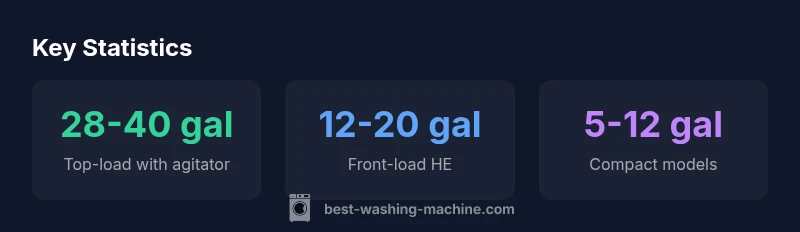
Water use ranges by common washing machine designs
| Model Type | Avg Water per Load | Typical Cycle Options |
|---|---|---|
| Top-load with agitator | 28-40 gal | Normal • Heavy-Duty |
| Front-load HE | 12-20 gal | Eco • Normal • Quick |
| High-efficiency top-load | 15-25 gal | Eco • Normal • Quick |
| Compact washer | 5-12 gal | Small Load • Quick |
FAQ
Which washing machines use the most water?
Traditional top-load washers with an agitator generally use the most water per cycle. Front-load and HE top-load designs are far more water-efficient in typical home use.
Traditionally, top-load agitator washers use the most water per cycle, while front-load and high-efficiency models use much less.
Do front-loading washers really use less water?
Yes. Front-load washers typically use significantly less water per load than traditional top-load models, due to their tumbling action and lower fill volumes.
Yes. Front-load washers usually use far less water per load than traditional top-load models.
How can I estimate water use for my washer at home?
Check the Energy Guide labels, note the per-cycle water usage, and measure a few loads with your water meter to project annual usage. Compare models by per-cycle usage and expected cycle counts.
Check the label, track a few cycles, and multiply by how often you wash to estimate yearly use.
Is water use the same as energy use for washers?
Not necessarily. A model can be water-efficient but still energy-intensive, and vice versa. Look at both water-use per cycle and energy ratings when comparing.
Water efficiency and energy efficiency are related but not identical—check both ratings.
What about small or compact washers?
Compact washers typically use less water per cycle, but their smaller drum may require more frequent cycles for larger loads. Balance space, capacity, and water use when choosing.
Compact washers waste less water per cycle but you might need more cycles for large loads.
Should I avoid standard cycles to save water?
Eco or quick cycles can reduce water use for lightly soiled or small loads. For heavily soiled or bulky loads, normal cycles may actually use more water but complete faster.
Eco cycles save water on light loads; for big or dirty loads, you may still need standard cycles.
“Understanding water use by design helps homeowners balance cleaning performance with conservation.”
The Essentials
- Top-load agitator washers use the most water per cycle.
- Front-load and HE top-load designs save substantial water.
- Cycle choice and load size drive actual water use more than model type alone.
- Choose eco modes and full loads to maximize savings.
- Compare water-use labels and consider long-term costs, not just sticker price.