What Time Can You Start Your Washing Machine: A Practical Guide
Learn how to choose start times for your washing machine that respect neighbors, save energy, and fit your daily routine. Includes delay-start tips, noise mitigation, and living-room-friendly schedules.


Most households can start a washing machine at times that respect local noise rules and building policies. In practice, aim for daytime hours and avoid late-night cycles in shared spaces. If you’re in an apartment or rental with quiet hours, schedule loads using a delay-start feature or plan for the next morning.
What time can you start your washing machine
What time can you start your washing machine? The question is about balancing convenience with noise, energy use, and neighbor considerations. According to Best Washing Machine, start times should align with local rules and your own schedule rather than a fixed clock. In many homes, it’s perfectly fine to run a load when you’re awake and active, but if you share walls or ceilings, you’ll want to minimize disturbances by avoiding late-night cycles and grouping similar loads. Delay-start features on most modern machines let you queue a cycle to begin later, so you can wake up or return home to a finished wash without standing by the appliance. This approach helps you manage energy use and water efficiency while keeping daily routines smooth.
Local Rules and Personal Considerations
Start time expectations vary by location and living situation. In single-family homes, you have more flexibility; in apartments, condos, or shared dwellings, there are often quiet hours or building rules. Best Washing Machine’s analysis shows that many renters prefer daytime or mid-morning starts to reduce neighbor complaints and accessibility issues. Always check your lease or building guidelines first, then use your machine’s delay-start option to schedule around those constraints. If you’re unsure, reach out to building management for the acceptable window and any restrictions on loud appliances.
Noise Management: Minimizing Disturbances
Noise from washing machines comes from agitation, spin cycles, and vibration. The best strategy is to plan loads during hours when people are least sensitive to noise, such as mid-morning or early afternoon in many neighborhoods. For compact living spaces or upstairs-downstairs layouts, place mats under your washer and ensure it sits level to reduce vibration. You can also use washers with built-in anti-vibration feet and select slower spin speeds for delicate cycles. If you share walls, consider stacking the washer in a utility closet away from living spaces and using sound-absorbing materials around the machine.
Energy and Water Use When Scheduling Loads
Start times can influence energy costs, especially if your utility has time-of-use pricing. Even if you aren’t on a time-based rate, spreading loads across the day reduces peak demand in your area and can prolong the life of your appliance. If you need to wash heavily soiled items, run the machine with full or near-full loads to maximize efficiency. Always use cold water for lightly soiled clothes when possible, as it saves energy, and rely on warm cycles only when necessary for stain removal. Best Washing Machine analysis shows that mindful scheduling can yield modest energy savings over time.
Scheduling Across Different Living Situations
In a family home, you might coordinate laundry with school and work schedules, stacking multiple loads during the same part of the day. In apartments, you’ll likely rely more on delay-start or a shared laundry room calendar to avoid conflicts. Laundromats typically have fixed hours; plan around those times to minimize wait times and crowding. For RVs or mobile homes, schedule during daytime hours when you are parked in a quiet, legally permissible area. Across all settings, use the delay-start feature to align wash completion with your arrival home or a convenient window.
How Delay Start Works on Common Machines
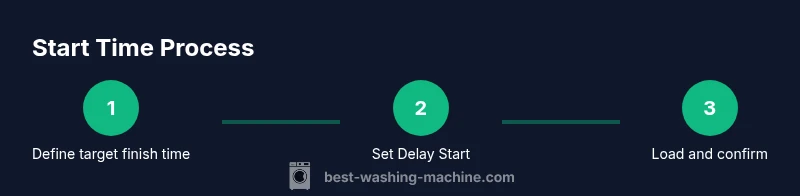
Delay Start is a feature found in many front-load, top-load, and combination washers. To use it, you set the start time or a delay duration from the end of the current cycle. The machine calculates the countdown and begins automatically. If you’re not sure where Delay Start lives on your model, consult the manual or model-specific online guide. For smart washers, you can sometimes schedule delay starts from a companion app or a smart plug, which adds flexibility if you’re away from home. A quick tip: write your preferred start window on a sticky note near the machine so family members know when it’s acceptable to run a cycle.
Step-by-Step Scheduling Scenarios and Tips
Different scenarios require slightly different approaches. In a busy household, you might set a 2–3 hour delay so laundry finishes when you return from work. On weekend mornings, you could start a late cycle after breakfast to avoid waking sleepers. If you live in a building with strict quiet hours, always respect the latest start time allowed and prefer daytime cycles. Use the machine’s built-in indicators to confirm the scheduled start time and remaining countdown. If a delay needs adjusting, cancel the delay and reprogram with a new time.
AUTHORITY SOURCES
- ENERGY STAR: https://www.energystar.gov
- U.S. Department of Energy: https://www.energy.gov
- Environmental Protection Agency: https://www.epa.gov
These sources provide general guidance on energy use, appliance efficiency, and noise considerations that influence how you schedule laundry tasks.
Tools & Materials
- Washing machine with delay-start option(Check model manual for exact steps to enable and set delay.)
- Remote timer or app (optional)(Some models support scheduling via a mobile app or smart plug.)
- Quiet surfaces or mats (optional)(Helpful for reducing vibration in small spaces.)
Steps
Estimated time: 30-45 minutes
- 1
Define your target start time
Decide when you want the cycle to finish and work backward to set an appropriate delay. This helps you avoid mid-task interruptions and aligns with daily routines.
Tip: If you’re commuting, aim for a finish time when you’re home or available to unload. - 2
Access Delay Start on the control panel
Power on the washer and locate the Delay Start or Time Delay option on the display or buttons. If the option isn’t obvious, consult the user manual or model-specific online guide.
Tip: Some models label it as “Time Delay,” “Delay,” or a clock icon. - 3
Set the delay duration
Enter the number of hours and minutes until you want the cycle to begin. Double-check the countdown shows the correct target finish time.
Tip: If you miss the mark, cancel and re-enter the delay rather than starting over. - 4
Choose cycle and options
Select the wash cycle, water temperature, and additional options (like extra rinse). Timing adjustments should not require changing the cycle itself unless necessary for soil level.
Tip: Full loads save energy; avoid underloading as it can waste water and time. - 5
Load laundry and confirm delay
Add clothes, close the lid or door, and press Start or confirm to activate the delay. The display should show the countdown until start.
Tip: Ensure items are evenly distributed to prevent unbalanced loads. - 6
Monitor the countdown
Verify the remaining time periodically to ensure the cycle starts as scheduled. If a timer drifts, reprogram quickly.
Tip: Some models emit a beep when the countdown completes. - 7
Make adjustments if needed
If plans change, use the Cancel or Reset feature and re-enter a new delay. Do not interrupt an active cycle once started.
Tip: Note that cancelling may discard current settings for the cycle. - 8
Consider energy peak times
Plan heavy-duty cycles for off-peak hours when possible to maximize efficiency and reduce potential rate impacts if your utility uses time-based pricing.
Tip: Pair high-load cycles with other energy-saving steps like avoiding dryers when possible. - 9
Finalize and unload
When the cycle completes, promptly unload and start any follow-up tasks. If you’re using a shared laundry space, remove items quickly to keep the area available.
Tip: Keep a small timer nearby to help coordinate multiple family members.
FAQ
Can I start my washing machine at any time?
You can start most washes at any time that complies with local rules and building policies. In shared spaces, avoid late-night cycles and use delay-start when available.
You can start most washes within the limits of local rules, but use delay-start in shared spaces to avoid disturbing neighbors.
What is delay-start and how does it help?
Delay-start schedules the beginning of a cycle for a future time. It helps with daily planning, energy use, and finishing when you’re home to unload.
Delay-start lets you set when the cycle starts so you can finish when you’re back home.
Is delaying start better for energy efficiency?
Delaying starts can help you take advantage of off-peak times in some utility plans. Even without time-based pricing, spreading loads can reduce peak demand and wear.
Scheduling starts can trim energy use and reduce peak demand where your utility supports it.
How do I set delay-start on different machines (front-load vs top-load)?
The steps are similar: access Delay Start on the control panel, select the delay duration, choose your cycle, load laundry, and start. If labels differ, consult the model’s manual or online guide.
Both types use the Delay Start option on the panel; check your model manual for exact labels.
What if my building has strict quiet hours?
Plan to start cycles during allowed windows and consider daytime loads that finish when people are awake. If unsure, ask building management for the exact restrictions.
If there are quiet hours, start during the allowed window and plan around it.
What should I do if the Delay Start won’t activate?
Verify the machine is plugged in, the door is securely closed, and the delay option is enabled for the chosen cycle. If problems persist, consult the manual or contact support.
Check power, door, and that Delay Start is enabled; consult the manual if issues persist.
Watch Video
The Essentials
- Plan start times to fit daily routines.
- Use Delay Start to control finish times.
- Respect local rules and quiet hours in multi-family housing.
- Schedule loads for energy efficiency when possible.