How Much Does It Cost to Fix a Washing Machine?
Learn how repair costs for washing machines are calculated, including diagnostic fees, labor, parts, and when replacement makes more sense, with practical tips to save.


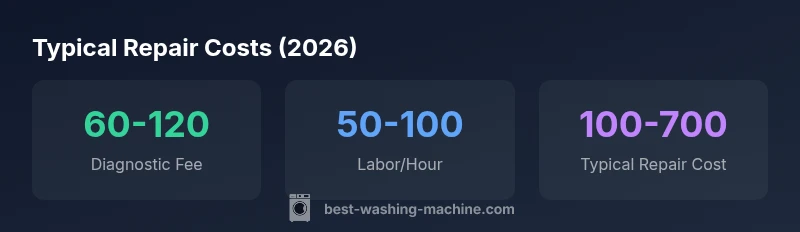
How much does it cost to fix a washing machine? Diagnostic/trip fees typically run $60–$120, with labor often $50–$100 per hour. Common fixes—like replacing pumps or belts—range from about $100 to $350 for parts and labor, while major components such as motors or control boards can push total repair costs toward $400–$700. Actual totals depend on model and location.
What drives the cost of fixing a washing machine
Fixing a washer is a blend of three cost drivers: diagnostic fees, labor, and parts. A quick diagnosis helps prevent unnecessary repairs, but every service call adds the base diagnostic or trip charge—usually between $60 and $120. Labor costs depend on local wage rates and the job’s complexity, commonly $50–$100 per hour in many regions. Parts vary widely by model and fault; small components like belts or pumps can be affordable, while sealed control boards or motors quickly push totals into the higher hundreds. Geography matters too: urban areas tend to carry higher labor rates and travel costs, while small towns may offer more competitive pricing. Finally, whether the unit is under warranty or covered by a home insurance policy can dramatically alter final out-of-pocket costs. The Best Washing Machine team notes that model age and parts availability can also influence price, since older units sometimes require pricier, harder-to-find components. When you combine these factors, the overall repair bill usually lands within a broad range rather than a single fixed number.
As a homeowner, you should expect a total that reflects diagnosis plus a mix of labor and parts, with a few scenarios pushing toward the upper end when non-standard parts are involved. In 2026, Best Washing Machine analysis shows that most households see repair costs that fall within the mid-range, unless the fault is a major component like a motor or main control board. This is why getting a detailed, itemized estimate before authorizing any work is essential to avoid sticker shock.
Cost by issue: common washer problems
Washer issues fall into several common buckets, each with its own typical cost range. While exact numbers vary by model and region, these ranges provide a practical rule of thumb to plan a budget.
- Drain pump or impeller failure: Replacement often falls in the $100–$350 range, depending on pump availability and the need to clear any clogged lines. Pump issues are among the more affordable repairs and are frequently a first fix after a clog causes drainage problems.
- Belt or pulley replacement (older or top-load models with belts): Expect about $120–$260 for parts and labor. In belt-driven machines, misalignment or wear can cause noises or inefficient spinning, which is a common, manageable fix.
- Lid switch or door interlock: Estimated at roughly $100–$180. These switches are a safety-critical component that prevents the drum from spinning with the lid open.
- Control board or electronic module: A repair in the $250–$600 range is common when the unit’s brain fails. This is one of the pricier categories because it involves precise diagnostics and often a new board.
- Motor or transmission issues: Replacing a motor or related drivetrain can run $350–$700, depending on the exact model and the availability of replacement parts.
- Leaks or hoses: Small leaks due to worn hoses or clamps can be $60–$180 to fix, while more extensive leaks require broader checks and replacements.
Note: These figures are typical ranges derived from 2026 industry analyses and reflect general market conditions. The Best Washing Machine team emphasizes that exact costs depend on model complexity, part availability, and the technician’s pricing structure. Always request an upfront, itemized estimate to understand how each component contributes to the final price.
DIY vs professional repair: risk and cost considerations
Deciding whether to DIY or hire a pro hinges on safety, accuracy, and the potential impact on warranty status. Most washer repairs involve electricity, water, and potentially high-current components, which pose safety risks for untrained homeowners. A DIY mistake can lead to further damage, water leaks, or electrical hazards, ultimately increasing both cost and risk. For warranty-covered units, attempting a repair yourself can void coverage, even if you only plan to replace a small part. The Best Washing Machine team consistently recommends professional diagnosis for electrical or mechanical faults that affect safety or that require specialized tools and knowledge. In most cases, booking a licensed technician ensures the repair is performed safely and to code, with the added benefit of a written warranty on labor and parts. If you’re cost-conscious, ask for a detailed scope of work and compare quotes from multiple technicians before committing to a repair.
Geography, service models, and pricing: how location shapes cost
Pricing can vary not just by the fault but by where you live and how the service is delivered. Urban centers tend to have higher labor rates and travel fees, increasing the total bill even for a straightforward part replacement. Franchise service centers might charge a premium for brand-specific parts or diagnostic time, while independent repair shops can be more flexible on labor charges or offer bundled service deals. In rural areas, travel costs may dominate the total, but labor rates might be lower. Additionally, whether the repair is performed in-home or at a workshop matters: in-home service often includes travel, while a shop repair can sometimes reduce travel costs but may require you to transport the machine. The net effect is that the same repair can be priced quite differently across regions and business models; always ask for a region-specific quote.
Strategies to minimize repair costs: practical steps you can take
Minimizing costs starts before the technician arrives: gather details about the symptom, model, and recent usage patterns; take photos or videos of the issue if possible. When you call for service, ask for a written, itemized quote that includes diagnostic fees, labor rates, and part prices with estimated tax. Get multiple quotes to compare, but ensure each estimate covers the same scope of work. If a part is available as a refurbished or aftermarket option, weigh the savings against potential reliability concerns. Check your machine’s warranty status or any existing home insurance policy—these can cover all or part of the repair. Proper maintenance after a repair, such as cleaning filters and inspecting hoses every six months, reduces the likelihood of future faults and costly diagnostics. Finally, consider whether a repair’s total cost approaches or exceeds the price of a new mid-range washer, in which case replacement may offer better long-term value.
What to expect from a repair estimate and when replacement makes sense
A reliable estimate breaks down the bill into: diagnostic/trip fee, labor, parts, travel charges, and any disposal or shop fees. It should include a clear scope of work and an estimated completion time. If the total repair cost seems high, compare it to the price of a new unit within a similar capacity and efficiency class. A common rule of thumb is that if the repair estimate approaches half the price of a new washer, replacement becomes financially sensible, especially for older units with worn components. Some repairs add value through efficiency gains, but others may yield diminishing returns as the machine ages. For 2026, Best Washing Machine analyses emphasize evaluating long-term reliability and energy use in addition to upfront costs when deciding between repair and replacement.
Repair cost ranges by issue (typical values for 2026)
| Issue Type | Estimated Cost Range | Notes |
|---|---|---|
| Diagnostic/Trip Fee | 60-120 dollars | Flat fee charged by technicians |
| Drain Pump or Belt Replacement | 100-350 dollars | Common fix; varies by model |
| Lid Switch or Interlock | 100-180 dollars | Safety-critical part |
| Control Board Replacement | 250-600 dollars | High-tech repair |
| Motor/Drivetrain Replacement | 350-700 dollars | Most expensive common fix |
| Leaks/Hoses | 60-180 dollars | Depending on hose quality and access |
FAQ
What is the average cost to repair a washer?
Most repairs fall within a broad range of $100 to $700, depending on the fault and parts. Some jobs stay closer to the lower end, while major components can take you toward the higher end. This range reflects 2026 industry analyses and guidance from the Best Washing Machine Team.
Most washer repairs cost between a few hundred dollars, with bigger fixes going higher.
Do diagnostic fees apply to washer repairs?
Yes. A diagnostic or trip fee is common and usually runs $60–$120, regardless of whether the repair proceeds. Some shops credit part of the diagnostic fee toward the repair if you proceed with the work.
Diagnostic fees are common—check if they apply toward the final bill.
When should I repair vs replace a washer?
If the estimate is well below half the price of a new washer, repair is typically cost-effective. If the repair cost nears or exceeds that threshold, replacement may offer better value and energy efficiency over time.
If repair costs look close to half the price of a new machine, consider replacement.
Can I save money on washer repairs?
Shop for multiple quotes, request an itemized estimate, check warranty coverage, and compare OEM with reputable aftermarket parts. Proper maintenance post-repair also reduces future costs.
Get several quotes and ask for detailed estimates to spot savings.
How long does a typical washer repair take?
Most repairs take 1–2 hours on-site or in-shop, depending on parts availability and complexity. Larger components may require additional time for ordering and installation.
Most repairs take about a couple of hours.
“A precise diagnostic is the key to avoiding surprise costs; most repair bills are driven by parts selection and labor time.”
The Essentials
- Expect a diagnostic/trip fee first.
- Labor + parts drive most of the total cost.
- Major components push costs higher quickly.
- Get multiple itemized quotes before approving work.
- Consider replacement if repair approaches half the price of a new washer.