What Happens When Washing Machine Pressure Switch Fails
Urgent, practical guide to diagnosing and fixing pressure switch failures in washing machines. Learn symptoms, diagnostic steps, safety tips, and how to prevent future issues.


The pressure switch failure commonly prevents the washer from filling, draining, or completing cycles. Start by inspecting hoses for kinks, testing the switch with a multimeter, and checking for blown fuses on the control board. If the issue persists after basic checks, contact a qualified technician for diagnostic and replacement.
What happens when washing machine pressure switch fails
When you consider what happens when washing machine pressure switch fails, the most immediate effect is a stalled cycle or unexpected stopping mid-wash. The control board relies on a signaling pressure switch to confirm that water levels are within safe, expected ranges before continuing. If the switch misreads or can no longer sense pressure, the washer may refuse to fill, overfill, or drain improperly. In some models, the display will show an error code or a fault indication. The root cause can be simple—like a kinked hose—or more complex, such as a worn sensor inside the switch. The key is to approach the problem with a structured, safety-first plan to avoid water damage and unnecessary part replacements.
Tip: Always unplug the machine before inspecting internal components to protect yourself from shocks and shorts.
How the pressure switch works
The pressure switch functions as a tiny sensor combined with a diaphragm or piston that translates water pressure into an electrical signal. As the tub fills, air pressure within a small hose changes and sends a signal to the control board. If the pressure is too low (not enough water) or too high (overfilling), the switch sends a fault signal and may halt the cycle. Some models also use a secondary sensor to cross-check readings, which improves accuracy but adds a potential point of failure. Understanding this flow helps you distinguish between a faulty diaphragm, a clogged line, or an electrical fault deeper in the wiring harness.
Note: Different brands and models implement the switch differently, but the basic principle remains the same: pressure reads through a line, and electronics decide if the cycle should proceed.
Common failure modes to watch for
Pressure switch problems can stem from several failure modes. A kinked or blocked pressure hose is a frequent culprit, as is mineral buildup from hard water that prevents accurate readings. The diaphragm inside the switch can tear or wear out, causing inaccurate pressure readings. Wiring harness corrosion or loose connections at the switch or control board can disrupt signals. In some cases, the fault is a failed micro-switch in the valve assembly or a blown fuse on the control board that powers the switch. Identifying the most plausible mode requires careful inspection and testing of hoses, the switch, and the control circuitry.
Pro tip: If your model allows, gently disconnect and re-seat connectors to rule out loose contacts.
Symptoms you might notice first
Early signs of pressure switch trouble often mirror other washer faults, so they warrant a careful check. You may notice water level inconsistencies, such as the tub not filling to the expected level or overflowing. The machine might rapidly fill and then drain without completing a cycle, or it may stop mid-cycle with a fault code indicating pressure irregularity. Loud pump noises during filling or draining can accompany a switch problem when the system tries to compensate for incorrect level readings. If you see repeated errors related to water level or pressure, start with the hose path and switch calibration.
Caution: Only perform basic visual checks if you’re unsure about electrical testing.
Diagnostic flow: symptom to diagnosis
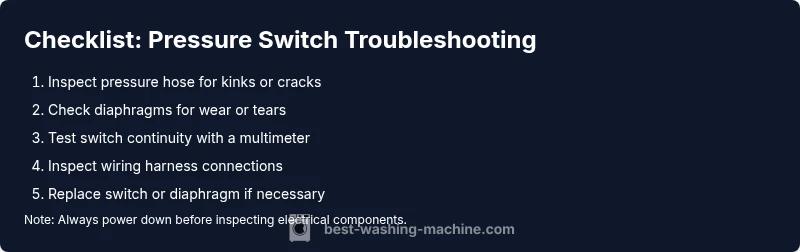
A practical diagnostic flow helps you trace symptoms to likely causes without guessing. Start with: (1) symptom you observe (e.g., no fill, no drain, or overfill), (2) inspect the pressure hose for kinks or obstructions, (3) test the continuity of the switch with a multimeter, (4) check related fuses and wiring harness connections, (5) replace the diaphragm or the switch if needed, and (6) perform a test run. If the symptom persists after these steps, the issue may lie in the control board, a dual-sensor setup, or a failed valve assembly.
Remember: Work in a dry area and never touch live electrical components.
Step-by-step: most common fix
- Power down and safety check: Unplug the washer, shut off water supply, and remove the access panel if needed. Ensure you’re working on a dry surface. 2) Locate the pressure switch and hoses: Trace the hose from the tub to the switch. 3) Inspect hoses: Look for kinks, cracks, or blockages. Detach and clear if necessary. 4) Test the switch: Disconnect the harness and test continuity with a multimeter according to your model’s manual. 5) Replace if needed: If the diaphragm is torn or the switch fails continuity tests, replace the switch or the entire valve assembly. 6) Reassemble and test: Reconnect everything, run a short cycle to confirm proper filling and draining.
Tip: Keep a small container nearby when testing to catch any residual water. Use manufacturer-recommended parts for compatibility.
Safety, warnings, and when to call a professional
Electrical safety comes first. Never work on live circuitry or unplugged appliances near water. If you’re unsure about testing electrical components, or if water leaks appear during inspection, stop and contact a certified appliance technician. A professional can verify the switch, check the control board, and ensure wiring integrity without risking further damage. For some models, the pressure switch is integrated with the valve assembly, which may require specialized tools and procedures. Always consult your service manual for model-specific cautions and torque specs.
Maintenance tips to prevent pressure switch issues
Regular maintenance reduces pressure switch failures. Use a rinse aid or vinegar periodically to dissolve mineral buildup in hoses, and check the hose connections for tightness and wear. Keep the area around the washer dry to minimize corrosion risk on connectors. If your water is hard, consider a filter or water-softening solution to reduce mineral deposition that can affect readings. Periodic inspection of hoses and the switch connections can catch wear before a fault occurs. Document and follow the manufacturer’s maintenance schedule to maximize reliability.
Replacement considerations: parts, cost, and warranty
If replacement becomes necessary, identify the exact part numbers from your model’s label or manual and compare aftermarket options for compatibility. Expect variations in price based on brand, whether you replace the diaphragm, the whole switch assembly, or the valve body. Check your warranty status; some models cover control components for specific periods. When in doubt, obtain a professional estimate to evaluate if a repair or replacement offers better long-term value.
Realistic expectations and getting back to reliable laundry
After completing diagnostics and any repairs, run a test cycle with towels or a small load to verify that the washer fills to the correct level, drains properly, and completes cycles without errors. If the fault recurs after a fix, it may signal a deeper electrical problem or a failed valve assembly that requires more extensive service. In many cases, routine maintenance can prevent reoccurrence, but remember that switches and diaphragms have finite lifespans and may need replacement every few years depending on usage and water quality.
Steps
Estimated time: 60-90 minutes
- 1
Power down and safety check
Unplug the washer, shut off the water supply, and open access panels as needed. Confirm the area is dry before touching internal components to avoid shock.
Tip: Keep a防水 mat under the machine when working on it. - 2
Identify pressure switch and hoses
Locate the small hose running from the tub to the pressure switch. Visually inspect for cracks, splits, or kinks. If the hose is damaged, replace before testing the switch.
Tip: Take a photo of hose routing to help reassemble correctly. - 3
Inspect and clear hoses
Disconnect the hose and inspect for blockages or mineral buildup. Use a soft brush or compressed air to remove debris. Reconnect firmly without twisting.
Tip: Do not over-tighten hose clamps to avoid cracking the hose. - 4
Test switch continuity
With the harness disconnected, test the switch with a multimeter per your model’s service manual. Compare readings to the spec values and replace if readings are out of range.
Tip: Use the correct test mode (ohms) and range for your switch. - 5
Replace if necessary
If the diaphragm is torn or the switch fails the continuity test, replace the switch or, if applicable, the valve assembly. Re-check all connections after installation.
Tip: Use OEM or compatible parts to preserve safety features and warranty. - 6
Run a test cycle
Reassemble panels, restore power and water, and run a short cycle with towels to verify proper fill and drain behavior. Watch for consistent readings and behavior.
Tip: Note any new error codes for future service notes.
Diagnosis: Washer won’t fill, won’t drain, or stops mid-cycle with pressure-related fault indicators
Possible Causes
- highBlocked or kinked pressure hose
- highWorn or torn diaphragm in pressure switch
- highFaulty pressure switch sensor or miscalibrated readings
- mediumElectrical fault in control board or loose wiring
Fixes
- easyInspect and straighten/replace the pressure hose; clear blockages
- mediumTest continuity of the pressure switch with a multimeter; replace if open/shorted
- easy reseat or replace wiring harness connections and blown fuses
- mediumReplace the switch or valve assembly if diaphragm is damaged or switch fails
FAQ
Can a pressure switch failure cause leaks?
Pressure switch failure can indirectly cause leaks if the tub overfills and water escapes. In most cases, leaks are due to hose misalignment or a damaged seal rather than the switch itself.
Yes, a faulty pressure switch can contribute to overfilling, which may lead to leaks if the tub overfills.
Will replacing the pressure switch fix error codes?
Replacing a defective switch often resolves related error codes tied to water level and cycle control. If codes persist after replacement, there may be a separate control-board issue.
Replacing the switch can fix level-related error codes, but if codes persist, a control-board check is advised.
How do I know if the pressure switch is bad?
Indicators include inconsistent fill levels, improper draining, frequent cycle interruptions, or abnormal error codes related to water pressure. A multimeter test confirms electrical faults.
Look for inconsistent water levels and error codes, then test the switch with a multimeter to confirm.
Can a clogged drain cause pressure switch failure?
A clogged drain can create back pressure that affects readings but is usually a separate issue from the pressure switch. Check the pump and drain hose for blockages as part of the diagnostics.
A drain clog can affect cycle timing, but it’s generally separate from the switch itself.
Is it safe to replace the pressure switch myself?
If you’re comfortable with appliance electronics and follow the manual, a homeowner can replace the switch. If the model uses integrated valve assemblies or you’re unsure about wiring, hire a professional.
You can replace it yourself if you follow the manual and stay safe; otherwise, hire a pro.
What maintenance prevents pressure switch problems?
Regular hose inspections, mineral buildup removal, and following the manufacturer’s maintenance schedule reduce failure risk. Use proper water-quality solutions if you have hard water.
Regular checks and maintenance reduce pressure switch problems over time.
Watch Video
The Essentials
- Inspect hoses first to rule out simple blockages
- Test the pressure switch with a multimeter before replacing it
- Safety comes first: unplug and dry area before work
- Replace diaphragms or switches only with compatible parts
- Regular maintenance helps prevent future pressure switch failures