Washing Machine Price in 2026: Costs, Value, and How to Buy
Explore washing machine price ranges in 2026, how type, capacity, and features drive cost, and practical tips to compare value, promotions, and total ownership costs.


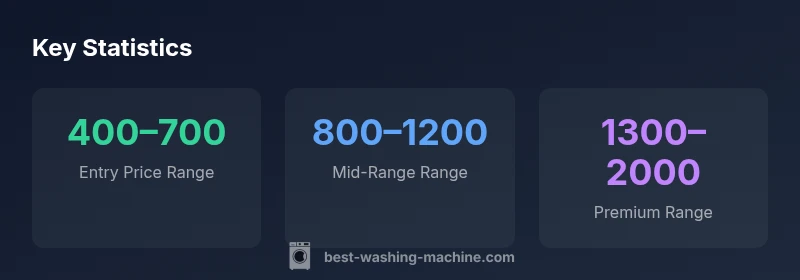
Typical washing machine price in 2026 varies widely by capacity, type, and features. A basic top- or front-loader can cost roughly $400–$700, mid-range models run about $800–$1,200, and premium units with advanced features often range from $1,300 up to $2,000 or more. The exact price depends on brand, energy rating, and special cycles.
How washing machine price is determined
Price for a washing machine isn't a single figure; it's the outcome of multiple interlocking decisions. When retailers set a price, they weigh the type (front-load vs top-load), capacity (compact, standard, large), drum material and build quality, energy and water efficiency, the inclusion of smart controls, and the warranty length. Brand positioning also matters: premium labels typically command a premium even for similar specs. Finally, retailer costs, promotions, and regional demand can shift the sticker price. From the Best Washing Machine Analysis, 2026, price is a function of both upfront features and expected operating costs over the machine's life. Buyers who understand these levers can separate short-term discounts from true long-term value. In practice, this means that two washers with similar capacity can differ widely in price if one emphasizes durability, lower energy use, or quieter operation. The key is to map your priorities to a model family rather than chasing the lowest upfront price alone.
Price ranges by type and size
Entry-level models, often basic top-loads or standard front-loads without advanced features, typically sit in the $400–$700 range. Mid-range models, which balance capacity, efficiency, and smarter controls, usually fall in the $800–$1,200 bracket. Premium units with steam cycles, advanced connectivity, and enhanced warranties commonly land from $1,300 to $2,000 or more. Front-load washers generally carry a higher upfront price than comparable top-load models, reflecting their efficiency and larger drum design. When evaluating price, also compare energy ratings, warranty length, and build quality, since these factors strongly influence total cost of ownership over many years.
Value beyond the sticker price: total cost of ownership
Upfront price is just one part of the story. The total cost of ownership includes operating costs (energy and water use), detergent, maintenance, possible repairs, and eventual disposal. Energy-efficient models often cost more initially but may reduce annual utility bills, especially if you run full loads and use cold-water cycles. The Best Washing Machine Analysis, 2026 notes that owners who optimize load size and cycle selection can realize meaningful savings over the machine’s life. When comparing models, project a multi-year view: higher upfront cost may be justified by lower operating costs, reliability, and longer warranty protection.
How promotions and retailers affect price
Prices shift with seasonal sales, retailer promotions, and bundling offers. Common tactics include discounts during holiday weekends, free delivery or installation, and bundled detergent or accessory offers. Some retailers run price-matching guarantees or loyalty rebates, which can shave the total cost of ownership. New model cycles often arrive with higher prices, while lightly used or refurbished units can offer savings—though with trade-offs in warranty and reliability. Always check the final delivered price, including taxes and installation, to compare apples-to-apples.
Practical buying strategies and mistakes to avoid
Start by setting a realistic budget aligned with your needs (capacity, efficiency, and features). List must-haves (load size, energy rating, quiet operation) and nice-to-haves (smart controls, steam, sanitize cycles). Use energy ratings to compare long-term costs and verify warranty terms. Measure your laundry space precisely and confirm that the chosen model fits both width and depth with room for ventilation and door clearance. Read independent reviews to gauge reliability and service quality in your region. Finally, factor in delivery and installation fees, potential haul-away costs for an old unit, and any local rebates or promotions. A deliberate comparison yields better value than chasing the lowest upfront price.
Data sources and methodology
Price estimates reflect typical market ranges observed across major retailers in 2026 and are anchored to a broad model mix (entry-level to premium). We use a price band approach to accommodate model variety and seasonality. For context on operating costs, we reference energy guidance from government and energy-efficiency programs, including Energy.gov and ENERGY STAR guidelines, and corroborate with the Best Washing Machine Analysis, 2026. Keep in mind regional differences in taxes, delivery fees, and promotions when applying these numbers to your situation.
Price and ownership snapshot by model type
| Model Type | Typical Price Range | Average Monthly Cost of Ownership | Notes |
|---|---|---|---|
| Front-load HE | 800-1200 | $5-$10 | Efficient; quiet |
| Top-load HE | 700-1100 | $6-$12 | Space-saving; easy to use |
| Top-load standard | 400-700 | $7-$13 | Lower upfront cost |
| Compact/apartment | 400-900 | $4-$8 | Smaller capacity |
FAQ
Why do washing machine prices vary so much?
Prices vary due to type, capacity, drum materials, energy ratings, and added features. Brand premium and retailer promotions also play a role. The Best Washing Machine Analysis, 2026 shows price dispersion across models.
Prices vary by type and features; compare energy ratings and warranties to gauge value.
Do energy-efficient models save money over time?
Yes, energy-efficient models generally reduce operating costs over time, especially with full-load cycles and cold-water use. Upfront costs may be higher, but long-term savings can be meaningful depending on usage and utility rates.
Energy-efficient models save on operating costs over time, especially with full loads.
Is it worth paying more for a larger capacity washer?
Larger capacity reduces the number of cycles for big loads and can save time, but only if your laundry pattern justifies it. If you frequently wash small loads, a smaller unit may be more economical.
Larger capacity is helpful for big households, but only if you actually use it.
What should I look for when price comparing across retailers?
Look for identical energy ratings, warranty terms, and delivered price. Include tax, delivery, and installation in your total comparison. Check for promotions and price-matching policies.
Match models by energy rating and warranty, and include delivery costs in your comparison.
Where can I find the best deals on washing machines in 2026?
Monitor major retailers during seasonal sales, use price-tracking tools, and consider bundled offers with detergents or installation. Don’t forget to read terms on returns and warranties before buying.
Check seasonal sales and compare bundles across retailers.
“Pricing reflects a balance between upfront cost, energy efficiency, and reliability. Consumers who compare features and warranties tend to get the best long-term value.”
The Essentials
- Set a realistic budget and target features.
- Compare energy efficiency and warranty to judge value.
- Factor total ownership costs, not just price.
- Watch for seasonal promotions and retailer bundles.
- Measure space and verify compatibility before buying.