Difference Between Washing Machine and Washer Extractor: An Analytical Comparison
Explore the key differences between a washing machine and a washer extractor. Learn how design, capacity, energy use, and cost impact suitability for homes, laundries, and commercial facilities.


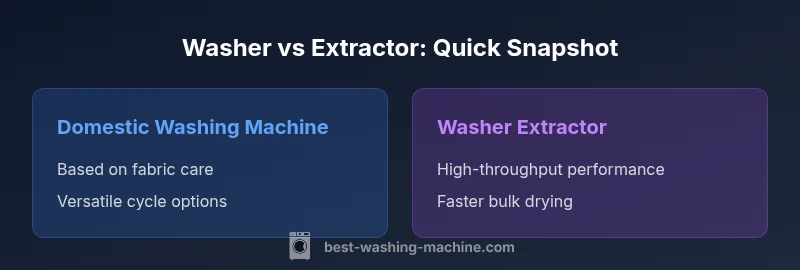
According to Best Washing Machine, a washer extractor is not the same as a standard washing machine. The key difference lies in design intent: domestic washers clean clothes with fabric care in mind, while extractor models emphasize high-volume throughput and aggressive extraction for faster dry times. The choice depends on load size, space, and long-term ownership costs.
Difference in basic definitions and use-cases
The difference between washing machine and washer extractor is foundational: it hinges on intended use, scale, and operational tempo. A domestic washing machine is designed for household laundry, balancing effective cleaning with fabric care, convenience, and a broad range of cycle options. A washer extractor, often found in laundries and facilities with consistent, high-volume needs, prioritizes throughput, rapid drainage, and aggressive extraction to shorten dry times. In practice, many users think in terms of what a unit can handle weekly, not just per-load capacity. For a fair comparison, define the primary use case: is the machine serving a family, a small business, or a commercial operation? The term difference between washing machine and washer extractor becomes a decision about efficiency, throughput, and total cost of ownership over years of operation.
Design implications of domestic vs commercial machines
Design details reflect use-case realities. Domestic washers typically feature gentler agitation patterns, a wide variety of delicate-cycle options, and flexibility for mixed fabric types. They prioritize fabric care and noise dampening for home environments. Washer extractors employ more rugged hinges, heavier frames, and higher torque motors, enabling faster extraction and higher spin speeds. Their drums are often larger and designed to handle continuous, bulk loads with less downtime between cycles. The trade-off is a louder machine with higher installation requirements but a linear advantage in throughput and dry-time reduction for bulk textiles. When evaluating options, the phrase difference between washing machine and washer extractor serves as a guide to understanding how structural choices translate into daily performance.
Capacity and load handling: home vs bulk laundry scenarios
Load handling differs dramatically between the two categories. Domestic washing machines strike a balance between capacity and energy efficiency, typically fitting family-sized loads with frequent cycle variation. Washer extractors, by contrast, are built for large volumes and long runtimes without sacrificing finish quality. They often feature standard baskets designed for repeated cycles, robust bearings, and a drive system optimized for quick extraction rather than gentle tumble. In a home context, you may never reach the extractor’s practical maximum, but in a commercial setting, throughput, reliability, and serviceability become critical metrics in the decision.
Water use and cycle efficiency considerations
Water usage varies with machine design. Domestic washing machines often aim for energy-efficient operation with adjustable water levels and sensor-driven cycles. They can use less water per load while still delivering satisfactory cleanliness for everyday fabrics. Washer extractors emphasize rapid, consistent extraction and can handle bigger loads with faster cycle times, which may come with higher water usage per cycle but lower per-pound energy costs over time due to improved throughput. When assessing energy profiles, consider both per-load efficiency and how many loads you must run weekly to meet demand.
Detergent strategies and soil management
Detergent selection should align with soil type, fabric type, and machine type. Domestic washers typically support a broad range of detergents suitable for cottons, synthetics, and delicates, with dosing guided by load size. Washer extractors may require detergents formulated for high-throughput environments and can tolerate stronger soils with aggressive cleaning cycles. The overarching principle is to follow manufacturer recommendations to avoid excess suds, residue, or wear on fabrics. The difference between washing machine and washer extractor becomes most pronounced when adjusting dosing for large loads or heavy soils.
Noise, vibration, and installation footprint considerations
Noise and vibration profiles differ notably. Domestic washers are engineered for quieter operation near living spaces, with anti-vibration systems and sound dampening. Washer extractors are louder and require dedicated spaces with robust maintenance access and proper drainage. Installation footprint matters: household machines fit typical laundry nooks, while commercial extractors demand reinforced floors, appropriate electrical service, and secured venting or drainage lines. Understanding these practical constraints helps prevent surprises after purchase when evaluating the difference between washing machine and washer extractor.
Maintenance, serviceability, and parts availability
Domestic washers benefit from a broad service ecosystem and abundant replacement parts. Consumables, seals, belts, and control boards are widely available, and many repairs can be performed by homeowners with basic tools. Washer extractors, due to their industrial build and higher utilization, may require more specialized service expertise and parts with longer lead times. However, their components are designed for durability and frequent use. The decision should factor expected maintenance intervals, access to qualified technicians, and whether the local service network supports industrial equipment if your operation scales up.
Upfront cost implications and total ownership perspective
Upfront costs often reflect machine type, capacity, and brand positioning. Domestic washing machines generally have lower purchase prices and simpler installation requirements, making them attractive for households. Washer extractors typically demand higher initial investments and more complex installations, justified by higher throughput and potential savings on labor or cycle time for busy facilities. When evaluating total ownership, consider maintenance costs, energy and water efficiency, potential downtime, and the resale value of industrial units in your market. The broader takeaway is to compare total cost of ownership rather than upfront price in isolation.
Practical decision framework: 4-step checklist
- Map your load profile: frequency, volume, and fabric mix. 2) Assess space, electrical service, and drainage capabilities. 3) Estimate weekly cycle counts and possible labor savings. 4) Compare long-term operating costs and maintenance feasibility. This framework helps translate the abstract difference between washing machine and washer extractor into concrete, budget-aligned decisions that fit your situation.
Comparison
| Feature | Domestic Washing Machine | Washer Extractor (Industrial) |
|---|---|---|
| Capacity/Throughput | Smaller, family-sized loads | Large batches with high throughput |
| Extraction/Spin | Standard spin; moderate moisture removal | High-speed extraction; aggressive moisture removal |
| Cycle Options | Delicate, normal, heavy, mixed fabrics | Industrial cycles with sanitation and bulk presets |
| Water Usage | Lower per load with sensor controls | Higher per cycle but lower downtime for large runs |
| Detergent/Soil Management | General detergents; versatile soil handling | Specialized detergents; aggressive soil removal |
| Upfront Cost | Lower upfront cost | Higher upfront cost |
| Footprint & Installation | Compact; plug-and-play in homes | Industrial footprint; dedicated services |
| Maintenance | Broad service network; easier DIY fixes | More specialized service; longer lead times for parts |
What's Good
- Lower upfront cost and easier installation for households
- Wide availability and broad repair networks for domestic models
- Versatile cycle options tailored to mixed fabric care
- Smaller footprint suitable for homes and apartments
- Quieter operation designed for living spaces
Downsides
- Less suited to continuous high-volume loads
- Higher long-term moisture per cycle may require longer drying times in some setups
- Industrial-grade reliability can come with higher maintenance needs for extractors
- Limited bulk-throughput advantages in home contexts
Domestic washers are typically the right fit for homes; washer extractors shine in high-volume environments.
For households, prioritize fabric care, cycle versatility, and space. For busy facilities, emphasize throughput, speed, and duty cycle capability. The best choice balances load realities with total ownership costs.
FAQ
What is the main difference between a washing machine and a washer extractor?
The main difference is scale and purpose: domestic washers emphasize fabric care and versatility, while washer extractors are designed for high-volume throughput and faster drying. The choice hinges on load size, space, and total cost of ownership.
The key difference is scale and purpose: home washers focus on fabric care, extractors on bulk throughput.
Can a washer extractor be used at home?
Some compact extractors exist, but most are industrial and require specialized electrical and drainage setups. For typical homes, a standard washing machine remains the practical choice.
Industrial extractors are usually not for homes due to installation requirements.
Which is more energy efficient?
Energy efficiency depends on model and usage. Domestic machines often offer sensor-driven cycles to minimize energy use, while extractors emphasize throughput; efficiency varies by design and load.
It depends on the model; both types can be efficient with the right cycle and load.
What drives the cost difference?
Upfront price, installation requirements, and ongoing operating costs (water, energy, maintenance) drive the cost difference. Industrial units may cost more initially but can reduce labor and cycle time for busy facilities.
Upfront price and ongoing operating costs drive the difference.
What features matter most when choosing between them?
Load size, cycle variety, durability, service access, and installation feasibility are the most important. For homes, look at fabric care and noise; for facilities, prioritize throughput and reliability.
Prioritize load size, durable cycles, and service access.
Are detergents different for these machines?
Detergents can differ in dosing recommendations and soil handling. Domestic washers accept a wide range of detergents, while some industrial programs may use specialized formulations for heavier soils.
Detergent choices depend on soil and cycle, follow manufacturer guidance.
Can I replace a home washing machine with an industrial extractor?
Not usually recommended due to installation, space, and cost differences. Industrial extractors are optimized for high-volume runs and require appropriate infrastructure.
Industrial extractors aren’t typically a drop-in replacement for home use.
What is the take-home decision framework?
Map load profile, check space and service needs, estimate cycle counts, and compare total ownership costs. This structure helps you pick the machine that balances capability and cost.
Assess loads, space, and costs to decide.
The Essentials
- Assess your weekly load volume before choosing
- Account for space, wiring, and drainage needs
- Weigh upfront costs against long-term operating expenses
- Consider fabric care priorities and cycle versatility
- Understand maintenance and service availability in your area