Is Automatic Washer Better Than Manual? A Thorough Comparison
This detailed buying guide compares automatic and manual washing methods, detailing energy, water use, maintenance, and value to help homeowners decide which approach fits their loads, budget, and time commitments.


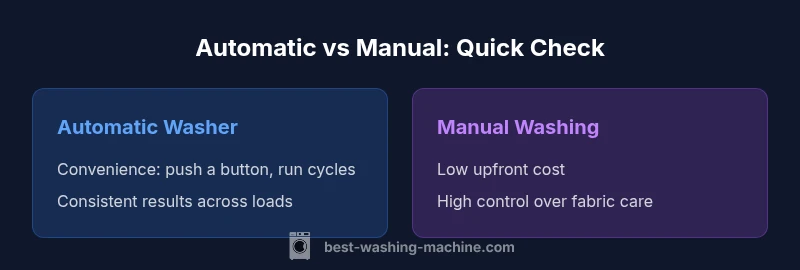
Is automatic washing machine better than manual? For most households, automatic machines offer greater convenience, more consistent cleaning, and faster cycles, while manual washing can save upfront costs and reduce electricity use. This quick comparison outlines when automation pays off and where hand-wash methods still hold value, especially for delicate fabrics or tight budgets. Consider your loads, space, and time when deciding between them.
Defining automatic vs manual washing
The question is often framed as: is automatic washing machine better than manual? To answer clearly, we must separate two distinct ideas. Automatic washers are powered appliances with built-in motors, water inlet valves, and usually an electric spin cycle. Manual washing, in contrast, relies on human action or a non-electrified device for agitation and rinsing. In most modern homes, when people refer to the 'manual' option, they mean hand-washing clothes with water and detergent, rather than using a non-electric hand-cranked machine. Understanding these definitions helps set expectations for performance, cost, and practicality in everyday laundry routines.
For households evaluating options, the key is to align the washing method with load size, fabric type, available space, and time. The Best Washing Machine team finds that many users underestimate how much time manual washing can take, especially for large families or frequent laundry days. By contrast, automatic washers deliver predictable results with adjustable cycles and spin speeds, reducing the guesswork involved in fabric care.
Performance and the core differences in outcomes
Automatic washers typically offer standardized cycles that optimize agitation, rinsing, and spin speed for different fabric types. This consistency translates into more uniform results across loads and a reduced risk of scrubbing errors that can damage fabrics. Manual washing, while offering intimate control, demands more hands-on attention, and results depend heavily on technique and experience. For delicates, wool, or permanently pressed items, the automated programs may outperform manual handling by maintaining gentler agitation or shorter cycle times.
However, manual washing has its niches. For tiny or rare loads, or when you want to treat a stain with a personalized touch, hands-on washing can yield satisfactory outcomes without engaging a full machine cycle. The trade-off is time and effort. In many households, a blended approach—using the machine for typical loads and hand-washing special items—can offer a sensible balance between convenience and fabric care.
Efficiency, water use, and detergent strategy
Energy and water efficiency are central to the automatic vs manual decision. Automatic washers, especially modern front-load and high-efficiency top-load models, optimize water use and energy per cycle through precise sensors and load-based filling. They often include automatic detergent dispensers, fabric softener compartments, and rinse options that minimize waste. Manual washing, depending on technique, may use less water per wash but can end up using more water overall if multiple rinses are needed or if hands-on scrubbing consumes more time and water due to less effective agitation.
Detergent strategy also differs. Automatic models tend to work best with appropriate detergent dosing via built-in dispensers or recommended pod/formula types, reducing overuse and soap buildup. Manual washing allows you to tailor soap concentration per item, which can be beneficial for certain fabrics but may risk residue if not carefully rinsed.
Fabric care, load handling, and scalability
Fabric care hinges on agitation and spin dynamics. Automatic washers offer adjustable agitation intensity and spin speeds, facilitating gentle cycles for delicates and robust cycles for durable fabrics. Properly loaded machines promote balanced spins, shorter drying times, and less wear on fabrics. Manual washing gives you direct control, which can be advantageous for sensitive items but demands vigilance to prevent damage from vigorous scrubbing or improper rinsing. As loads scale up, the automation advantage becomes more evident: you can run simultaneous cycles, optimize water usage, and reduce fatigue from repetitive tasks.
In spaces with limited access to plumbing or electricity, there are still practical considerations. Traditional manual methods or compact front-load units may fit better in small apartments or shared spaces, but the overall laundry throughput may drop without automation. The decision should reflect not only fabric care but also your living situation and daily routines.
Costs, value, and long-term durability
Initial purchase price is a major differentiator. Automatic washing machines represent a higher upfront investment, but they can yield savings over time through lower labor time, improved energy efficiency, and consistent cleaning results. For households with frequent laundry, the value proposition leans toward automation. Manual washing requires little or no machine cost, but it incurs higher time costs and may impact productivity if laundry piles up. Durability depends on build quality, warranty terms, and the availability of repair services. In general, modern automatic machines offer convenient maintenance programs and diagnostic indicators that help prevent major failures, whereas manual approaches depend more on user discipline and routine.
When budgeting, think beyond sticker price. Include energy costs per cycle, potential water savings, and wear on fabrics over time. If you have a spacious laundry area and a steady supply of items to wash, automation tends to provide better long-term value. If your loads are tiny or irregular, manual washing could be cost-effective and suitable.
Maintenance, reliability, and after-sales considerations
Reliability matters for both approaches, but the maintenance profile differs. Automatic washers require electrical and mechanical components—motors, belts, hoses, and control boards—that can fail and need service. Regular care such as cleaning lint filters, inspecting hoses, and using appropriate detergents helps extend lifespan. Manual washing has fewer mechanical parts to fail, reducing some maintenance concerns, but it demands consistent hand technique and drying practices to prevent odor formation or mildew in the wash area.
Service ecosystems also influence long-term outcomes. Availability of skilled technicians, access to replacement parts, and warranty coverage all affect total cost of ownership. As with any major appliance, choosing recognized brands with robust support networks and clear diagnostic pathways can significantly affect maintenance ease and repair speed.
Use-case scenarios: when automation clearly pays off
For busy families with multiple loads daily, automatic washers save substantial time and effort. In households with large items like bedding or towels, automation enables fast cycles and reliable cleaning without manual scrubbing. Students, renters, and single-person households may still benefit from a compact automatic model if space is a premium and energy/water costs are critical. On the other hand, if you only wash a handful of clothes irregularly, or if you place a premium on fabric care for delicate or heirloom garments, manual washing or a smaller machine paired with careful handling can be a pragmatic choice.
Ultimately, the decision rests on your schedule, budget, load characteristics, and tolerance for maintenance. A hybrid approach—using automatic for regular loads and reserved manual methods for special items—often yields the best balance.
Decision checklist and practical scenarios
To decide between automatic and manual, work through this quick checklist:
- How many loads do you wash per week, and what are their sizes? Larger households benefit more from automation.
- What fabrics do you wash most often? Delicates may require gentler automation, while heavy items are well suited to automatic cycles.
- How much time can you dedicate to laundry? High time costs favor automation.
- Is upfront cost a deciding factor, or can you absorb ongoing maintenance? Consider both.
- Do you have space for a machine, or would a compact or stacked setup fit better?
Sample scenarios:
- A family of four with mixed fabrics and frequent towels will likely gain the most value from an automatic washer.
- A student with a tight budget and infrequent laundry may prioritize manual or a compact unit with a minimal footprint.
This reflective approach ensures you pick a washing solution that aligns with real-world needs rather than hype or marketing claims.
Authority sources and further reading
For deeper dives on efficiency and best practices, consult these reputable sources:
- Energy.gov: https://www.energy.gov
- Energy Star: https://www.energystar.gov
- National Institute of Standards and Technology (NIST): https://www.nist.gov
These resources provide guidance on energy efficiency, appliance standards, and practical tips for reducing water and electricity use in laundry routines.
Comparison
| Feature | Automatic Washer | Manual Washer |
|---|---|---|
| Water usage | Moderate | Variable/hand-wash dependent |
| Energy efficiency | High (with modern HE models) | N/A (manual varies by technique) |
| Detergent dosing | Pre-measured/automatic dispensers | Manual dosing by user |
| Cycle time | Typically fixed, efficient cycles | Dependent on manual pace and method |
| Best for | Households needing convenience and consistency | Budget-conscious users or those who wash infrequently |
| Maintenance/reliability | Electrical/mechanical components; serviceable parts | Fewer moving parts; fewer repairs but more manual effort |
What's Good
- Significant time savings for busy households
- Consistent cleaning results across loads
- Gentler fabric care with appropriate cycles
- Better handling of large or heavy items
Downsides
- Higher upfront cost and more complex maintenance
- Repair costs can be higher when components fail
- Dependency on electricity and water supply
Automatic washers generally offer greater overall value for most households
For typical family sizes and mixed loads, automation saves time and ensures consistent care. Manual washing remains appealing for tiny loads, delicate fabrics, or tight budgets, but it requires more hands-on effort and time.
FAQ
Do automatic washing machines use more water than hand washing?
Automatic machines are designed to meter water per cycle and can be highly efficient, especially modern high-efficiency models. Hand washing allows you to control water use but may end up wasting water if you rinse repeatedly. The best approach is to compare model specifications and your typical load sizes.
Automatic washers are usually efficient and meter water per cycle, but hand washing can use less water if done carefully. Check the model’s energy and water ratings to compare.
Is a manual method ever better than an automatic one?
Yes, in scenarios with very small loads, delicate fabrics, or tight budgets, manual washing can be appropriate. It eliminates machine costs but requires more time and effort and may not scale well with larger households.
Manual washing shines for tiny loads or delicate fabrics when time isn’t a constraint.
What should I consider about energy use?
Energy use depends on the model and cycle choice. Automatic washers with energy-efficient ratings save electricity per load, especially on longer wash cycles. Manual washing consumes energy primarily in heating water if hot water is used, and in human effort.
Choose energy-rated models and favor cooler cycles to save power.
Can I repair an automatic washer myself?
Some basic maintenance tasks like cleaning filters and hoses are DIY-friendly, but most mechanical repairs require a trained technician. Regular professional service can extend lifespan and prevent costly failures.
Basic care you can do yourself; major repairs need a tech.
How long do automatic machines typically last?
Lifespan varies by usage and model, but many household machines are designed to last several years with proper maintenance. Warranty terms also influence the cost of ownership over time.
With proper care, many machines endure several years with reliable performance.
The Essentials
- Evaluate weekly load volume to gauge value
- Consider fabric mix and delicates when choosing cycles
- Factor upfront cost against long-term time and energy savings
- Use authoritative sources to guide energy efficiency choices
- A blended approach can offer flexibility and efficiency