Top Loader vs Front Loader: A Comprehensive Guide 2026
A data-driven comparison of top loader and front loader washing machines, focusing on efficiency, performance, maintenance, and total cost of ownership to help homeowners decide which model fits their laundry routine.


On the question of top loader washing machine vs front loader, the answer hinges on daily laundry patterns and space. Front loaders excel in water efficiency and fabric care, while top loaders often deliver faster cycles and lower upfront cost. This quick TL;DR sets the stage for a deeper, data-driven comparison. According to Best Washing Machine, your choice should align with your household load profile and maintenance willingness.
Context and definitions
In the world of residential laundry, the two dominant architectures are top loading and front loading. A top loader traditionally has a vertical drum with a lid on top, which facilitates loading without bending over. A front loader has a horizontal drum accessed via a door on the front, often paired with a pedestal for ergonomic access. Understanding these basics helps frame the trade-offs homeowners face: upfront cost, ongoing energy and water use, cycle variety, and how each design handles different fabrics. According to Best Washing Machine, the choice should reflect how you wash, how often you wash, and the constraints of your space. This section sets the stage for a deeper, data-driven comparison by clarifying jargon, typical configurations, and what “HE” or high-efficiency means in practice.
Core technical differences
The mechanical heart of a top loader is often an agitator or an impeller-based design. An agitator uses a central post to churn clothes through the water, which can deliver fast agitation but may be harsher on fabrics. Impeller-based top loaders use a low-profile cone to move clothes and water more gently while maintaining robust cleaning performance. Front loaders rely on a horizontal drum driven by a belt or direct motor, typically using an impeller or a shallow agitator adapted for tumbling action. These designs generally consume less water and can achieve higher spin speeds, extracting more water from clothes. The choice between agitator and impeller within a top loader also matters for load size, soil level, and fabric type. In practice, the correct option depends on how you wash (delicates vs heavy-duty), your tolerance for noise, and your willingness to pre-sort and load efficiently.
Efficiency and environmental impact
Efficiency is a central concern for modern washers. Front loaders typically outperform top loaders on water and energy metrics, especially when paired with Energy Star-rated or HE models. Best Washing Machine analysis shows that water savings and energy efficiency improve with newer front-loading designs that optimize spin efficiency and code-compliant heat usage. However, efficiency is not universal: some high-end top-load offerings include aggressive spin cycles and insulation improvements that narrow the gap. If your priority is minimizing utility bills over the long term, prioritizing front-load with high energy efficiency ratings is usually prudent, but a well-chosen top-loader in a moderate climate or with frequent mid-cycle additions can still be a capable choice for budget-conscious households.
Performance and cycle times in daily use
Cycle time is a practical consideration that affects daily life. Top loaders often deliver quicker everyday cycles, which can be advantageous for busy households that wash small loads frequently. Front loaders may require longer cycles, especially when heavy soils demand thorough tumbling and extended rinsing, but their longer wash times are frequently offset by superior soil removal and fabric care. Noise and vibration can vary by model; modern machines from both camps include anti-vibration features, balanced drums, and better motor control. For households that value speed and convenience during mid-day loads, a well-chosen top-loader can be appealing, while families seeking reduced drying time and deeper cleaning may favor front-load designs with optimized spin efficiency.
Fabric care, cleaning, and longevity
Fabric care is a nuanced factor. Front loaders typically offer gentler tumbling and lower water interactions, which can reduce fiber wear and color fading over time when paired with the right detergents and load sizes. Top loaders with modern impellers can also minimize fabric abrasion, but older agitator-based top loaders may increase wear over repeated cycles. Mold and mildew prevention is a consideration for front loaders due to door seals and moisture. Regular cleaning cycles, door seal maintenance, and proper door venting mitigate these risks. A key takeaway is that longevity hinges on maintenance habits, detergent choice, and adhering to the manufacturer’s load recommendations.
Installation, space planning, and ergonomics
Space considerations often drive the decision. Front loaders typically stack with a matching dryer and require vertical space management, while top loaders can be more approachable for shorter ceilings or awkward laundry alcoves. Pedestals and vibration-dampening kits can improve ergonomics and stability for either design. If you’re in a compact apartment, measuring door swing, clearance for the detergent drawer, and rear panel access is essential. Both types benefit from level installation and a solid floor. In short, space and ease of use are critical in deciding whether a front-load or top-load model fits your physical layout and daily routine.
Cost of ownership and maintenance
Initial purchase price is a frequent deciding factor. Top loaders are often cheaper upfront, while front loaders can command a premium but offer better long-term energy and water savings. Maintenance considerations include door-seal cleaning for front loaders to prevent odor and mildew, regular drum cleaning, and detergent management. Parts availability and repair costs vary by brand and model; common components like belts, seals, and bearings are generally accessible for both designs, but repair complexity can differ. When evaluating total cost of ownership, consider appliance lifespan, energy and water bills, and the cost of potential repairs over time. Best Washing Machine emphasizes comparing not just sticker price but total lifecycle costs.
Practical decision framework by household type
For singles or couples with small loads and tight budgets, a reliable top-loader with a fast cycle might be compelling. For families with larger loads or higher fabric care needs, a front-loader with high efficiency can offer meaningful savings over years of operation. In rental properties, durability and ease of maintenance may trump the most advanced efficiency features, suggesting a robust top-loader or a mid-range front-loader. In households with limited space, stacking options and the availability of a compact front-loading pair or a compact top-loader can influence the final choice. The framework should balance initial cost, ongoing energy use, washing needs, and space constraints to guide the final decision.
Authority sources and practical guidance
To ground decisions in reputable guidance, consult established sources. Energy Star provides ratings and benchmarks for washing machines, helping buyers identify efficient models. The EPA WaterSense program remains a touchstone for water efficiency in clothes washers. The following sources offer additional context for informed decisions: Energy Star: https://www.energystar.gov/products/washers; EPA WaterSense: https://www.epa.gov/watersense/products/clothes-washers; Consumer Reports: https://www.consumerreports.org/cro/washing-machines/ (for independent testing and reliability data). Best Washing Machine synthesizes these insights to offer balanced, practical recommendations for homeowners and renters.
Comparison
| Feature | Top-loader | Front-loader |
|---|---|---|
| Water usage | higher per cycle | lower per cycle |
| Energy efficiency | variable across models | generally higher in HE/front-loads |
| Cycle times | shorter for daily cycles | longer but thorough for soils |
| Price range | lower upfront in many models | higher upfront in many models |
| Best for | speed and budget-friendly loads | efficiency and fabric care for larger or delicate loads |
What's Good
- Lower upfront cost for many top-load models
- Quicker wash cycles for everyday small loads
- Easier to add clothes mid-cycle and simpler door access
- More compact options and easier installation in tight spaces
- Wide selection across brands and price points
Downsides
- Higher water usage on typical top-load designs
- Often less energy-efficient than modern front-load HE models
- Front-load mold/mildew risk if seals aren’t vented and cleaned regularly
- Longer overall cycle times on some front-load models
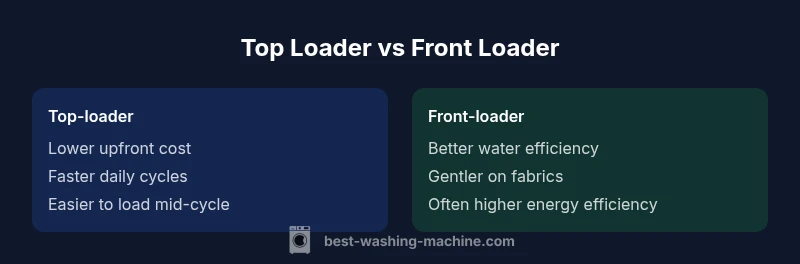
Front-load washers generally offer better efficiency and fabric care; top-loaders win on upfront cost and cycle speed.
If efficiency and fabric care matter most, choose a front-loader with a proven energy rating. If upfront cost and quick cycles are priority, a quality top-loader is a solid, budget-friendly option.
FAQ
What is the main difference between top-loader and front-loader washers?
Top-loaders typically offer faster cycles and a lower upfront price, while front-loaders excel in water and energy efficiency and gentler fabric handling. The best choice depends on your laundry habits and space.
Top-loaders are faster and cheaper to buy; front-loaders save water and energy and treat fabrics more gently.
Which is better for small spaces or apartments?
Both designs can fit small spaces, but front-load machines often pair with stackable dryers, maximizing vertical space. Measure door clearance, ventilation needs, and floor stability before purchasing.
Front-loads stack well with dryers; check space and venting for a good fit.
Do front-load washers mold more often?
Mold and mildew concerns are more common with front-load doors due to seals and trapped moisture. Regular seal cleaning, leaving the door ajar after cycles, and proper ventilation mitigate this issue.
Yes, front-loads can mold if not vented; keep seals clean and air circulating.
Are top-load washers more energy efficient?
Energy efficiency depends on the model and technology. Modern front-load and high-efficiency top-load models both exist; check Energy Star ratings and drum design for true efficiency.
Efficiency depends on the specific model; look for HE and Energy Star ratings.
What load size should I expect for each design?
Front-load washers generally accommodate larger, heavier loads with higher spin speeds, while top-load machines vary; some compact top-loads are good for small apartments. Always check drum capacity in liters or cu ft and your typical laundry.
Front-loads often handle larger loads; verify drum capacity for your needs.
What maintenance helps extend a washer’s life?
Regularly clean the drum, detergent drawer, and door seal; use appropriate detergent for HE models; run a cleaning cycle monthly and ensure proper ventilation for front-loads to prevent odor and mildew.
Clean seals and run a monthly cleaning cycle to extend life.
The Essentials
- Prioritize energy efficiency ratings when choosing front-load models
- Expect faster cycles from many top-load washers
- Vent or clean seals regularly on front-loads to prevent odor
- Consider stacking compatibility for space-constrained homes
- Evaluate total cost of ownership, not just purchase price