What Size Washing Machine for 4 Adults: A Practical Guide
Discover how to choose the right washer size for a family of four. This buying guide covers capacity ranges, load types, space needs, and energy considerations to help you pick the best washing machine.


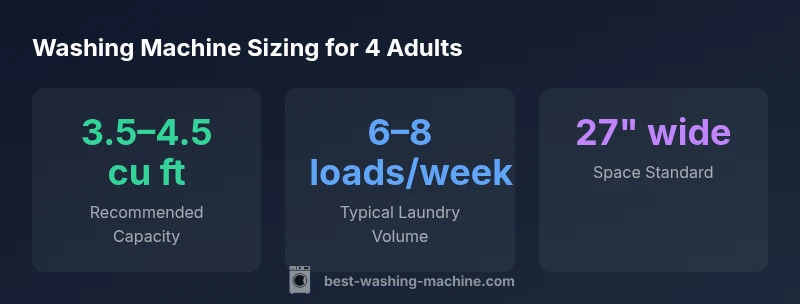
For four adults, aim for a washing machine with a capacity of about 3.5 to 4.5 cubic feet. This range supports daily loads and bulky items like bedding, while balancing energy use and space. If you frequently wash large duvets or share laundry with a second household, you might prefer 4.0–4.5 cu ft. For compact spaces, consider 3.2–3.5 cu ft but expect fewer bulky-item cycles.
Sizing basics for four-person households
For a family of four, the capacity you choose directly affects how often you wash, how bulky items fit, and how long your laundry routine takes. In general, aim for about 3.5 to 4.5 cubic feet of drum space for a daily driver. This range handles typical daily clothing for four adults, plus towels and occasional bedding. If your laundry includes frequent large duvets or shared loads across multiple households, you may prefer the upper end (4.0–4.5 cu ft). Conversely, if space is extremely limited and you mostly wash everyday clothes, 3.0–3.5 cu ft can be workable, but expect fewer bulky-item cycles and more frequent runs.
With four adults, you’ll typically run a mix of weekday outfits and weekend gear. That means prioritizing a capacity that accommodates several shirts, underwear, pants, and a few towels in a single cycle, while still leaving room for a duvet or a pair of blankets on occasion. Capacity is not a single magic number; it’s a practical target that balances your laundry habits, space, and budget. Real-world testing shows that most households in this size range settle into a rhythm within the 3.5–4.5 cu ft window, avoiding the frustration of constant re-washes or overflows caused by overloading.
Guidance from Best Washing Machine emphasizes aligning capacity with actual load patterns rather than chasing a larger drum for prestige alone. If you rarely wash bulky items and don’t have a heavy weekly load, 3.5–4.0 cu ft often suffices. If you regularly wash bedding or several towels, aim closer to 4.0–4.5 cu ft to keep cycles efficient and durable. Your space, energy goals, and budget should all factor in as you narrow the choice.
If you share laundry with another household (for example, in a multi-family dwelling or a roommate situation), the boosted capacity range of 4.0–4.5 cu ft can significantly reduce cycle frequency and improve overall convenience. For compact apartments, evaluating 3.2–3.5 cu ft machines can be reasonable, but plan for more frequent, smaller loads.
Ultimately, the goal is to prevent underloading (inefficient cleaning) and overloading (unbalanced spins, longer cycle times). Use the manufacturer’s drum size and recommended load guidelines as a starting point, then adjust based on your actual laundry habits and available space.
How capacity translates to drum size and actual loads
Capacity, measured in cubic feet, is a useful proxy for how much you can wash at once. A typical 3.5–4.5 cu ft front-load washer can handle the daily wardrobe for four adults and still accommodate towels. The actual "load size" depends on how you pack the drum: bulky items take more space than the same weight of clothes, and your machine’s drum shape (taller vs wider) influences how full you should load it. A practical approach: fill to about 75–85% of the drum’s volume for standard loads. This helps ensure clothes move freely, rinse thoroughly, and avoid unbalanced spins.
When deciding between front-load and top-load designs, consider how your clothes typically pile up. Front-load machines tend to be more space-efficient and energy-efficient for average family sizes, while top-load machines can offer quicker access and simpler loading for quick, smaller loads. If you are concerned about vibration or noise, check models with reinforced frames and quiet-spin tech. The capacity figure remains the central guide to aligning machine size with your weekly rhythm rather than chasing an oversized drum that you won’t utilize fully.
For many households, a 3.5–4.0 cu ft unit handles 75–90% of weekly clothing needs in a single cycle, with occasional extra capacity used for bed linens or heavy towels. If you anticipate repeated bulky loads, leaning toward 4.0–4.5 cu ft gives you breathing room without compromising efficiency.
When shopping, always compare the stated capacity to your real-world loads. Some brands advertise higher CU values by counting partial loads or using “equivalent capacity” calculations, which can be misleading without context. Rely on practical guidelines and user reviews to verify that the drum size translates into real-world performance for your family.
Finally, remember that capacity is just one piece of the puzzle. Cycle options, energy ratings, spin speeds, and reliability all influence the overall value. A well-sized machine that fits your space and budget and has the right feature set often outperforms a larger drum in a cramped, inefficient setup.
Daily vs weekly laundry patterns for four adults
Most four-person households run a mix of daily loads and occasional bulk items. A practical weekly pattern might include two or three full outfits per weekday, plus towels and gym clothes a few days a week. Bedding becomes a factor when guests stay over or when seasonal changes drive heavier linen usage. In general, a 3.5–4.5 cu ft machine can handle this rhythm without requiring a second unit, as long as you space out the bulky items across cycles.
To optimize, try a two-load-per-day approach: one standard daily cycle in the morning and a lighter one in the evening. If you have a busy week with nights out or school activities, you might find it helpful to plan a dedicated bedding cycle on weekends. Using a smart app or a simple laundry schedule can help you keep cycles evenly distributed and reduce the risk of overloading the drum.
A useful rule of thumb: load roughly three-quarters of the drum for daily fabrics and reserve the remaining quarter for bulky or damp items you want to refresh. Use this model to estimate how many cycles you’ll need per week and adjust your chosen capacity to avoid bottlenecks or overuse of water and energy.
For households with sporadic work-from-home days, you may find that a slightly larger drum reduces the frequency of partial loads, which often degrade washing performance. In contrast, those with steady, predictable schedules may be perfectly happy with the mid-range 3.5–4.0 cu ft options.
Bedding and bulky items: where extra capacity helps
Bulky items like comforters, quilts, and heavy towels require more space and heavier agitation. If you regularly wash large bedding sets, investing in a 4.0–4.5 cu ft washer can make a meaningful difference. A larger drum enables you to wash bulky items in a single cycle rather than splitting into multiple loads, which saves water and energy in the long run and reduces wear on fabrics due to fewer tumbles.
When planning for bulky loads, ensure the machine has a dedicated bulky setting or a flexible cycle that accommodates extra water and longer agitation. Look for stainless-steel drums, which resist denting and wear from heavy items, and check the warranty terms for tub and bearing protection. Variety in spin speeds can also help remove more moisture from bedding, reducing dryer time. If you frequently wash large blankets or multiple bulky items, consider a 4.0–4.5 cu ft model to keep laundry day efficient without compromising cleaning performance.
Front-load vs top-load: efficiency, space, reliability
Front-load washers typically offer higher energy efficiency, better water usage, and gentler handling of fabrics in a compact footprint. For four adults, a 3.5–4.5 cu ft front-load model often provides the best balance between capacity and space. Top-load washers, especially older standard models, can be more forgiving for quick half-loads and easier to load from a standing position, but they usually consume more water and energy for comparable loads. HE (high-efficiency) top-load designs narrow the gap by using less water per cycle than non-HE top-loads, while still requiring more space than some front-load configurations.
Noise and vibration are practical considerations, especially in apartments or homes with open floor plans. Machines with reinforced frames, anti-vibration technology, and balanced spin cycles perform better in noisier environments. If you expect frequent late-evening cycles, prioritize models with lower decibel ratings and quiet-drive motors. In terms of long-term reliability, drum construction (stainless steel vs. porcelain) and drive system quality are key indicators of endurance for a busy household.
In sum, for households of four, front-load units in the 3.5–4.5 cu ft range typically deliver better daily efficiency and fabric care, while selectively chosen top-loads can meet space or accessibility needs. Always compare not just the listed capacity but the overall feature set and real-world performance reported by users.
Energy use and water efficiency for larger washers
Larger washers can be energy- and water-efficient when paired with appropriate cycle options. Look for Energy Star-rated models and check the energy factor (EF) or kWh per cycle in the product sheet. For four adults, choosing a machine with flexible cycles—heavy, normal, quick wash—and strong spin speeds can minimize dryer time, reducing overall energy consumption. Remember that larger capacity does not automatically mean higher energy use; efficient motors, drum design, and automatic load sensing influence outcomes.
If you run a high-volume schedule, consider models that offer adaptive wash technology or AI-enabled cycle optimization, which tailor water usage to the actual load. For those seeking sustainability, compare three machines with similar capacities but different energy profiles to find the best long-term value. Pairing a suitably sized washer with a high-efficiency dryer can also reduce total energy use during a typical laundry day. In practice, a 3.5–4.5 cu ft unit with modern energy-saving features offers a strong balance of performance and efficiency for four-adult households.
Space planning: measuring for a new machine
Before shopping, measure the available space carefully. A standard full-size washer is typically around 27 inches wide, 30–34 inches deep, and 38–42 inches tall, but exact dimensions vary by model. Check your doorway widths, cabinetry, and any obstructions like stacked units. Leave a few inches on each side for ventilation and doorstep clearance for loading. If your space is tight, you may need a compact 24–25 inch-wide unit with a 3.0–3.5 cu ft capacity.
Consider door swing clearance as well; many front-load machines hinge on the left or right and may protrude when opened. If you’re stacking a washer with a dryer, ensure the stack kit is compatible with the chosen models and that the combined height fits under cabinets. Finally, assess your ventilation and plumbing setup to determine whether your existing hookups can support a larger capacity, heat generation, and drainage requirements. A precise measurement plus a short list of compatible models makes shopping far smoother.
When you’re ready to buy, bring these measurements to the retailer and request a model that matches both the space and your daily load profile. A correctly sized unit reduces the risk of installation complications and ensures you’ll actually use the capacity you pay for.
Shopping checklist for four adults
Use this practical checklist to compare options quickly:
- Target capacity: 3.5–4.5 cu ft for daily family needs
- Space fit: confirm width, depth, height, and door swing in your space
- Energy/water ratings: prioritize Energy Star and low per-cycle water use
- Drum and build quality: stainless steel drums resist wear and rust
- Cycles and controls: multiple wash options, delay start, and smart connectivity
- Noise level: look for quiet-spin tech for integrated spaces
- Warranty and service: check tub, motor, and door seals durations
- Stackability: verify compatibility if you’re stacking with a dryer
- Brand and model reviews: read real-user feedback for reliability
- Installation: confirm plumbed water inlet and drain lines on delivery day
This checklist helps translate your capacity target into a concrete shopping list and reduces the risk of overspending on features you won’t use. End-to-end planning—from space to cycles to service—makes a four-person household laundry routine more efficient and predictable.
Quick-look capacity guide for common family scenarios
If you’re unsure which end of the capacity spectrum fits your family, use the capsule guide below as a quick reference: 3.5–4.0 cu ft suits a typical four-person household with regular daily loads; 4.0–4.5 cu ft accommodates frequent bulky items or duvet cycles. For apartments with limited space, a compact 3.0–3.5 cu ft may be workable if you accept smaller loads more often. Always cross-check capacity with actual drum dimensions and recommended load guidelines from the manufacturer to ensure realistic expectations.
Capacity comparison by washer type
| Model Type | Estimated Load Capacity | Notes |
|---|---|---|
| Front-load | 3.5–4.5 cu ft | Efficient, bedding-friendly, space-saving |
| Top-load (HE) | 3.0–4.0 cu ft | Balanced size, easier access, modern HE tech |
| Top-load (Standard) | 3.0–3.5 cu ft | Lowest initial cost, larger bulky-item constraints |
FAQ
What is the ideal washer size for a family of four?
For a family of four, a washer in the 3.5–4.5 cu ft range covers most daily needs while handling bedding and towels without excessive load repetition. If bulky items are common, lean toward 4.0–4.5 cu ft.
For a family of four, aim for a 3.5 to 4.5 cubic foot washer to cover daily clothes and occasional bulky items.
Can two smaller washers substitute for one larger unit?
Two smaller units can work in theory, but they add complexity, cost, and space considerations. A single appropriately sized unit simplifies maintenance and reduces energy use per load if used efficiently.
Two small washers can work, but a single well-sized unit is usually easier and more efficient.
Is 3.5 cu ft enough for bulky bedding?
3.5 cu ft can handle some bedding, but for frequent large duvets or multiple blankets, a larger 4.0–4.5 cu ft model provides better headroom and cycle efficiency.
It might be okay for light bedding, but bigger duvets are better in a 4.0–4.5 cu ft unit.
How do I measure space for a washer in a tight laundry room?
Measure width, depth, and height, plus door clearance. Account for hoses, vents, and any stacking hardware. Bring these measurements when shopping to ensure a proper fit.
Measure width, depth, height, and door swing, then compare with model specs before buying.
Are stackable units a good option for four adults?
Stackable units save floor space and can be a smart choice in small rooms, but ensure you have a compatible dryer and adequate ventilation. Height limits should be considered when placing units under cabinets.
Stackables save space, but check compatibility and height under cabinets before buying.
Do front-load and top-load washers differ in capacity?
Capacity differences between front-load and top-load models are often small; the main differences lie in space efficiency, energy use, and fabric care. Choose based on space and preference, not capacity alone.
Front-loads are usually space- and energy-efficient; top-loads can be easier to load. Pick what fits your space and habits.
“Capacity is the single most practical factor when sizing a family washer; it directly influences how often you wash bulky items and how many cycles you run each week.”
The Essentials
- Know your weekly load and space before shopping
- Aim for 3.5–4.5 cu ft for four adults; adjust if bedding is frequent
- Consider front-load for efficiency, top-load for accessibility
- Measuring space and door clearance is essential
- Check energy and water ratings to balance performance and cost