Front-Loading Washing Machine Size: Practical Guidelines for 2026
Explore front-loading washing machine size basics, including capacity ranges, dimensions, and guidance to pick the right size for your space and laundry needs in 2026.


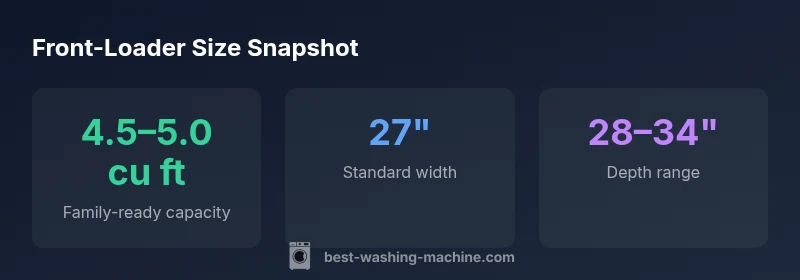
Front loading washing machine size typically refers to capacity measured in cubic feet. For most households, a 4.5–5.0 cu ft model suits a family of four, while smaller apartments may opt for 2.8–4.0 cu ft. Standard widths are around 27 inches, with depths from 28 to 34 inches. When space is tight, consider compact 24-inch models.
What 'front loading washing machine size' means
Front loading washing machine size is primarily about capacity, measured in cubic feet, and how that capacity aligns with your laundry load and space. In practice, the size you choose affects how many clothes you can wash per cycle, how often you run the machine, and how efficiently it uses water and energy. According to Best Washing Machine analysis, most households are well served by a model in the 4.5 to 5.0 cu ft range, balancing daily needs with efficiency; smaller households or apartments may opt for 2.8 to 4.0 cu ft, while larger families or shared-laundry settings lean toward 5.0 to 5.5 cu ft or larger. Capacity isn’t the only metric; drum design, spin speed, and drum diameter influence how much you can fit in a cycle. The term 'size' also encompasses physical footprint—width, depth, and height—and many assume bigger is better, but fit and placement matter as much as capacity. When shopping, compare cu ft while considering space and typical loads.
According to Best Washing Machine, pay attention to energy-efficient features and load-sensing cycles that can optimize performance regardless of capacity.
Measuring space and fit for a front-loader
Sizing a front-loading washer isn’t only about capacity. You must account for how the unit sits in your laundry area. Start with a precise floor plan: measure width (including clearance on both sides), depth (from wall to the furthest front edge, including door clearance), and vertical space (top clearance for a hinge or vent). Don’t forget to account for adjacent cabinetry, dryer placement if you plan to stack, and the door swing. Allow space for hoses and drainage connections, plus a few inches of breathing room for airflow and maintenance access. If you have a tight doorway or hallway, verify that the appliance can be maneuvered through before purchase. A compact 24-inch model can sometimes sidestep a difficult entry, but you’ll trade capacity for space. Always confirm manufacturer clearance recommendations and your own measurements to avoid costly returns.
Capacity vs performance: what size means for your loads
Capacity determines how much you can wash per cycle, but performance hinges on drum design and electronics. A larger cu ft model can handle bigger loads, reducing wash frequency and potentially saving time. However, if you mostly run small loads, a huge drum may waste water and energy unless the machine includes efficient sensors and auto-load detection. Modern front loaders often optimize water use and energy based on load size, so don’t assume bigger is always better. Consider your typical weekly load—the number of towels, jeans, and delicates—and compare cycles that tailor water usage to load size. If you frequently exceed a single large load, a larger capacity model may be convenient; if you rarely fill the drum, a mid-size unit with smart sensors could be more economical. In all cases, ensure the machine’s efficiency ratings align with your household habits and energy goals.
Size configurations by household type
Apartment or small-space living: 2.8–3.5 cu ft models are common, with compact footprints around 24 inches wide to fit tight spaces. Family of two: 3.0–4.0 cu ft covers moderate loads with flexible cycle options. Family of four: 4.5–5.0 cu ft remains the popular choice for daily laundry, balancing capacity with energy use. Large households or shared laundry environments: 5.0–5.5 cu ft or larger provide headroom for bulky items like comforters and multiple loads per week. If you must stack with a dryer, verify stacking compatibility and ventilation requirements. Remember that standard width is typically around 27 inches, but some compact designs are 24 inches. Consider potential resale value and warranty terms when sizing for long-term use.
Practical tips for choosing size in real life
Start with your typical weekly laundry volume and the space you can allocate. Create a simple matrix: number of people x average loads per week x average load size. Then map those numbers to cu ft ranges and model widths, always cross-checking with actual product dimensions. Look for energy-efficient ratings and sensor-based load detection to maximize efficiency at any size. If you have seasonal or irregular laundry, a mid-sized model with flexible cycles can adapt well. Finally, consider service and parts availability in your area; a widely available model makes repairs easier and cheaper over the life of the machine.
Common sizing mistakes and how to avoid them
Avoid choosing size purely on price or brand without measuring space. Don’t assume a larger drum solves all problems; ensure your doorway, stairwell, and laundry entrance can accommodate the unit. Don’t ignore dryer compatibility if you plan to stack. Always check for proper clearance around the machine for maintenance and airflow. Finally, examine the warranty and service network; a well-supported model with easy access to parts reduces total ownership cost.
Size categories by household needs
| Category | Typical size | Notes |
|---|---|---|
| Apartment/Compact | 2.8–3.5 cu ft | Best for tight spaces |
| Family of 2 | 3.0–4.0 cu ft | Moderate loads |
| Family of 4 | 4.5–5.0 cu ft | Regular daily washes |
| Large households | 5.0–5.5 cu ft | Heavy-duty, bulky loads |
FAQ
What is a cu ft capacity and why does it matter?
Cu ft measures how much laundry a washer can handle in a typical cycle. It matters because it helps determine how many clothes you can wash at once and how often you’ll run the machine. Pair cu ft with drum design and load-sensing features to optimize performance.
Cu ft capacity is the space inside the drum that holds clothes. It helps you decide how big of a load you can wash at once and how often you’ll run the machine.
Do front-loading washers require more space than top-load models?
Front-loaders typically share similar widths with many top-loads but require clearances for doors and stacks. Depth and height can vary; measure carefully. Accessibility for maintenance is also important.
Front-loaders usually fit similarly in width to top-loads but you must account for the door and clearances.
Can I mix a large-capacity washer with a small laundry room?
Yes, if you choose a compact depth and verify doorway clearance. Some 27-inch-wide models with shallow depths fit smaller spaces, but you may trade raw capacity for fit. Stacking may help conserve floor space.
If you pick a model with a compact depth and you can stack it, a large-capacity washer can still fit in a small room.
How do I measure for fit around doors?
Measure width, depth, and height, including door swing and clearance for hoses. Subtract any cabinetry protrusions. Check for ventilation and access panels so you can service the unit without removing it.
Measure the doorway and space around the washer, including door clearance and ventilation.
Is a larger washer more energy-efficient?
Not necessarily. Efficiency depends on sensor-driven load detection and cycle design. A larger unit that’s rarely filled can waste water and energy. Look for high energy-efficiency ratings and responsive load sensors.
Bigger isn’t always better for efficiency—look for sensors and energy ratings instead.
What should I consider besides capacity when sizing a washer?
Consider width, depth, height, door swing, stacking compatibility, and accessibility for maintenance. Also assess warranty coverage and local service availability to minimize lifecycle costs.
Besides capacity, check dimensions, stacking, and service reach to avoid problems later.
“Choosing the right size is about matching your laundry habits to the machine’s capacity and space. Bigger isn’t always better if it sits idle or isn’t easy to install.”
The Essentials
- Match capacity to your weekly laundry load
- Measure space before choosing dimensions
- Consider door clearance and stacking needs
- Prioritize energy-efficient load sensing