How Much Does It Cost to Run a Washing Machine for 2 Hours? A Practical Guide
Estimate the energy and water costs of running a washing machine for two hours. Learn the math, try the calculator, and discover practical tips to save on laundry day.


Why understanding the cost of running a washing machine matters
In today’s households, electricity and water bills are a meaningful part of the laundry budget. If you’re asking how much does it cost to run a washing machine for 2 hours, the answer depends on your machine’s efficiency, the cycle you choose, and local utility rates. This guide explains the math behind those costs and provides a practical calculator to personalize estimates for your home. According to Best Washing Machine, breaking costs into energy and water components helps you compare models and optimize cycles for lower bills.
The math in plain terms
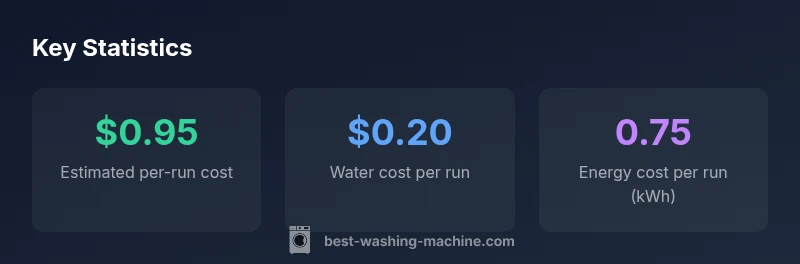
Costs break into two parts: energy and water. Energy cost is calculated as hours × kWh per hour × price per kWh. Water cost is hours × gallons per hour × price per gallon. Add them together to get the total run cost. For example, if you run for 2 hours, use 0.5 kWh per hour, electricity costs $0.15 per kWh, consume 15 gallons per hour, and pay $0.005 per gallon, your total would be energy: 2 × 0.5 × 0.15 = $0.15 and water: 2 × 15 × 0.005 = $0.15, totaling $0.30 per run. Real-world rates produce higher totals, especially with larger loads or warmer cycles.
How to use the calculator effectively
The calculator lets you tailor inputs to your setup. The five inputs—hours, kWh per hour, cost per kWh, gallons per hour, and cost per gallon—allow you to model both older and newer machines. Use your latest utility bill to find current rates, check your machine’s spec sheet for energy and water use per cycle, and adjust hours to reflect actual wash times. This helps you see how small changes can save money over time.
Real-world scenarios: small apartments vs. large families
People in small apartments often use fewer full loads, which can lead to longer cycles and higher per-load energy use. Large families typically run more loads, but with fuller machines, the incremental energy and water cost per load may drop due to efficiency. The calculator’s outputs will vary with load size, cycle selection, and local tariffs, so it’s helpful to run different scenarios to identify the best balance of cost and cleanliness.
Energy-saving and water-saving tips that actually work
- Run full loads whenever possible to maximize efficiency per kilogram.
- Use cold water cycles for fabrics that tolerate it to reduce energy consumption.
- Opt for high-efficiency (HE) machines and modern heat-pump or cold-water prewash options when available.
- Pre-treat stains to avoid longer or extra cycles.
- Compare utility rates and consider off-peak timing if your provider offers time-of-use pricing.
- Maintain your washer: clean lint filters, check hoses for leaks, and ensure door seals are tight to prevent expensive waste.
- Consider a water-efficient setting or a shorter cycle for lightly soiled clothes to cut water use.
Common pitfalls and misconceptions
- Assuming all cycles cost the same; presets like heavy duty or hot water can raise both energy and water usage.
- Underestimating standby or warm-up losses; many machines draw power even when not actively washing.
- Ignoring regional rate differences; a $0.10/kWh difference in electricity costs can swing totals by several dollars per month.
- Forgetting to account for detergent and fabric softeners, which aren’t part of the running cost but affect overall laundry expenses and cycle choices.