How Much Does Washing Machine Cost to Run?
Estimate yearly washing machine running costs by energy use, loads, and local electricity rates. Learn the math, factors, and tips to lower bills, with a calculator and data table.


What the numbers mean for running costs
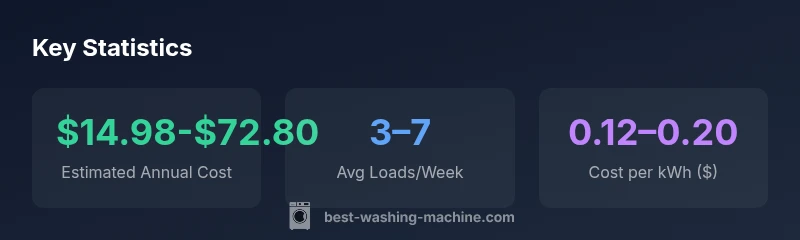
If you wonder how much does washing machine cost to run, the answer hinges on energy use per load, how many loads you run per week, and your local electricity rate. The calculation is straightforward: multiply the energy used per load (in kilowatt-hours, kWh) by the number of loads per week, then multiply by 52 weeks and by the price you pay per kWh. For example, if a typical load uses 0.8 kWh and you run 5 loads per week at $0.15 per kWh, your annual electricity cost would be roughly 5 * 0.8 * 0.15 * 52 = 31.2 dollars. In practice, many households see a broader range because energy rates vary, and some cycles use more energy than others. In addition, water costs may contribute if your utility charges per gallon, but the electricity is usually the dominant factor. This quick framework helps you compare models and understand why a more efficient machine can save money over time.
Energy efficiency matters in cost to run a washer
Energy efficiency is a major driver of long-term costs. Energy Star-rated or similarly efficient machines use less electricity per cycle, which translates into lower annual costs even if you run more loads. Front-loading washers typically use less water and energy per cycle than traditional top-loaders, though usage patterns still matter. When evaluating models, compare energy consumption figures across cycles you actually use (normal, bulky, and heavy soil) and consider the label's yearly energy use (kWh/year) estimate. Remember that the unit price of electricity in your area and how you run cycles can swing costs a lot. The goal is to favor efficient cycles and avoid high-energy modes whenever practical.
How to estimate your costs with real numbers
To estimate your running costs, start with three key inputs: loads per week, energy use per load, and the cost per kWh. Then apply the simple formula: loadsPerWeek × kWhPerLoad × costPerKwh × 52. This yields an annual electricity cost. You can adjust the inputs to reflect your actual usage, and the calculator in this guide will do the math for you. If you want to benchmark your numbers, create a table of a few scenarios (low, average, high usage) and compare the resulting yearly costs. If you also pay for hot water or municipal water, factor water costs separately to get a complete picture.
Scenarios: usage patterns and costs
Different households have different patterns. A small apartment with 3 loads per week and efficient cycles might spend around a dozen dollars a year on electricity for laundry, while a busy family with 7 loads per week and less efficient cycles could incur a few dozen dollars. Real-world costs also reflect local electricity pricing, which can fluctuate with time-of-use plans and seasonal rates. Use the calculator to plug in your numbers and see where you stand. This helps you prioritize changes that will lower your annual total.
Practical tips to lower running costs
To curb running costs, maximize efficiency on every load. Run full, balanced loads instead of partial ones, and use cold water cycles when fabrics allow. Select energy-saving modes and shorter cycles when possible. Schedule laundry during off-peak hours if your provider offers time-of-use pricing. Keep your washer well maintained—clean gaskets, run occasional cleaning cycles, and ensure it spins effectively. Small routine habits add up to meaningful annual savings.
Data-driven decisions: reading energy labels and calculating yearly costs
Energy labels or data sheets show how much energy a model uses per year. Compare these figures across models, not just the upfront price. Use the yearly kWh estimates and your local rate to compute expected annual costs for each model. Remember that actual costs depend on usage patterns, cycle selections, and maintenance. Choosing a model with lower annual energy use can be a smart long-term investment.
Bottom line: what to consider when shopping for lower running costs
When shopping, look beyond sticker price. Focus on annual energy use, water efficiency, and warranty terms. Consider your typical loads per week, cycle preferences, and whether a newer model offers better efficiency or features you actually use. A higher upfront cost can be offset by substantial savings over several years, especially in households with many weekly loads.