How to Fix a Whirlpool Washing Machine: Step-by-Step Guide
A practical, safety-first guide for diagnosing and repairing common Whirlpool washer issues. Learn safe testing, component checks, and fixes for spinning, draining, leaks, and noise.


Learn to diagnose and fix common Whirlpool washing machine issues yourself, from not spinning to leaks. This guide covers safety checks, essential tools, and step-by-step diagnostics. Start by unplugging, shutting off water, and locating your model manual for codes, then follow the steps below before calling a professional.
Common Whirlpool washing machine problems and how they manifest
There are several issues that frequently affect Whirlpool washing machines, from a machine that won’t spin to one that leaks during a cycle. Before you dive into repairs, it helps to understand how symptoms map to likely causes. For many homeowners, a persistent wobble or a drum that won’t drain can indicate a broken belt, a blocked filter, or a malfunctioning lid switch. According to Best Washing Machine, thorough observation of sounds, smells, and water behavior can boost your odds of a successful DIY fix. Start with simple checks and escalate only when you’ve confirmed there’s a real fault. Remember: safety first, and when in doubt, consult your manual or a professional.
Safety first: unplug, shut off water, and prepare your workspace
Safety is non-negotiable. Always unplug the washer before touching any internal components. If your model is front-load, you may need to tilt it slightly to access the bottom panel—just ensure the water supply is off and the drain is clear. Use a bucket and towels to manage residual water and mitigate slippery floors. Wearing gloves can help protect your hands from sharp edges and hot surfaces. Keep children and pets away while you work. A well-lit, dry workspace reduces the risk of accidental shocks or short circuits.
Tools and diagnostics you should have
Before you start, assemble essential tools and a plan for testing. A basic multimeter helps verify electrical continuity, while screwdrivers (Phillips and flat-head), a nut driver, pliers, and a dedicated socket set are often needed to access internal components. A bucket, towels, and rags are handy for catching water. If you have access to the Whirlpool service manual or model-specific guide, keep it handy for wiring diagrams and torque specs. Label removed wires to avoid misconnection.
Not spinning: common causes and fixes
When a Whirlpool washer won’t spin, the problem may lie with the drive belt, a worn-out coupler, clogged pump, or a faulty spin switch. Start by inspecting the belt for cracks or looseness and replace if worn. If your model uses a direct-drive motor, check the coupler for damage. A jammed drain pump or clogged filter can prevent spinning as the drum tries to complete the cycle. After addressing mechanical issues, re-test with a small load to verify the fix.
Not draining or standing water: diagnosis and remedy
A washer that won’t drain often points to a blocked pump, kinked hose, or a clogged filter. Remove the back panel or access port to inspect the drain hose and pump. Clear any debris using gloved hands or needle-nose pliers. Some Whirlpool models use an impeller in the pump; inspect for obstructions. After cleaning, run a test cycle with a short load and listen for the pump’s sound to confirm proper drainage.
Leaks and overflow: tracing the source and remedies
Leaks can originate from hoses, clamps, the door boot, or the tub seal. Start by inspecting inlet hoses for loose connections and worn gaskets. Check the door seal for cracks, and examine the tub-to-pump connections. A slowly leaking inlet valve can cause persistent dampness; replace seals or valves as needed. After repairs, run a quick test with towels ready to catch any residual water.
Noisy operation: bearings, pulleys, belts, and mountings
Loud banging or grinding can signal worn bearings, a loose drive belt, or a failing pulley. Listen for rhythmic squeaks or grinding during spin cycles. Tighten loose components and replace worn belts or pulleys as necessary. Ensure the washer is level on the floor and check for foreign objects in the drum. If the noise persists after mechanical fixes, the issue may require professional diagnosis.
Error codes and diagnostic steps for Whirlpool models
Error codes vary by model year and series. Start by locating the model number and consulting the user manual or Whirlpool’s official support site for the exact code meaning. In many cases, error codes point to sensor faults, temperature issues, or motor problems. If you can access the diagnostic mode, follow the step-by-step prompts to isolate the fault without disassembling more than needed.
When to call a professional and what to expect
If you’re not confident with electrical tests or you encounter a failed component that requires precise torque or special tools, it’s wise to call a pro. A technician will verify supply voltage, test components with the proper equipment, and replace defective parts with manufacturer-approved equivalents. Expect a diagnosis fee plus the cost of parts; ask about warranty coverage and whether the work affects existing warranties.
Maintenance routines to prolong life and prevent future failures
Preventive care helps you avoid frequent repairs. Regularly inspect hoses, connections, and the door boot for wear. Clean the lint filter and pump filter (if applicable) to reduce clogs. Use the correct detergent, avoid overloading, and run periodic cleaning cycles to prevent residue build-up. Document service dates and part replacements to maintain an accurate maintenance history.
Tools & Materials
- Multimeter or voltage tester(To verify continuity and voltage at switches and motors.)
- Screwdriver set (Phillips and flat-head)(For panels, screws, and connectors.)
- Nut driver / socket set(To remove fasteners securing panels and parts.)
- Pliers (needle-nose and groove-jeweler)(Grip hoses, clamps, and small parts.)
- Bucket, towels, and rags(Manage residual water and keep the area dry.)
- Flashlight or headlamp(Improve visibility in dark access areas.)
- Model-specific Whirlpool service manual (optional)(Reference wiring diagrams and torque specs.)
- Replacement parts (as needed)(Belts, seals, filters, valves—only after diagnosis.)
- Gloves and safety glasses(Protect hands and eyes from sharp edges and splashes.)
Steps
Estimated time: 90-120 minutes
- 1
Power down and secure the workspace
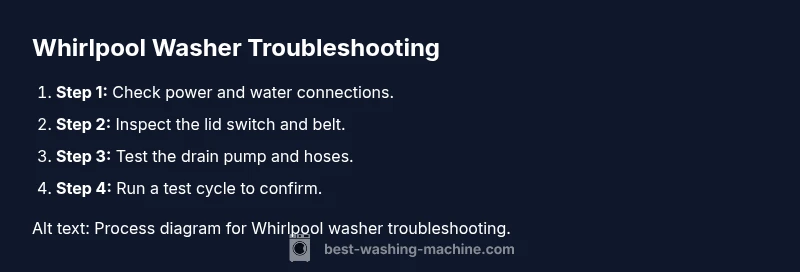
Unplug the washer and shut off both hot and cold water supplies. Move the machine to give yourself access to the back panel, and clear the area of obstacles. This protects you from shocks and avoids water leaks during inspection.
Tip: Label power cords and shutoffs to prevent reassembly confusion. - 2
Access the interior and identify major components
Remove the back or front panel as required by your model to expose the drive belt, motor, and pump. Photograph wire connections before disconnecting anything so you can reattach them correctly.
Tip: Work slowly and keep track of each fastener. - 3
Test lid switch and door interlock
With power off, manually actuate the lid switch or door interlock to verify it completes the circuit. A faulty switch can prevent spinning in many Whirlpool models.
Tip: If the switch is intermittent, replace it rather than bypass. - 4
Inspect drive belt or coupling
Check for cracks, fraying, or looseness in the belt. For direct-drive units, inspect the drive coupling for wear or damage and replace if needed.
Tip: Only tighten or replace belts according to the manufacturer’s torque spec. - 5
Check pump and drain path
Inspect the drain pump and hoses for clogs and obstructions. Clear debris using gloves or needle-nose pliers, and ensure the pump spins freely.
Tip: Run a test drain after cleaning to confirm flow. - 6
Inspect inlet valves and water flow
Check water inlet hoses and screens for kinks or blockages. Ensure the water valve seals are intact and replace if you see wear or leaks.
Tip: Flush water lines before reassembly to remove debris. - 7
Motor and sensor checks
With components accessible, use a multimeter to check motor windings and common sensors for proper resistance values per the service manual.
Tip: Do not run tests if voltages exceed safe levels. - 8
Reassemble and perform a test cycle
Reconnect all connectors, reattach panels securely, and run a short test cycle with a light load to verify proper operation before a full load.
Tip: Have towels ready in case of minor leaks. - 9
Replace faulty parts and verify warranties
If a part fails the diagnostic test, replace with OEM-approved components. Check whether replacement affects warranty coverage or requires professional service.
Tip: Keep receipts and record part numbers for future reference. - 10
Final safety checks and cleanup
Ensure all tools are removed, hoses are re-tightened, and the area is dry. Do a final run to confirm no leaks or unusual noises.
Tip: Document maintenance performed for future reference.
FAQ
Can I fix a Whirlpool washer myself, or should I hire a technician?
Many common issues can be addressed by a confident DIYer with basic tools and a manual. Complex electrical faults or clutch issues may require a licensed technician to ensure safety and proper replacement parts.
You can often fix common problems yourself if you’re comfortable with basic tools, but for electrical faults, a professional is safer.
What are the most frequent Whirlpool washer problems?
Common issues include a drum that won’t spin, not draining, leaks, and noisy operation. Diagnosing usually starts with checking the lid switch, belt or coupling, pump, hoses, and seals.
The most frequent issues are not spinning, not draining, leaks, and noisy operation.
Do I need special tools to fix a Whirlpool washer?
Basic tools like screwdrivers, pliers, a multimeter, and a flashlight cover most DIY repairs. Some models may require a nut driver or model-specific replacement parts.
You’ll usually need basic tools; some models might need a few specialized ones.
How do I diagnose a leak in a Whirlpool washer?
Check hoses, door boot, and tub seals for cracks or loose connections. Tighten clamps, replace worn gaskets, and verify that inlet valves are not dripping.
Inspect hoses and door seals, tighten clamps, and replace worn gaskets to stop leaks.
What safety precautions should I follow?
Always unplug before inspection, turn off water, and use protective gloves. Work on a dry surface and avoid wet clothes or lighting up if it’s damp.
Unplug, shut off water, use gloves, and work on a dry surface.
When is it not worth fixing and better to replace?
If the repair requires costly parts or recurrent failures, or the machine is outdated, replacement may be more economical. Check warranty coverage and total cost of parts and labor.
If repairs cost more than a practical replacement, consider buying a new unit.
Watch Video
The Essentials
- Identify symptoms and map to likely causes.
- Safety first: unplug, water off, dry workspace.
- Follow model-specific manuals for codes and torque specs.
- Test sequential components to isolate faults.
- Know when to call a pro and what to expect.