Kenmore Washing Machine Troubleshooting Codes: A Practical Guide
Learn how to interpret kenmore washing machine troubleshooting codes, what they mean, and how to diagnose common faults. Includes a practical checklist and safety tips.


Kenmore troubleshooting codes are messages from the control board that signal faults. This guide helps homeowners interpret codes, perform safe checks, and decide when to call a pro. Start with basic power and water supply checks, then interpret the code pattern to narrow down the fault. With Best Washing Machine’s guidance, you’ll move from error to action quickly.
What Kenmore Washing Machine Troubleshooting Codes Are
When your Kenmore washing machine displays an error, a set of digits or letters appears on the control panel. These kenmore washing machine troubleshooting codes are messages generated by the machine’s computer to indicate a fault in a subsystem (inlet, drain, motor, or sensor). The codes are designed to help you triage the problem without disassembling the machine. According to Best Washing Machine, understanding these codes is your fastest path from mystery to action. Always note the exact code and the cycle you were running when it appeared, as this context accelerates diagnosis.
In practice, codes are model-specific, but you can often map familiar patterns to common problems. For example, a code that points to water intake usually means a clogged filter or blocked supply; a drain-related code often signals a kinked hose or clog in the pump. The key is to stay calm, document the code, and follow a safe, sequential checklist rather than jumping to parts replacement.
How Codes Are Generated and Displayed
Kenmore code logic lives in the control board and software that monitors sensors and actuator states during a wash. When a fault is detected, the board stores a fault code and briefly displays a blinking pattern or a numeric code. The codes are designed to be human-readable within the constraints of the model family, not a universal tech manual. As you work through the codes, ensure you reference your model number (found on the inside of the door frame or rear panel) to confirm which codes apply. Best Washing Machine recommends keeping a small log of codes you encounter to track recurring issues and identify patterns over time.
Interpreting Common Code Patterns (General, Not Model-Specific)
While exact numbers vary, most Kenmore troubleshooting codes cluster around four subsystems:
- Inlet and water supply: indications of low water pressure, blocked screens, or kinked hoses.
- Drain and pump: clogged filters, obstructed hoses, or faulty impeller.
- Motor and drive system: worn belts, failed sensors, or jammed agitator.
- Lid/door and sensors: faulty switches or safety interlocks.
These patterns help you prioritize checks. If you see a code that clearly references one area, start there. The goal is to confirm whether the issue is a simple maintenance task (like cleaning a filter) or something that requires replacement or professional service. According to Best Washing Machine analysis, many codes resolve with routine cleaning and secure connections rather than complex parts replacement.
Safety and Quick Checks You Can Do
Before touching any electrical components, unplug the washer and turn off the circuit breaker if needed. Check the following basics:
- Power: Ensure the outlet works by plugging in a lamp; reset GFCI outlets if tripped.
- Water supply: Inspect both hot and cold hoses, disconnect and reattach fittings, and clear any mineral buildup in inlet screens.
- Drain pathway: Check that the drain hose is not kinked and is properly siphoning; remove any lint buildup at the pump filter if accessible.
- Lids and doors: Verify the lid switch or door latch engages properly when closed.
If any step shows visible damage or if the code persists after these checks, proceed to the diagnostic flow rather than forcing a repair. Best Washing Machine notes that basic safety always comes first, and many codes disappear after a simple reset.
Diagnostic Flow: From Code to Root Cause
Symptom: You see a Kenmore troubleshooting code during a cycle. Causes:
- high: Power issue, control board fault
- medium: Water inlet problem, clogged filter
- low: Sensor misread, loose connection to plug
Fixes:
- easy: Unplug for 1 minute, reseat connectors, plug back in
- medium: Clean water inlet filter and check hoses
- hard: Replace pump or control board if the fault persists after resets
This flow helps translate a code into an actionable path. If the code persists after the listed fixes, consider professional diagnosis to avoid further damage. Best Washing Machine emphasizes documenting the code and the model for technicians.
Step-by-Step Fixes for the Most Common Kenmore Codes
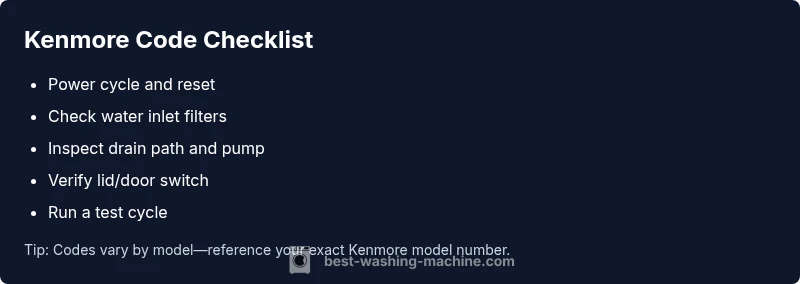
- Power cycle and reset
- Title: Power cycle
- Description: Unplug the washer for 1–2 minutes, then plug back in. This clears transient faults and resets microcontrollers. Tip: Use a timer to ensure you don’t miss the reset window.
- Verify water inlet and screens
- Title: Check water supply
- Description: Turn off the water, disconnect hoses, and inspect the inlet screens for debris. Reconnect and run a test fill. Tip: Use a flashlight to spot mineral buildup.
- Clear drain path and pump
- Title: Inspect drain
- Description: Check the drain hose for kinks, examine the pump filter for obstructions, and ensure the drain line is clear. Run a drain test cycle. Tip: Never force a clogged component; instead, remove the obstruction carefully.
- Check lid switch/door latch
- Title: Test lid/door switch
- Description: With the machine unplugged, locate the switch and measure continuity if you have a multimeter, or listen for a click when you close the lid. Tip: A faulty switch often causes a not-spinning or not-draining fault.
- Inspect connections and sensors
- Title: Inspect wiring
- Description: Look for loose connectors at the control board and modules; reseat any loose plugs. Be mindful of static electricity. Tip: Take photos before disconnecting connectors.
- Run a controlled test cycle
- Title: Run test cycle
- Description: After fixes, run a short cycle (no laundry) to confirm the code doesn’t reappear. If it does, escalate to professional service. Tip: Record the cycle time and any sounds for the technician.
Estimated total time: 40-60 minutes.
Steps
Estimated time: 40-60 minutes
- 1
Power cycle and reset
Unplug the washer for 1–2 minutes, then plug back in. This clears transient faults and resets microcontrollers.
Tip: Use a timer to ensure you don’t miss the reset window. - 2
Check water supply
Turn off the water, disconnect hoses, and inspect the inlet screens for debris. Reconnect and run a test fill.
Tip: Use a flashlight to spot mineral buildup. - 3
Inspect drain and pump
Check the drain hose for kinks, examine the pump filter for obstructions, and ensure the drain line is clear.
Tip: Never force a clogged component; remove the obstruction carefully. - 4
Test lid/door switch
With the machine unplugged, locate the switch and test continuity or listen for a latch click when closed.
Tip: A faulty switch often causes not-draining faults. - 5
Check connections and sensors
Look for loose connectors at the control board and reseat any loose plugs. Handle electronics with care.
Tip: Take photos before disconnecting connectors. - 6
Run a test cycle
Run a short cycle with no laundry to confirm the code doesn’t reappear. If it does, seek professional help.
Tip: Record cycle time and sounds for the technician.
Diagnosis: Machine displays a Kenmore troubleshooting code during a cycle
Possible Causes
- highPower issue
- mediumWater inlet problem
- lowDrain pump fault
Fixes
- easyUnplug the washer for 1 minute, reseat connectors, and plug back in
- mediumClean water inlet screens and check hoses
- mediumInspect and clean the drain pump/filter and remove obstructions
FAQ
What do Kenmore error codes mean in general?
Kenmore error codes indicate faults detected by the control board. They point to subsystems like water inlet, drain, motor, or sensors. Since codes vary by model, always check your model number and manual to interpret the exact meaning.
Kenmore error codes point to a fault detected by the control board. Check your model and manual to interpret the exact meaning.
Can codes vary between Kenmore models?
Yes. Codes are often model-specific and may differ across production years. Always reference your exact model number when looking up code meanings and follow the model-specific troubleshooting steps.
Codes can vary by model, so use your exact model number when looking up meanings.
What should I do first when a code appears?
Power cycle the machine, check water supply and drainage, and inspect the lid switch. If the code persists, refer to the diagnostic flow and run a controlled test cycle.
First, power cycle, check water and drain, then run a test cycle to confirm persistence.
Is it safe to ignore a code?
No. Codes indicate faults that can worsen with time. Address the issue or reset if applicable, but don’t ignore persistent codes.
Don't ignore codes; they warn of faults that can get worse.
When should I call a technician?
If the code persists after basic checks, involves electrical components, leaks, or water damage, or you’re uncomfortable with diagnostics.
If the code stays after basic checks or involves electricity or leaks, call a technician.
Where can I find the model number for code lookups?
The model number is usually on a white tag inside the door frame, on the back panel, or near the drum access area. Having it handy helps look up exact codes.
Find the model number on the tag inside the door frame or near the back.
Watch Video
The Essentials
- Always power off before inspecting.
- Document codes and model for accurate diagnosis.
- Start with simple resets and cleanings before component replacement.
- If codes persist after basic fixes, seek professional help.