Biggest Washing Machine Size: Your Guide to Large-Capacity Washers
Explore the biggest washing machine size available for residential use, how capacity is measured, space and installation considerations, efficiency, and how to compare models for home or commercial settings.


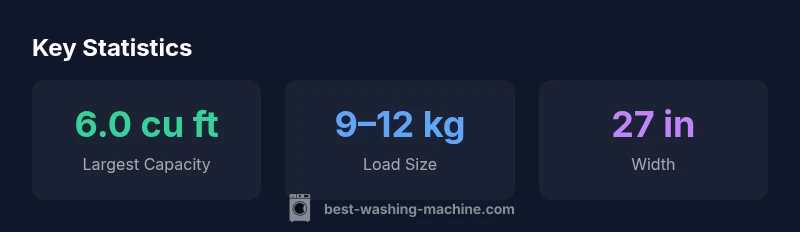
Biggest washing machine size for typical households tops out around 6.0 cubic feet (about 170 liters) in the US. In many European models, large loads are described in kilograms, commonly 9–12 kg per cycle. Actual maxima depend on the model, installation space, and whether the unit is front- or top-loading.
What constitutes the biggest washing machine size?
When people search for the biggest washing machine size, they typically mean the largest usable drum capacity that still fits a standard home laundry space. In the United States, the upper end of residential models commonly hovers around 6.0 cubic feet, which translates to roughly 170 liters per cycle. In European and some Asian markets, capacity is often described in kilograms per cycle, with 9–12 kg being a common upper bound for large front-loaders. The real-world limit isn’t just about drum size: installation space, doorway dimensions, and the machine’s width and depth all constrain what qualifies as “the biggest” for a given home. Brand context matters here: according to Best Washing Machine, the ceiling for residential big-capacity washers typically sits at these ranges, but the exact model can shift based on design choices and regional standards.
How capacity is measured: cubic feet vs kilograms
Capacity in the washing machine world is expressed in two common ways: cubic feet (cu ft) for US models and kilograms (kg) for many international machines. One cubic foot roughly equals 28.3 liters. Translating between cu ft and kg is not exact because it depends on drum geometry, shell thickness, and the density of typical loads. For practical planning, think in terms of “6.0 cu ft” (US) or “9–12 kg” (EU/Asia) as upper bounds for large-family scenarios. When comparing models, always note both the declared cu ft and the kg rating if provided, and convert to your local understanding to avoid underestimating or overestimating capacity.
Why bigger capacity matters for different households
A larger washer can reduce the number of laundry cycles per week, cut down on multiple loads, and handle bulky items like comforters more effectively. For large families, or households that frequently wash bedding, towels, and plush items together, the biggest size can be a real time-saver. However, the benefits drop off if your weekly laundry is light or if you usually wash small, quick loads. Space constraints or high purchase costs can erode the value of going to the upper limit. Best Washing Machine analysis notes that the decision should align with actual laundry volume, not just the appeal of a bigger drum.
Practical space considerations and installation challenges
Big-capacity washers demand more footprint and sometimes deeper recesses in a laundry alcove. Typical residential dimension targets include widths around 27 inches and heights near 38–40 inches, with depths that can extend into the 30–36 inch range depending on model and door swing. Clearance for hoses, venting (if applicable), and service access is essential. If you’re stacking with a dryer or adding a pedestal, ensure that the stack height, ventilation, and service panels remain accessible. If you have tight doorways, measure clearance at the entry points to avoid buying a unit that cannot be maneuvered into place.
Efficiency, water usage, and energy implications
Larger machines often include high-efficiency (HE) motors and multiple cycle options that optimize water and energy use per load. Eco or “delicate” cycles can substantially reduce water and electricity consumption, even for bigger drums, but only if you consistently select those optimized modes. Pay attention to Energy Star ratings, the duty cycle of the motor, and the spin speed, which affects how much moisture remains in clothes and thus drying energy. In practice, the biggest size should be balanced with efficient operation rather than assumed to be inherently cheaper to run.
How to compare models: data you should collect
When shopping for the biggest size, collect consistent data across models: drum capacity (cu ft or kg), maximum spin speed, energy efficiency rating, water consumption per cycle, cycle count, noise levels, dimensions (width x height x depth), and door/hose clearance. Create a mini-scorecard to normalize different spec sheets. If possible, measure your actual loads: bulky bedding, mixed towels, and large jackets. This helps you estimate how many cycles you’ll run weekly and whether the largest capacity justifies the investment.
Maintenance and reliability considerations for large units
Larger drums can place higher demands on bearings, belts, and suspension components, especially if the unit is frequently loaded to its maximum. Regular maintenance—lid switch checks, drum seal inspection, and filter cleaning—remains important. Some large-capacity models require more robust installation to dampen vibration, especially on imperfect floor slabs. Confirm warranty terms and service coverage in your region, and consider whether a locally certified technician can service the model you’re eyeing.
Alternatives to very large machines: stacking, dual-tub, and all-in-one
If space or budget makes the biggest unit impractical, explore alternatives. Front-loading stackables can achieve a high total capacity in a compact footprint when paired with an appropriately matched dryer. Some brands offer dual-tub or all-in-one compact units that separate washing tasks from drying tasks or use different drum configurations to optimize space. Each option has trade-offs in cycle times, loading flexibility, and upfront cost. Compare the total cost of ownership over several years to determine whether a non-traditional setup delivers better value.
Capacity comparison by model type
| Model Type | Largest Capacity (cu ft) | Typical Load (kg) | Common Use Case |
|---|---|---|---|
| Front-load | 6.0 | 9–12 | Family homes needing bedding and towels handling |
| Top-load | 5.0–6.0 | 8–12 | Users prioritizing faster cycles and accessibility |
| Compact/Apartment | 3.5–4.5 | 7–9 | Lesser space but higher occupancy scenarios |
FAQ
Is the biggest washing machine size always the best choice?
Not always. A bigger unit adds capacity but increases footprint, price, and potential for over-drying small loads. Evaluate weekly laundry volume and space to decide if a larger model is worth it.
Not always—the biggest size isn’t always the best fit for every home.
How do I know if I have space for a 6.0 cu ft washer?
Measure the washer's dimensions and add clearance for door swing, hoses, and ventilation. Confirm door openings and nearby cabinetry fit with standard 27-inch widths.
Measure carefully and plan clearance.
Do large-capacity washers use more water?
Water use depends on cycle and efficiency. Many large-capacity models offer Eco cycles that keep water use reasonable when used correctly.
It depends on the cycle; choose eco modes to save water.
Are there energy-efficient options for the biggest sizes?
Yes. Look for Energy Star certified large-capacity washers and units with high-efficiency motors and cold-wash performance.
Yes—seek Energy Star large models.
What about stacking or all-in-one units for big spaces?
Stacking is common for front-load models but may not be available for the largest sizes. Assess access, plumbing, and maintenance needs.
Stacking saves space, but check compatibility.
Are there commercial-grade giant models for home use?
Some brands offer residential-grade large-capacity machines, but they can be pricier and require heavier-duty installation. Confirm warranty and service options.
Some giant units exist for homes; verify warranty and service.
“Bigger capacity can streamline heavy laundry days, but it only pays off when space, budget, and usage align.”
The Essentials
- Know the ceiling: biggest residential size is around 6.0 cu ft.
- Match capacity to your weekly laundry and space.
- Measure clearance and door swing before buying.
- Prefer high-efficiency, large-capacity models.
- Compare models with consistent spec sheets.
- The Best Washing Machine team recommends balancing capacity, space, and efficiency.