Front Load Washing Machine vs Top Load: An In-Depth Comparison
Compare front load vs top load washing machines across efficiency, performance, space needs, and cost to help homeowners and renters pick the right model. Best Washing Machine analysis highlights key trade-offs and practical tips.


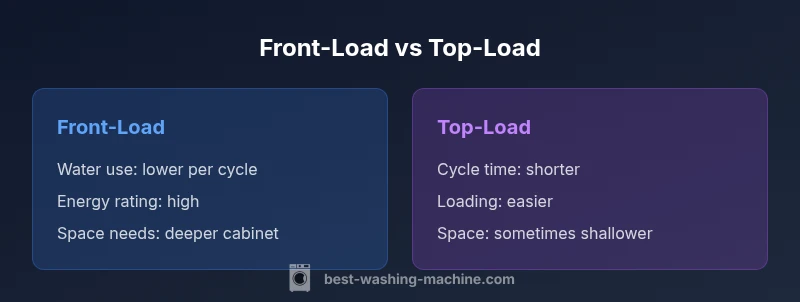
The choice between a front load washing machine vs top load hinges on several factors that matter to most households: efficiency, space, budget, and laundry patterns. In general, front-load models deliver lower water use and better energy efficiency with gentler fabric care, but require a deeper cabinet and longer cycles. Top-load washers excel in loading ease and shorter cycles, often with a lower upfront cost.
What matters in the front load washing machine vs top load decision
Choosing between the two main orientations for washing machines hinges on several practical factors that affect day-to-day use. For many households, efficiency and lifestyle dictate the final pick. In the context of the broader market, the Best Washing Machine analysis suggests that you should weigh water and energy use, loading ergonomics, space availability, and maintenance expectations. The goal is to align your laundry habits with a machine that minimizes effort and maximizes reliability across years of use. When you read our comparison, look for how each model handles your most frequent loads, whether you do small daily washes or large bulky items, and how much you value quick cycles versus lower operating costs. The decision framework will become clearer as you move through the core criteria below.
Efficiency and Water Use: the core difference
The efficiency gap between front load washing machine vs top load models is often the most consequential factor for long-term operating costs and environmental impact. Front-load washers generally use substantially less water per cycle because the drum architecture allows clothes to be spun dry with less rinse. This water savings compounds with energy efficiency, as less hot-water heating is required over time. In contrast, many traditional top-load models rely on a vertical drum and tend to consume more water per cycle. That said, high-efficiency top-load models exist and can close the gap, especially in households with modest laundry frequency. When evaluating options, compare per-cycle water use ratings and the energy factor (or energy star rating) rather than relying on sticker prices alone. Best Washing Machine analysis highlights that the combined effect of water savings and energy efficiency can yield meaningful lifetime savings, especially for households with frequent laundry.
Cleaning Performance and Fabric Care
Performance in cleaning and fabric care is not a one-size-fits-all metric. Front-load washers tend to deliver strong cleaning performance for heavily soiled loads due to tumbling action and consistent agitation, while their low-moisture rinsing can leave detergent residues if not properly rinsed. Many users report excellent results on everyday clothes, sheets, and towels. Top-load machines often provide robust cleaning as well, with the advantage of faster cycles and easier access. For delicate fabrics, both types can perform well if you choose models with gentle wash options, proper drum speeds, and temperature controls. Maintenance and detergent choices also influence results; using the right detergent type and following manufacturer recommendations helps optimize outcomes in the long run.
Convenience: Loading, Ergonomics, and Cycles
Loading ergonomics differ markedly between front-load and top-load configurations. Front-load models require bending to access the drum and typically sit deeper in cabinets, which can be a consideration for shorter users. Some households mitigate this with pedestals or by placing washers at waist height. Top-load models excel in ease of loading and unloading because the door is on top and the drum is more accessible without bending. Cycle variety and duration also vary: front-load machines often offer longer cycles with more specialized options (steam, sanitize, heavy-duty), while top-load machines vary from quick wash to eco modes. Your daily rhythms and household size will determine which cycle suite aligns with your needs.
Capacity, Spin, and Drying Outcomes
Capacity means more than total drum volume; it includes how the drum geometry handles bulky items and how the spin cycle reduces moisture in the load. Front-load washers generally feature higher spin speeds, which translates to clothes emerging with less moisture and shorter dryer times. This can be a meaningful savings in energy and time for households with limited drying options. Top-load models vary in spin performance, and some high-end top-loads achieve competitive moisture reduction. Consider your typical laundry mix (sheets, towels, bulky jackets) and whether you rely on a separate dryer or a ventless setup to determine which configuration provides the best combined wash-dry workflow.
Detergent and Maintenance Considerations
Front-load machines require more attentive gasket maintenance and door seals because the moisture-rich environment can promote mold or mildew if not cared for. Regular gasket cleaning, door-ajar storage between cycles, and monthly maintenance routines help prevent odors. Top-load washers typically have fewer gasket concerns, though they still benefit from routine cleaning and sensor checks. Detergent choice matters for both types: low-sudsing or high-efficiency formulas are often essential for front-load machines to avoid residue or buildup after multiple cycles. Following the manufacturer’s recommendations will optimize lifespan and cleaning performance.
Space, Installation, and Placement
Space planning is a decisive factor when comparing front-load washing machine vs top load options. Front-load machines often require a deeper footprint and can be harder to fit into very tight spaces without stacking or pedestal strategies. Top-load models may be more forgiving in shallow closets or narrow laundry alcoves, though they still require room for the door and drum clearance. If you’re in a small apartment or a compact home, evaluate the cabinet depth, door swing, and accessibility. In some layouts, stacked configurations with a separate dryer reveal a practical path to maximize vertical space while preserving wash capacity.
Noise, Vibration, and Stability
Both orientations have advances in noise reduction, but the experience can differ by model. Front-load washers with advanced suspension systems and vibration-damping features can run very quietly during wash and spin cycles, which benefits open-plan living spaces. Top-load machines, especially older models, may produce more audible thumps during fast spins, but newer designs have improved insulation and mountings. If you live in an apartment or shared wall setup, prioritize models with low-wattage motors, anti-vibration feet, and solid chassis for calmer operation.
Durability, Repair, and Longevity
Durability and expected lifespans hinge more on model design, build materials, and maintenance than on the door orientation alone. Front-load machines often rely on a sealed drum and gasket components; these may require periodic replacement in high-mileage homes. Top-load machines may exhibit longer warranty coverage for certain mechanical parts, but repair costs can vary widely by brand and service availability. When selecting, consider the availability of local technicians, the ease of obtaining replacement parts, and the manufacturer’s reputation for long-term reliability. Regular service and timely part replacements can extend the life of either configuration.
Cost of Ownership and Price Trends
Initial price is a common differentiator between front-load and top-load models. Front-load machines tend to be pricier upfront, but their efficiency savings over time can offset the premium for busy households. Top-load washers may offer lower purchase prices and shorter cycle times, which appeals to buyers with immediate budget constraints. The total cost of ownership includes water and energy use, cycle duration, and maintenance costs. In markets where electricity and water costs are high, the efficiency advantages of front-load washers often become more pronounced. Budget-conscious buyers should compare total lifetime costs rather than just upfront price.
Real-World Scenarios: Which home fits which model
Consider a small apartment with limited vertical space and a busy family schedule. A compact top-load model with fast cycles might suit daily wash needs, but if you plan to stay in the unit long-term, a front-load option with a pedestal and efficient performance could reduce energy bills and wear on fabrics. For households with large laundry volumes (workers, children, sports gear), a high-capacity front-load system paired with an efficient dryer can streamline the entire process. If you have pets or highly soiled items, mind the detergent strategy and cycle choices to keep odors minimal and fabrics protected. The best choice depends on your living situation, laundry load patterns, and tolerance for maintenance routines.
How to Decide: A practical decision framework
A practical decision framework starts with space and budget, then moves to performance needs and maintenance readiness. Step 1: measure the available space and door swing, Step 2: estimate your weekly laundry load and cycle frequencies, Step 3: compare per-cycle water and energy usage, Step 4: evaluate warranty and service options in your area, Step 5: shortlist models that meet your criteria and test them in-store if possible. Use the decision framework to balance efficiency gains with upfront cost and maintenance obligations. The framework is designed to be repeatable for future purchases, ensuring your selection remains aligned with evolving needs.
Comparison
| Feature | front-load washer | top-load washer |
|---|---|---|
| Water Usage | lower per cycle | higher per cycle |
| Energy Efficiency | high | moderate |
| Cycle Time | longer cycles | shorter cycles |
| Best For | efficiency-focused households | budget-conscious users |
| Detergent & Maintenance | requires gasket care | less gasket maintenance |
| Space Needs | deeper cabinet | shallower cabinet |
| Spin/Drying Performance | higher spin, drier load | lower spin, more moisture |
| Initial Price | higher upfront cost | lower upfront cost |
| Reliability & Repairs | model-dependent | model-dependent |
What's Good
- Lower water and energy use with front-load models
- Easier on fabrics and generally better cleaning performance
- High spin speeds can reduce drying time
- Stackable configurations save space in smaller homes
- Longer-term energy and water savings justify higher upfront costs
Downsides
- Higher upfront cost and longer cycle times
- Deeper cabinet footprint and gasket maintenance risk
- Potential for mold or odor without proper maintenance
- Repairs can be pricier if seals or bearings fail
Front-load washers generally offer better efficiency and fabric care, but require more space and maintenance awareness; top-load washers excel in loading convenience and upfront affordability.
Choose front-load if you prioritize efficiency and fabric care. Choose top-load if loading ease, cycle speed, and upfront cost matter more.
FAQ
What is the primary difference between front-load and top-load washers?
The main difference is the door orientation and how the clothes are tumbled. Front-load washers open from the front with a horizontal drum, while top-load washers open on the top and use a vertical drum.
Front-load washers open from the front and tumble clothes; top-load washers open on the top and rotate the drum.
Are front-load washers more energy-efficient than top-load washers?
In general, front-load models use less water and energy per cycle, but efficiency varies by model and usage patterns.
Front-loads typically save water and energy per cycle, but check the specific model's rating.
Do front-load washers require more maintenance due to mold and odor?
Front-load machines can develop mildew in seals if not cleaned regularly. Leave the door ajar between uses and clean the gasket monthly.
Mold can happen in front-load washers if you don’t clean the gasket and keep the door open between uses.
Which is better for hard water areas?
Both types can suffer from mineral buildup; use detergents formulated for hard water and consider a water softener if your area is very hard.
Hard water can affect both; using the right detergent and possibly a water softener helps.
Do top-load washers spin faster than front-load washers?
Front-load washers generally achieve higher spin speeds, resulting in drier clothes, though high spins exist in many top-load models.
Front-loads often spin faster, leaving clothes drier after the cycle.
What should I consider for small spaces?
Front-load units can be deeper; consider stacking with a dryer or choosing compact/stackable models and measure depth and door swing.
In tight spaces, stacking and compact options matter; measure carefully.
The Essentials
- Assess space and cabinet depth before buying.
- Prioritize efficiency for long-term savings.
- Consider spin speed and drying needs.
- Plan for gasket maintenance with front-load models.
- Choose based on your typical laundry loads and budget.